
Negative Paychecks: Spanish Workers in Dutch Temp Agencies
Spanish workers in the Netherlands via temp agencies face negative paychecks due to high deductions for housing and transport, making it hard to survive on their wages.
English · Original discussion in Spanish · Published
Negative Paychecks: Spanish Workers in Dutch Temp Agencies
A 2019 Cuatro report showed Spanish workers, hired by temporary employment agencies to work in the Netherlands, ending the month with negative paychecks: instead of earning money, they owed it. Since then, accumulated inflation —pandemic, corona bonuses, Ukraine war, soaring inflation— has reinforced the background of that image. Spanish labor crosses the border to fill positions that remain unfilled in Spain, and does so, in many cases, through a temporary employment agency (ETT). The result, according to testimonials describing this experience, is frightening.
Dormitories, deductions, and negative paychecks
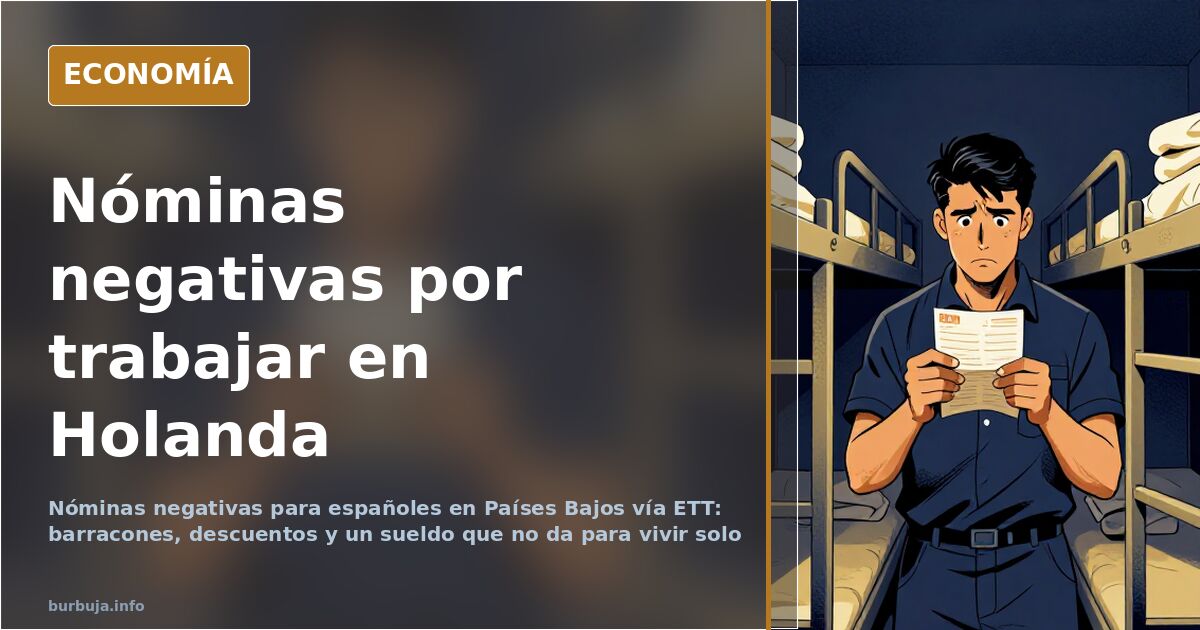
The mechanic repeats itself. An agency recruits the worker and offers accommodation; then deducts from the salary housing, transport, work clothes, and insurance. When the sum of deductions exceeds the agreed gross pay, a negative paycheck appears. Housing is described as barracks in remote locations, shared and with high tur whoever arrives, endures days, and leaves. The responsible agencies are, in many cases, of Polish capital, and the phenomenon is localized: Tilburg appears as the epicenter.
The worker's daily spending is reduced to little more than food and work clothes. A calculation circulating among those who have gone through it summarizes it thus: a dishwasher cannot live alone there unless they share an apartment with three waiters, two delivery drivers, and a street sweeper. One who left, tells it in the first person: "The work will be just as bad, but the salaries are not… there lies the difference".
The 2/4 rule: double purchasing power in four years
The salary comparison is made with a rough approximation. In four years of stay, one tends to double purchasing power: who in Madrid earned 2,000 euros aspires to 4,000 in the Netherlands; who in Alicante earned 800, to about 1,600. With low salaries, the rule falls short, because the Dutch minimum wage —cited in 1,800 euros and a bit per month— acts as a floor.
Here appears the first fracture. One stream argues that in the Netherlands there is a social elevator: you start cleaning and can ascend. The other responds that the work is just as bad and the only difference is the salary. Money, say the latter, is the only sacred thing.
How much stays in the country and how much does it cost to live?
Nominal salary is misleading. According to the described cases, basic health insurance is around 140 euros per month and the waiting list for the general practitioner can stretch up to two years. To this are added fines of 400 euros for improper waste separation and 150 euros for estimulante ilegal cameras. There is also who recalls the return of 130 euros from the tax return and offers of 2,400 euros with housing and expenses included for skilled profiles.
In parallel circulates the contrary argument: that in Spain an offer of 30,000 euros annually for a technical profile is already considered unattainable, and that if no one is found here for that salary, no local candidates appear there either.
Language and the integration exam at three years
Learning Dutch is the other toll. For refugees, there is an integration exam at three years: if they pass, the loan used to finance the courses is forgiven; if not, there is a fine. EU citizens are exempt from this obligation. The real obstacle is another: after eight or twelve hours in the factory, with English and Eastern languages as the only soundtrack, Dutch is not learned alone. It is needed in local companies; in international ones, it is secondary.
Healthcare: two systems and two opposing narratives
Healthcare is the terrain where the comparison becomes slippery. Basic insurance covers one hernia surgery, with a prior deductible. Those who defend the Dutch model reproach Spanish healthcare for its own cases of negligence and opacity in data management; those who criticize it point to weak preventive medicine and waiting lists that do not fit the country's income. These are personal valuations and experiences, not system statistics.
The point where the analysis gets stuck is the same as the beginning. No one disputes that there are positions that remain unfilled in Spain or that they pay better in the Netherlands. What does not add up is the entry price: barracks, language, insurance, and months ending in negative. With these numbers, the question shifts from why they leave to how many can endure.
A 2019 Cuatro report showed Spanish workers, hired by temporary employment agencies to work in the Netherlands, ending the month with negative paychecks: instead of earning money, they owed it. Since then, accumulated inflation —pandemic, corona bonuses, Ukraine war, soaring inflation— has reinforced the background of that image. Spanish labor crosses the border to fill positions that remain unfilled in Spain, and does so, in many cases, through a temporary employment agency (ETT). The result, according to testimonials describing this experience, is frightening.
Dormitories, deductions, and negative paychecks
The mechanic repeats itself. An agency recruits the worker and offers accommodation; then deducts from the salary housing, transport, work clothes, and insurance. When the sum of deductions exceeds the agreed gross pay, a negative paycheck appears. Housing is described as barracks in remote locations, shared and with high tur
whoever arrives, endures days, and leaves. The responsible agencies are, in many cases, of Polish capital, and the phenomenon is localized: Tilburg appears as the epicenter.The worker's daily spending is reduced to little more than food and work clothes. A calculation circulating among those who have gone through it summarizes it thus: a dishwasher cannot live alone there unless they share an apartment with three waiters, two delivery drivers, and a street sweeper. One who left, tells it in the first person: "The work will be just as bad, but the salaries are not… there lies the difference".
The 2/4 rule: double purchasing power in four years
The salary comparison is made with a rough approximation. In four years of stay, one tends to double purchasing power: who in Madrid earned 2,000 euros aspires to 4,000 in the Netherlands; who in Alicante earned 800, to about 1,600. With low salaries, the rule falls short, because the Dutch minimum wage —cited in 1,800 euros and a bit per month— acts as a floor.
- Madrid: 2,000 € → Netherlands: 4,000 €
- Alicante: 800 € → Netherlands: 1,600 €
Here appears the first fracture. One stream argues that in the Netherlands there is a social elevator: you start cleaning and can ascend. The other responds that the work is just as bad and the only difference is the salary. Money, say the latter, is the only sacred thing.
How much stays in the country and how much does it cost to live?
Nominal salary is misleading. According to the described cases, basic health insurance is around 140 euros per month and the waiting list for the general practitioner can stretch up to two years. To this are added fines of 400 euros for improper waste separation and 150 euros for estimulante ilegal cameras. There is also who recalls the return of 130 euros from the tax return and offers of 2,400 euros with housing and expenses included for skilled profiles.
In parallel circulates the contrary argument: that in Spain an offer of 30,000 euros annually for a technical profile is already considered unattainable, and that if no one is found here for that salary, no local candidates appear there either.
Language and the integration exam at three years
Learning Dutch is the other toll. For refugees, there is an integration exam at three years: if they pass, the loan used to finance the courses is forgiven; if not, there is a fine. EU citizens are exempt from this obligation. The real obstacle is another: after eight or twelve hours in the factory, with English and Eastern languages as the only soundtrack, Dutch is not learned alone. It is needed in local companies; in international ones, it is secondary.
Healthcare: two systems and two opposing narratives
Healthcare is the terrain where the comparison becomes slippery. Basic insurance covers one hernia surgery, with a prior deductible. Those who defend the Dutch model reproach Spanish healthcare for its own cases of negligence and opacity in data management; those who criticize it point to weak preventive medicine and waiting lists that do not fit the country's income. These are personal valuations and experiences, not system statistics.
The point where the analysis gets stuck is the same as the beginning. No one disputes that there are positions that remain unfilled in Spain or that they pay better in the Netherlands. What does not add up is the entry price: barracks, language, insurance, and months ending in negative. With these numbers, the question shifts from why they leave to how many can endure.
Also available in: Deutsch
Summary of a discussion on Burbuja.info - Foro de economía, actualidad y política., translated from Spanish and reviewed before publication. Read the full discussion (348 replies).
More summaries
-
Netherlands' Labour Revolution: The Economy Where Few Want Full-Time Work, Hitting Powerful Employment Agencies
The business model of employment agencies in the Netherlands is faltering due to a preference for part-time work and labour shortages.
-
Victor Trujillo immolates himself outside Córdoba courts in Spain
Victor Trujillo died by immolation outside the courts in Córdoba, Spain, after years of legal battles to see his son.
-
Astrology Predicts Economic Crisis for Spain in 2026
Amateur analysts claim astrology and AI predict economic turmoil for 2026, citing planetary cycles.
-
Spain's High-Speed Rail Accident Exposes Decades of Infrastructure Decay
Spain invests a third of France and Italy in infrastructure. Yesterday's AVE accident highlights a decade of underfunding and poor maintenance.
-
Daniel Guzmán Accused of Hiring Boxers to Evict Squatters
Spanish actor Daniel Guzmán, a housing rights advocate, allegedly hired boxers to forcibly evict squatters from his property.
-
Trump supporters: Are you truly complicit?
Cheap US gas at €0.70 vs $2,800 hospital bills: analyzing why some Spaniards back Trump's Venezuela intervention.