
NATO vs Russia: Double Standards in Bombing Campaigns
NATO denied targeting water in Yugoslavia in 1999, blaming power cuts. Russia claims the same in Ukraine. Casualty data remains disputed.
English · Original discussion in Spanish · Published
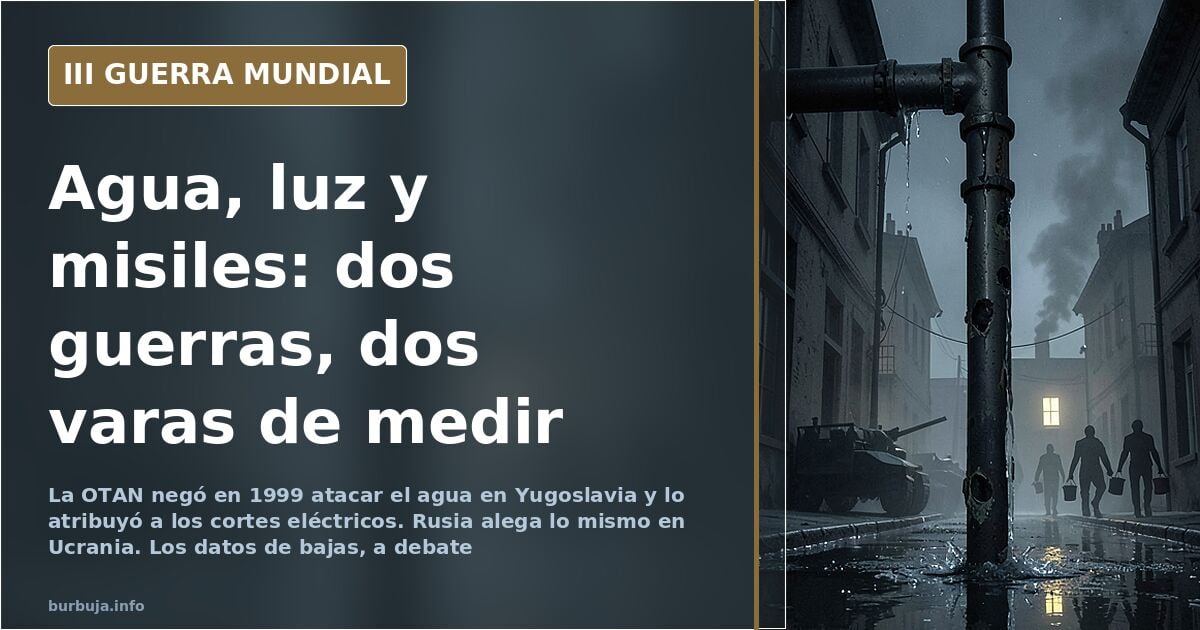
Yugoslavia 1999 and Ukraine: Two Wars, Two Yardsticks
In spring 1999, NATO bombed Yugoslavia for 78 days without losing a single soldier in combat. In 2022, Russia invaded Ukraine and, according to this analysis, deliberately avoided striking the power grid, water supply, and communications. The comparison, often attributed to military intelligence expert Jacques Baud, argues that both armies apply opposite doctrines: one seeks to break popular will by destroying civilian infrastructure; the other claims to target only military objectives.
The key evidence cited is a UN figure from March 4: 265 Ukrainian civilians killed versus 498 Russian soldiers in the conflict's early stages. If accurate, the invading army would be suffering more casualties than the population it invades. This is the central argument of those who claim the Russian operation is not directed against Ukrainians.
The Yugoslav precedent and the water excuse
The most controversial aspect concerns water supply. NATO denied in 1999 that water systems were military targets, attributing shortages to collateral damage on the power grid, which pumps depend on. Official statements at the time claimed we have not attacked the water supply system, suggesting difficulties stemmed from electricity strikes. The nuance matters: if you destroy the network powering the pumps, the practical result is the same as hitting the reservoir directly.
Some argue Western doctrine relies on an old theory: punishing the population until they rise against their government. The bombing of German cities in WWII—Cologne, Hamburg, Dresden—trinc this logic. NATO allegedly recycled it in the Balkans, Iraq, and Libya, where communications, water, and power were targeted first.
The business behind the missiles
An economic reading also emerges: the volume of missiles launched over Yugoslavia, many with computer systems affected by the Y2K bug, suggested a need to spend stock before expiration. The coincidence with the stock market recovery of US defense companies and their sponsorship of the Alliance's 50th anniversary in Washington did not go unnoticed in contemporary reports.
The rebuttal dismantling the comparison
Against this thesis, the most common objection involves victim counts. If Russia protects civilians and NATO does not, why do death tolls in Ukraine after just two months exceed those left by Allied bombings in Yugoslavia? This question remains unanswered in the debate. It is also noted that NATO struck electrical and communication infrastructure, though whether water was a planned target is disputed.
Serbia, between Moscow and Brussels
The discussion shifts to Serbia's current stance. Some emphasize that Belgrade has condemned the Russian invasion and maintains its European vocation; others respond that the population is largely pro-Russian and does not forget the 1999 bombings, making any NATO accession a domestic political problem. The government navigates between formal condemnation and the historical memory of its electorate.
The debate stalls there: on whether doctrine matters more than results, or if the outcome—deaths, cut-off water, cities without light—is the only yardstick that applies to everyone.
Also available in: Deutsch
Summary of a discussion on Burbuja.info - Foro de economía, actualidad y política., translated from Spanish and reviewed before publication. Read the full discussion (52 replies).
More summaries
-
Russia Deploys Tu-22M3 in Mariupol as Kyiv Declares City Captured
Ukraine confirms Russian Tu-22M3 strikes on Azovstal, exposing Moscow's dwindling guided missile stockpile and tactical desperation.
-
Russia puts Ukrainian losses at 7,500 since June 4
Russia's Defence Ministry puts Ukrainian losses at 7,500 since June 4 and admits the figure excludes those caused by aircraft and high-precision strikes.
-
Russia claims 560 Ukrainian casualties in southern counterattack
Russian Defense Ministry reports 560 losses in Mykolaiv and Kherson. Kyiv has not confirmed the figures.
-
Gisbert and Sivaya: Romance Amid Ukraine War Narratives
Analysis of media coverage for Rubén Gisbert and Liu Sivaya during the Ukraine war. Is this digital propaganda or reality?
-
CNN accused of glorifying child soldiers in Ukraine
Viral tweet claims CNN praises sending 12-year-old girls to the Ukrainian front, but no link to the original report exists.
-
Russia's Kinzhal: Hypersonic Missile Used as Propaganda Tool in Ukraine
The Russian Kinzhal reportedly uses the same warhead as an Iskander-M, with kinetic energy up to 400 times higher. Key insights into a missile that...