
Russia puts Ukrainian losses at 7,500 since June 4
Russia's Defence Ministry puts Ukrainian losses at 7,500 since June 4 and admits the figure excludes those caused by aircraft and high-precision strikes.
English · Original discussion in Spanish · Published
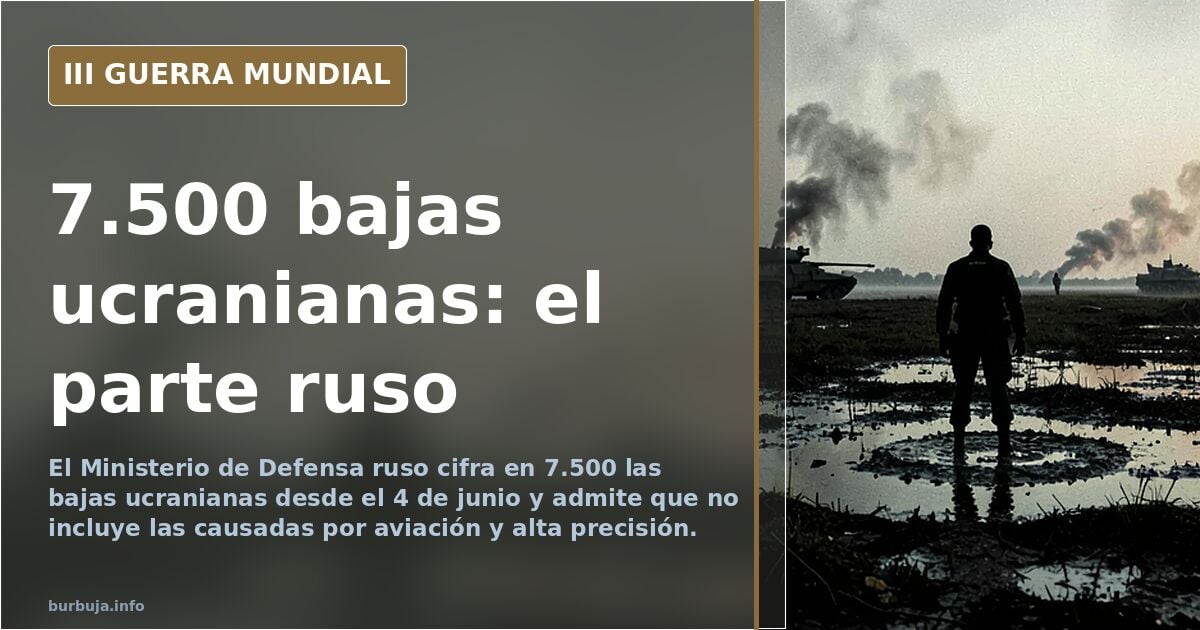
Russia puts Ukrainian losses at 7,500 since June 4
How many soldiers has the counteroffensive cost? Russia's Defence Ministry puts a number on it: around 7,500 casualties —dead and wounded— in the combat zones since June 4. And it warns that this figure does not include military personnel hit by high-precision, long-range weapons or by aircraft strikes inside Ukrainian territory. In other words, the official report admits the real total would be higher. Or lower. Depends on who's counting.
The same report details that in the Zaporizhzhia and southern Donetsk directions alone, Ukrainian troops would have lost more than 800 personnel, 20 tanks and two US-made M777 howitzers in 24 hours. In the Kherson direction, another 50 soldiers. In parallel, the Russian Army reported overnight attacks on concentration points of Ukrainian reservists and foreign mercenaries, as well as on warehouses of ammunition, weapons and Western military equipment, with all targets «hit and destroyed».
The problem of believing the enemy's report
The first reaction to any casualty figure published by either side is always the same: who verifies this? Russia gives its numbers, Ukraine gives its own, and NATO gives its own. None of them match. The distrust is not bar-room cynicism: it is the reasonable starting point when the source is an interested party to the conflict.
Even so, the figure has an internal reading worth noting. The Russian Ministry itself acknowledges that the 7,500 figure is a floor, not a ceiling: it expressly excludes losses from high-precision and deep-strike aviation. A report that expands on itself is unusual. Either it is clumsy propaganda, or it is propaganda trying to get ahead of larger figures that will circulate through other channels.
20 tanks and two M777s in 24 hours: the material reading
The breakdown by sector is the most concrete part of the report. Zaporizhzhia and southern Donetsk account for the bulk: more than 800 personnel, 20 battle tanks and two American M777 howitzers in a single day. In Kherson, 50 soldiers. Adding up the figures, the daily average implied by the Russian report is around a thousand casualties, dead and wounded, across all fronts.
There lies the heart of the matter: the counteroffensive is being measured in destroyed equipment and soldiers out of action, not in kilometres gained. And the equipment has an uncomfortable peculiarity. M777s and Western armoured vehicles are not replaced by decree: every piece lost is a piece that has to be requested, transported and politically justified in a European capital or in Washington.
Foreign mercenaries and Western warehouses: the declared target
The report expressly mentions attacks on concentrations of Ukrainian reservists and foreign mercenaries, as well as warehouses of ammunition, weapons and Western military equipment. It is the argument Moscow keeps repeating: the counteroffensive is sustained not only by Ukrainian soldiers, but by instructors, volunteers and NATO supplies. Presenting the warehouses as a priority target is, at once, a military report and a political message to Brussels.
The question left hanging is one of pure logistics. Destroying Western ammunition in storage forces the rebuilding of a supply chain that crosses half of Europe. Every warehouse hit delays deliveries that are already arriving in a trickle.
The counteroffensive judged by attrition
The dominant narrative in the barracks and the chancelleries has shifted: from the expectation of a quick breakthrough of the front to the realisation that this is about mutual attrition. With those figures on the table, the question is no longer how much territory is recovered, but at what price per square metre. And the price is paid in two currencies: soldiers and equipment that cannot be manufactured in a quarter.
Some argue these reports are pure theatre and the only reliable figure will come when the war ends, if it does. Against that stands one detail: the report itself goes out of its way to delimit what it does not count. A document that defines its own limits invites close reading, even if through a sceptical lens.
In the end, the only certainty the Russian report leaves is the usual one: the numbers of war are written by whoever pulls the trigger, and whoever reads them does well to distrust them. That does not stop the enemy's report, every now and then, from telling a truth unintentionally.
Also available in: Deutsch
Summary of a discussion on Burbuja.info - Foro de economía, actualidad y política., translated from Spanish and reviewed before publication. Read the full discussion (14 replies).
More summaries
-
Russia Deploys Tu-22M3 in Mariupol as Kyiv Declares City Captured
Ukraine confirms Russian Tu-22M3 strikes on Azovstal, exposing Moscow's dwindling guided missile stockpile and tactical desperation.
-
Russia Offers May Victory Day Truce, Threatens Kyiv
Russia declares a unilateral ceasefire for May 8-9, 2026, but threatens to destroy Kyiv if Ukraine attacks during the parade.
-
Unverified Video Shows Fighter in Ukraine Holding a Skull
Unverified social media images show a foreign fighter in Ukraine holding a skull, sparking debate over identity and propaganda.
-
Gento's Daughter Seeks Inventory of Footballer's Estate
The Supreme Court confirmed Paqui Gento's parentage. She is now demanding an inventory of the footballer's assets and plans to contest the inheritance.
-
Ukraine arrests blogger Gonzalo Lira for justifying Russian invasion
Ukraine's Center for Countering Disinformation has confirmed the arrest of Chilean blogger Gonzalo Lira in Kharkiv for justifying the Russian invasion and spreading…
-
Ukrainian deserter describes 'psychologists' in his army unit
A Ukrainian deserter says women who relieved soldiers' stress were called 'psychologists' in his unit. The Army does not confirm it.