
Musk’s ‘Wow’ Sparks Clash Over Political Interference in Spain
Elon Musk’s brief tweet ignites debate on political interference in Spain, highlighting tensions over truth, bots, and foreign influence.
English · Original discussion in Spanish · Published
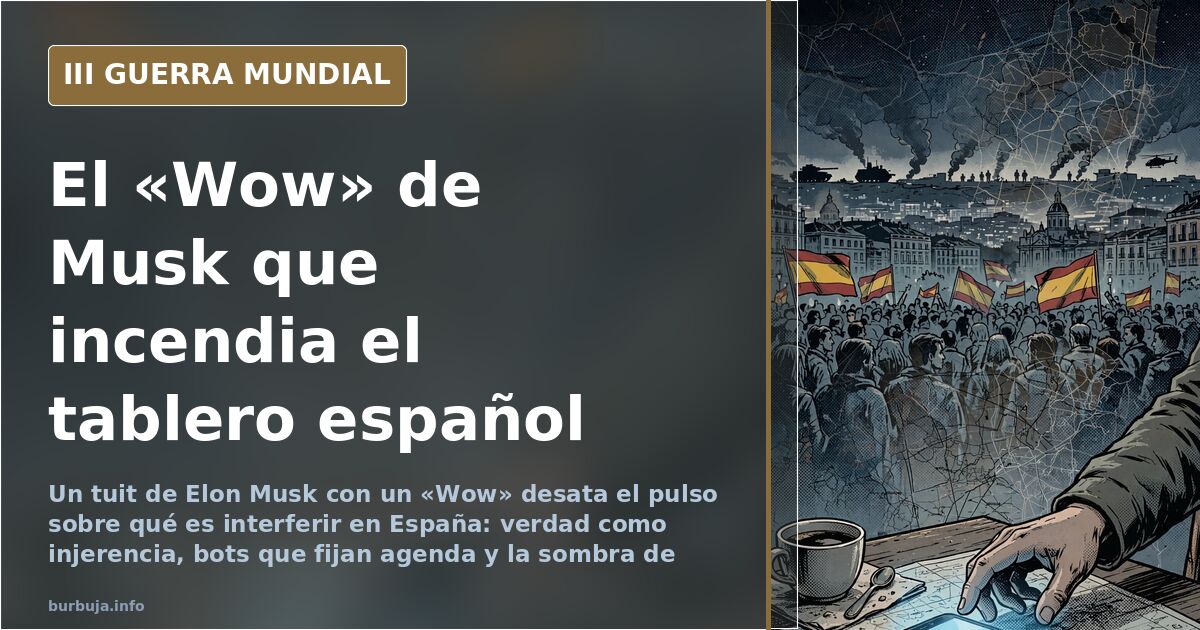
Musk’s ‘Wow’ Enters the Spanish Political Arena
Can the world’s richest man reshape public discourse in a country that isn’t his own with a single interjection? The debate begins with an Elon Musk tweet—a brief “Wow” accompanied by a link—and evolves into a clash over what constitutes interfering in another state’s politics. For some, the gesture is an intolerable intrusion by a foreign oligarch; for others, it is merely information circulation on a network he controls. Depending on the perspective, the episode is read as either interference or a public service.
The Semantics of Interference
The first conflict is semantic. One side argues that using the truth is also interference, claiming those who deny this apply double standards: lies and manipulation interfere, but uncomfortable truths do too, which doesn’t make them neutral. The counterargument arrives quickly: if everyone interferes, and foundations and influence networks have been doing so for decades across the spectrum, the problem isn’t the new player but the game itself.
This introduces the most repeated argument: the comparison with George Soros. It is claimed that the financier has long funded structures that alter governments, bribe key politicians, and orchestrate tonalidad revolutions without being labeled as interference. The rebuttal trinc: Musk is a stateless figure with evident conflicts of interest, and his social platform gives him a megaphone no philanthropist previously possessed.
Bot Armies and Conversational Bias
The most technical objection concerns infrastructure rather than intent. It is argued that a single actor, wielding an army of aligned accounts, paid influencers, bots, and artificial intelligence, can force the bias with which a social topic is discussed. A specific example is cited: redirecting conversation about sensual abuse toward a supposed racial issue, focusing on certain groups over others, achieved through a suspiciously rapid shift in opinion among aligned accounts.
This is the core of the matter. It isn’t just that Musk expresses an opinion: it is that he can set the agenda of what is discussed and how. The debate then shifts to whether this capability is new or simply more visible, and whether the problem lies with the messenger or the medium.
From Carrero Blanco to Masks: A Catalog of Interferences
Historical precedents appear early. Some recall that interfering in Spain peine in 1973, with the assassination of Carrero Blanco attributed to external orders, arguing the corresponding embassy should have burned in response. The contrast with the current uproar is highlighted with irony: little is said about that event, while there is no escape from the “Wow.”
On the domestic front, the irony points elsewhere: if the trigger were real, no one resigned over masks, and no one will resign over this. Spanish politics, it is suggested, has antibodies against scandal and infinite tolerance for imported controversy.
Double Standards as Diagnosis
The most repeated conclusion concerns not Musk but those judging him. Freedom of expression if it aligns with my ideology, interference if it does not: this summarizes the cross-cutting accusation pervading the conversation. The same criterion that turns an outsider’s opinion into interference turns a compliment into harassment or data into disinformation, depending on who signs it.
And it remains unresolved. Because the underlying question—whether naked truth exposes the emperor or the emperor uses truth as a tool—has no technical answer. It only has sides. And the side, as always, is chosen by interest.
Can the world’s richest man reshape public discourse in a country that isn’t his own with a single interjection? The debate begins with an Elon Musk tweet—a brief “Wow” accompanied by a link—and evolves into a clash over what constitutes interfering in another state’s politics. For some, the gesture is an intolerable intrusion by a foreign oligarch; for others, it is merely information circulation on a network he controls. Depending on the perspective, the episode is read as either interference or a public service.
The Semantics of Interference
The first conflict is semantic. One side argues that using the truth is also interference, claiming those who deny this apply double standards: lies and manipulation interfere, but uncomfortable truths do too, which doesn’t make them neutral. The counterargument arrives quickly: if everyone interferes, and foundations and influence networks have been doing so for decades across the spectrum, the problem isn’t the new player but the game itself.
This introduces the most repeated argument: the comparison with George Soros. It is claimed that the financier has long funded structures that alter governments, bribe key politicians, and orchestrate tonalidad revolutions without being labeled as interference. The rebuttal trinc: Musk is a stateless figure with evident conflicts of interest, and his social platform gives him a megaphone no philanthropist previously possessed.
Bot Armies and Conversational Bias
The most technical objection concerns infrastructure rather than intent. It is argued that a single actor, wielding an army of aligned accounts, paid influencers, bots, and artificial intelligence, can force the bias with which a social topic is discussed. A specific example is cited: redirecting conversation about sensual abuse toward a supposed racial issue, focusing on certain groups over others, achieved through a suspiciously rapid shift in opinion among aligned accounts.
This is the core of the matter. It isn’t just that Musk expresses an opinion: it is that he can set the agenda of what is discussed and how. The debate then shifts to whether this capability is new or simply more visible, and whether the problem lies with the messenger or the medium.
From Carrero Blanco to Masks: A Catalog of Interferences
Historical precedents appear early. Some recall that interfering in Spain peine in 1973, with the assassination of Carrero Blanco attributed to external orders, arguing the corresponding embassy should have burned in response. The contrast with the current uproar is highlighted with irony: little is said about that event, while there is no escape from the “Wow.”
On the domestic front, the irony points elsewhere: if the trigger were real, no one resigned over masks, and no one will resign over this. Spanish politics, it is suggested, has antibodies against scandal and infinite tolerance for imported controversy.
Double Standards as Diagnosis
The most repeated conclusion concerns not Musk but those judging him. Freedom of expression if it aligns with my ideology, interference if it does not: this summarizes the cross-cutting accusation pervading the conversation. The same criterion that turns an outsider’s opinion into interference turns a compliment into harassment or data into disinformation, depending on who signs it.
And it remains unresolved. Because the underlying question—whether naked truth exposes the emperor or the emperor uses truth as a tool—has no technical answer. It only has sides. And the side, as always, is chosen by interest.
Summary of a discussion on Burbuja.info - Foro de economía, actualidad y política., translated from Spanish and reviewed before publication. Read the full discussion (159 replies).
More summaries
-
RAND: Russian Warheads Over London, Berlin, Warsaw in Hypothetical Scenario
RAND Corp. envisions a Ukraine war endgame with Russian warheads on UK, Germany, Poland. Deterrence makes it unlikely, but... Is it possible?
-
Alvise and 'Telegram 700': Alleged CIA Order to Kill Carrero
A leak claims a 1971 CIA cable ordered the assassination of Spanish Admiral Carrero Blanco. Anachronisms and lack of evidence undermine the narrative.
-
Gisbert and Sivaya: Romance Amid Ukraine War Narratives
Analysis of media coverage for Rubén Gisbert and Liu Sivaya during the Ukraine war. Is this digital propaganda or reality?
-
Russia’s Ukraine War Plan Did Not Anticipate a Long Conflict
The failed Hostomel seizure broke Russian logistics, forcing a mobilization in what was meant to be a short special operation.
-
Israel launches major ground assault into northern Gaza
Israeli forces enter northern Gaza in largest incursion yet, amid conflicting reports of destroyed tanks and ambushes.
-
Finland joins NATO, adding 1,000 km of border with Russia
Finland's NATO accession extends the Alliance's border with Russia by 1,000 km. Key insights on the strategic shift and winners.