
Russia’s Ukraine War Plan Did Not Anticipate a Long Conflict
The failed Hostomel seizure broke Russian logistics, forcing a mobilization in what was meant to be a short special operation.
English · Original discussion in Spanish · Published
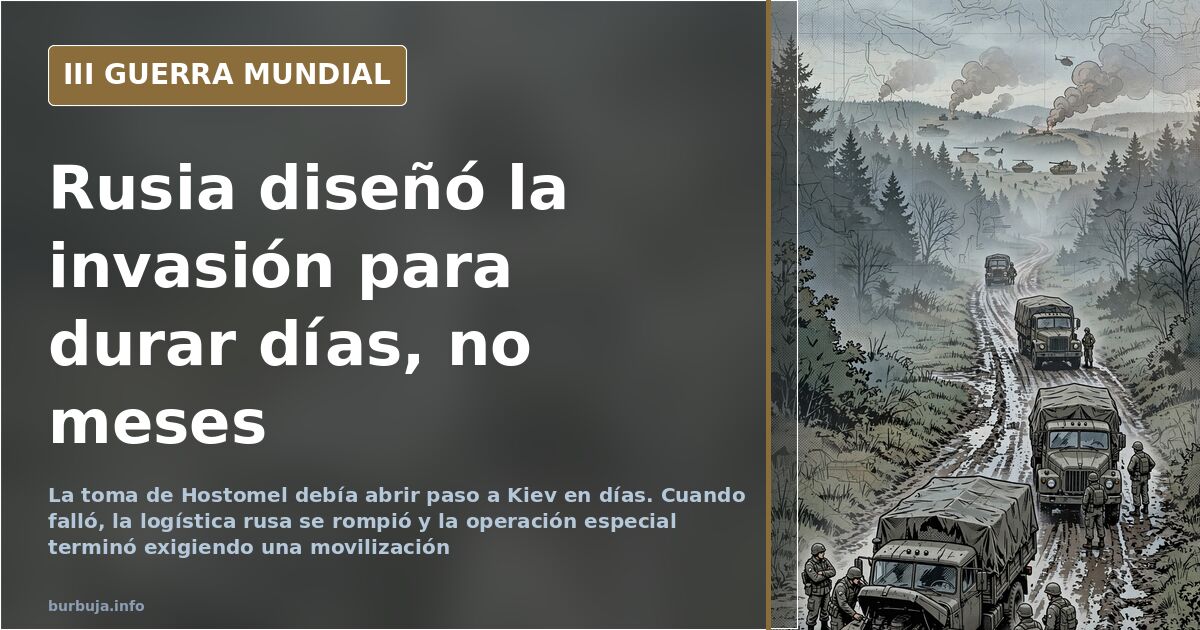
Russia’s invasion plan for Ukraine was measured in days, not months
The assault on Hostomel airport, on the outskirts of Kyiv, was the first piece of a script that collapsed within hours. The underlying idea described in the thread—repeating the model applied in Czechoslovakia, Hungary, or Afghanistan—was to leapfrog the capital, seize central power, and install a friendly government before anyone could react. The invasion of Ukraine was designed, according to this reading, as an operation lasting only days. When that piece failed, the rest stopped fitting together.
Retreats revealing a plan designed for short duration
The list of withdrawals illustrates the failure of that bet. Kyiv. Chernihiv. Snake Island. Kharkiv. Kherson. More than half of the Donbas vanished after being declared under control. Russia has not even managed to approach Odesa. None of these moves align with an army that planned for a long war, but they do fit a force that organized its logistics for a short campaign: supply problems appeared exactly when the timeline stretched.
Some argue the key was decided at Hostomel. The Russian disaster at the airfield prevented the capture of Kyiv, and since then, regime change became a chimera. Others nuance that Russian intelligence knew about large Ukrainian troop concentrations in the Donbas and that no sensible person planned to conquer a city of millions with a couple of commando units. What is repeated is that the land corridor between Crimea and the Donbas did end up under Russian control.
Why did a special operation end up requiring mobilization?
This is the point that grates most. An action presented as limited and surgical does not call reservists to arms. The partial mobilization arrived when the calendar was already broken and attrition was irreversible. One participant argues that the term deliberately avoided the word "war" because the issue was never intended to be conceived as such. For others, that vocabulary is proof it was designed to last days: when it stopped lasting days, improvisation was necessary.
For one participant, official vocabulary has shifted more than the front line: Russia has changed its declared objectives at least three times since the start of the war and, as of this discussion, there is no defined exit route. In their reading, to stop the war, Russia would have to offer Ukraine something it cannot refuse, and the only thing it could offer today is returning everything conquered since 2014.
The miscalculation: own strength and foreign determination
For one participant, two estimation errors explain almost everything. The first, overestimating military and logistical capacity. The second, underestimating NATO's determination to sustain Ukraine. Under that analysis, Russia is not facing just its neighbor: it faces a bloc with vastly superior resources and matériel. Economic suffocation, lack of spare parts, and dependence on external supplies have weighed as heavily as combat.
That error had deeper roots, according to another intervention. For years, military propaganda sold itself an arsenal that never existed as advertised: supposedly hypersonic missiles, next-generation armored vehicles, latest-model aircraft. The machinery of informational maskirovska ended up convincing those who fabricated it. The problem with believing your own lies is that you don't prepare for the scenario where they turn out false.
The bubble of power and lack of checks
There is a political reading that goes beyond the military. In a system without real counter-power, information reaching the top gets distorted along the way, according to participants defending that thesis. Those with something to say say it in the direction the boss wants to hear, because that’s how better business is done. The result is a diagnosis of the enemy and of one’s own forces built on complacent data.
Within that framework, the decision was taken at the top and executed without debate. Those carrying it out might have had very different ideas about what needed to be done, but, as one participant summarizes, in that system you obey and stay silent. The question is no longer what commanders thought, but how much real margin they had to say aloud that the plan wasn’t sustainable.
How ends a war that isn’t known how to win
The knot remains untied. The first option was a quick takeover in the style of Czechoslovakia, Hungary, or Afghanistan. When it failed, it shifted to a war of attrition for which there was neither preparation nor calculation. And now, with the front forcibly stabilized and the economy strained, the unknown is how long the country can hold out before social costs outweigh the conflict itself.
The detail that disorients doesn’t come from the front. A participant, citing a report by Time magazine after two weeks alongside Zelensky in the presidential compound on Bankova Street, argues that a group of commandos attempted to assassinate him in the early days. That data, if sustained, fits with the rest: the plan wasn’t to win a war, it was to decapitate a regime before there was a war to win.
The assault on Hostomel airport, on the outskirts of Kyiv, was the first piece of a script that collapsed within hours. The underlying idea described in the thread—repeating the model applied in Czechoslovakia, Hungary, or Afghanistan—was to leapfrog the capital, seize central power, and install a friendly government before anyone could react. The invasion of Ukraine was designed, according to this reading, as an operation lasting only days. When that piece failed, the rest stopped fitting together.
Retreats revealing a plan designed for short duration
The list of withdrawals illustrates the failure of that bet. Kyiv. Chernihiv. Snake Island. Kharkiv. Kherson. More than half of the Donbas vanished after being declared under control. Russia has not even managed to approach Odesa. None of these moves align with an army that planned for a long war, but they do fit a force that organized its logistics for a short campaign: supply problems appeared exactly when the timeline stretched.
Some argue the key was decided at Hostomel. The Russian disaster at the airfield prevented the capture of Kyiv, and since then, regime change became a chimera. Others nuance that Russian intelligence knew about large Ukrainian troop concentrations in the Donbas and that no sensible person planned to conquer a city of millions with a couple of commando units. What is repeated is that the land corridor between Crimea and the Donbas did end up under Russian control.
Why did a special operation end up requiring mobilization?
This is the point that grates most. An action presented as limited and surgical does not call reservists to arms. The partial mobilization arrived when the calendar was already broken and attrition was irreversible. One participant argues that the term deliberately avoided the word "war" because the issue was never intended to be conceived as such. For others, that vocabulary is proof it was designed to last days: when it stopped lasting days, improvisation was necessary.
For one participant, official vocabulary has shifted more than the front line: Russia has changed its declared objectives at least three times since the start of the war and, as of this discussion, there is no defined exit route. In their reading, to stop the war, Russia would have to offer Ukraine something it cannot refuse, and the only thing it could offer today is returning everything conquered since 2014.
The miscalculation: own strength and foreign determination
For one participant, two estimation errors explain almost everything. The first, overestimating military and logistical capacity. The second, underestimating NATO's determination to sustain Ukraine. Under that analysis, Russia is not facing just its neighbor: it faces a bloc with vastly superior resources and matériel. Economic suffocation, lack of spare parts, and dependence on external supplies have weighed as heavily as combat.
That error had deeper roots, according to another intervention. For years, military propaganda sold itself an arsenal that never existed as advertised: supposedly hypersonic missiles, next-generation armored vehicles, latest-model aircraft. The machinery of informational maskirovska ended up convincing those who fabricated it. The problem with believing your own lies is that you don't prepare for the scenario where they turn out false.
The bubble of power and lack of checks
There is a political reading that goes beyond the military. In a system without real counter-power, information reaching the top gets distorted along the way, according to participants defending that thesis. Those with something to say say it in the direction the boss wants to hear, because that’s how better business is done. The result is a diagnosis of the enemy and of one’s own forces built on complacent data.
Within that framework, the decision was taken at the top and executed without debate. Those carrying it out might have had very different ideas about what needed to be done, but, as one participant summarizes, in that system you obey and stay silent. The question is no longer what commanders thought, but how much real margin they had to say aloud that the plan wasn’t sustainable.
How ends a war that isn’t known how to win
The knot remains untied. The first option was a quick takeover in the style of Czechoslovakia, Hungary, or Afghanistan. When it failed, it shifted to a war of attrition for which there was neither preparation nor calculation. And now, with the front forcibly stabilized and the economy strained, the unknown is how long the country can hold out before social costs outweigh the conflict itself.
The detail that disorients doesn’t come from the front. A participant, citing a report by Time magazine after two weeks alongside Zelensky in the presidential compound on Bankova Street, argues that a group of commandos attempted to assassinate him in the early days. That data, if sustained, fits with the rest: the plan wasn’t to win a war, it was to decapitate a regime before there was a war to win.
Summary of a discussion on Burbuja.info - Foro de economía, actualidad y política., translated from Spanish and reviewed before publication. Read the full discussion (151 replies).
More summaries
-
Putin: Russia's Most Divisive Statesman or Tyrant?
Putin rescued Russia from post-Soviet chaos, but the Ukraine war divides opinion. Is he the century's greatest statesman or a tyrant?
-
Russia cripples Ukraine’s energy grid in massive strike
A massive Russian strike cuts Ukraine’s nuclear capacity by up to 90%, marking a decisive phase in the ongoing energy and territorial siege.
-
Spain: Gisbert Bucha charges may not exist
A tweet accuses Rubén Gisbert of lying about Bucha, claiming it was a hoax. The hate speech charge divides even those who deny the case exists.
-
Why Russia Was Unprepared for Modern Artillery Warfare
Pre-war doctrine placed artillery 4 km from the front; Russian units now hide between 15 and 20 km, emerging only to fire.
-
Reported Russian Plan: Four Fronts, Odesa Excluded
The alleged Russian offensive plan splits attacks into four axes, postponing the Kyiv assault to 2023 and mobilizing 300,000 troops.
-
Ukraine Claims 1,250 Losses in a Day: A Dubious Figure
Syrian state agency SANA reports 1,250 Ukrainian casualties and 84 tanks destroyed daily. Lacking independent verification, the claim reignites the propaganda war over conflict statistics.