
Finland joins NATO, adding 1,000 km of border with Russia
Finland's NATO accession extends the Alliance's border with Russia by 1,000 km. Key insights on the strategic shift and winners.
English · Original discussion in Spanish · Published
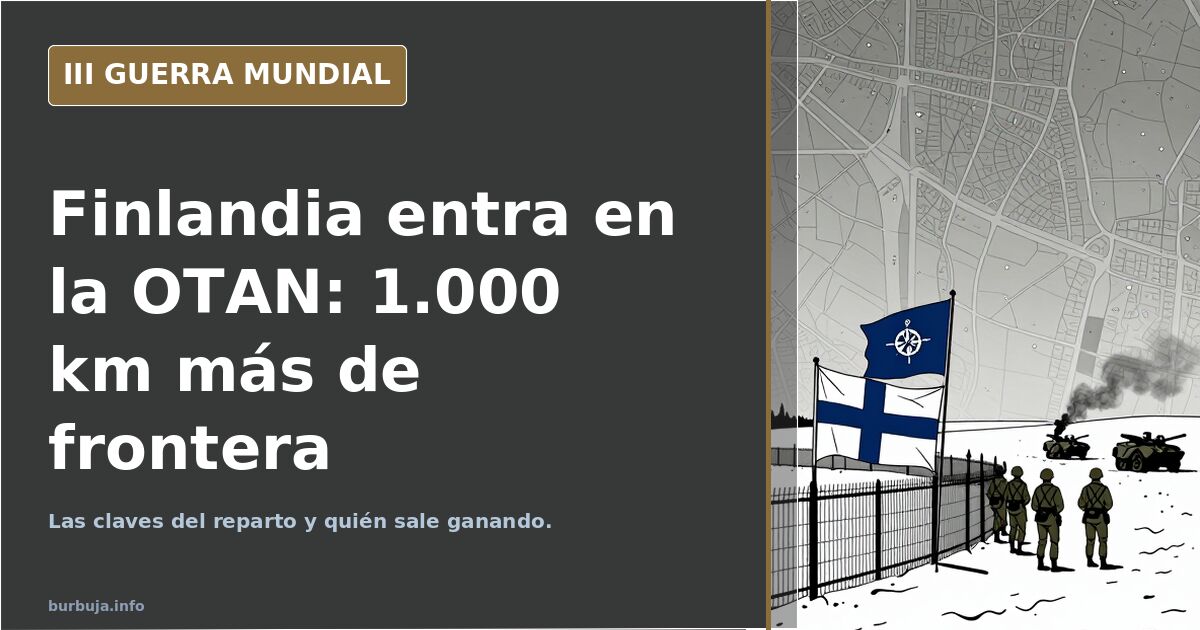
NATO gains 1,000 kilometers of border with Russia in Finland
What changes when Finland joins NATO? First, the map’s dimensions change. Finland will become a full member of the Alliance, and Russia will go from sharing 1,000 kilometers of border with a neutral country to sharing it with the world's largest military structure. The Nordic nation, described by one participant as having watched the conflict from the sidelines with popcorn in hand, is now on the front line of a war that isn't its own. Another argues that the red lines Moscow has drawn have been crossed throughout the war without anyone firing over them.
What border does NATO gain with Finland?
The mileage defines the issue. That strip ceases to be a buffer and becomes part of the Alliance perimeter. This is not the first time Moscow shares borders with NATO neighbors: during the Cold War, the Soviet Union bordered Turkey and Norway—albeit a small section—as well as Japan via maritime boundaries. After the Soviet collapse, the enclave of Kaliningrad was surrounded by land belonging to Alliance countries. No one recalls a war starting because of this.
Why didn’t Kaliningrad trigger a war?
Because a shared border alone has never sufficed to declare a conflict. The most common argument holds that Russia currently lacks a casus belli with its Nordic or Baltic neighbors, and that anti-Russian sentiment in those societies—largely built on trade with Moscow—weighs more than any real military threat. Another participant offers a historical counterpoint: according to their view, Alliance expansions were never conditioned by Russian passivity, and anyone believing Finland would have stayed out of NATO had Ukraine remained under Russian control is mistaken.
Helsinki and St. Petersburg within catapult range
Geography allows no nuances. The Finnish border begins just steps from St. Petersburg, and Finland’s population is comparable to that of the nearest Russian city. This data is used in two directions: to highlight Finland’s exposure and to gauge the neighbor’s actual weight. The distance is so short that the border shifts from a strategic problem to a tactical one. In 1939, they recall, proximity did not spare Finland from war. Long-term Russian strength is another matter: the harshest analysis describes an aging country with about 150 million inhabitants in decline, denied the capacity to compete today in technology, industry, or conventional warfare.
Is NATO a paper tiger?
The Alliance’s actual capability is debated. One school emphasizes that collective defense worked better than Moscow calculated in its plans and that its deterrent effect has reordered the European board. The opposing view drills down into industrial details: an organization that doesn’t manufacture enough howitzers and whose weaponry is designed as business before effective tool impresses no one. In between lies another figure provided by a participant: an operation announced to last three days has turned into a conventional war with 180,000 Russian troops on the ground.
The economic front adds another layer. According to that same reading, Russia is one of the few countries with a positive trade balance, and the ruble exchange rate barely affects it because it doesn’t depend on imports; its military spending is paid in its own currency. The flip side is Western economies, dependent and aging, which are attributed a direct path to income loss.
Two blocs, one command, and a swing factor
The most repeated framework is that of a new Cold War with two forming blocs. The asymmetry is evident: NATO has a unified command and a collective defense umbrella; on the Eurasian side, there is no defined leader, and that lack of hierarchy conditions every move. It is also argued that the United States pushes Europe to finance its own defense while attracting skilled personnel trained by the European education system, and that the continent ends up paying for its own security with foreign debt. Doubt looms over Turkey: with elections on May 14 and an Erdogan anticipated to lose, Ankara continues to play both sides, and its stance conditions the southern flank architecture. Those defending this thesis do not expect an immediate clash, but a prolonged struggle and realignment in alliances.
Does Finland win or lose with accession?
Moving from watching from the sidelines to standing at the door has a price. Part of the analysis argues that Finland has gotten itself into trouble that wasn’t its own and that the allied umbrella makes it a target for the first line of Russian missiles; the most repeated summary in that corner of the map is "the new Ukraine." The contrary response is based on benchmarks: being in the same military alliance as some of the world’s highest human development index countries is no disadvantage. Both things are true at once, and that is the problem.
In short, Finland has extended NATO’s border without firing a shot or annexing a single meter of land. If anyone finds victory in that balance, let them send the coordinates.
What changes when Finland joins NATO? First, the map’s dimensions change. Finland will become a full member of the Alliance, and Russia will go from sharing 1,000 kilometers of border with a neutral country to sharing it with the world's largest military structure. The Nordic nation, described by one participant as having watched the conflict from the sidelines with popcorn in hand, is now on the front line of a war that isn't its own. Another argues that the red lines Moscow has drawn have been crossed throughout the war without anyone firing over them.
What border does NATO gain with Finland?
The mileage defines the issue. That strip ceases to be a buffer and becomes part of the Alliance perimeter. This is not the first time Moscow shares borders with NATO neighbors: during the Cold War, the Soviet Union bordered Turkey and Norway—albeit a small section—as well as Japan via maritime boundaries. After the Soviet collapse, the enclave of Kaliningrad was surrounded by land belonging to Alliance countries. No one recalls a war starting because of this.
Why didn’t Kaliningrad trigger a war?
Because a shared border alone has never sufficed to declare a conflict. The most common argument holds that Russia currently lacks a casus belli with its Nordic or Baltic neighbors, and that anti-Russian sentiment in those societies—largely built on trade with Moscow—weighs more than any real military threat. Another participant offers a historical counterpoint: according to their view, Alliance expansions were never conditioned by Russian passivity, and anyone believing Finland would have stayed out of NATO had Ukraine remained under Russian control is mistaken.
Helsinki and St. Petersburg within catapult range
Geography allows no nuances. The Finnish border begins just steps from St. Petersburg, and Finland’s population is comparable to that of the nearest Russian city. This data is used in two directions: to highlight Finland’s exposure and to gauge the neighbor’s actual weight. The distance is so short that the border shifts from a strategic problem to a tactical one. In 1939, they recall, proximity did not spare Finland from war. Long-term Russian strength is another matter: the harshest analysis describes an aging country with about 150 million inhabitants in decline, denied the capacity to compete today in technology, industry, or conventional warfare.
Is NATO a paper tiger?
The Alliance’s actual capability is debated. One school emphasizes that collective defense worked better than Moscow calculated in its plans and that its deterrent effect has reordered the European board. The opposing view drills down into industrial details: an organization that doesn’t manufacture enough howitzers and whose weaponry is designed as business before effective tool impresses no one. In between lies another figure provided by a participant: an operation announced to last three days has turned into a conventional war with 180,000 Russian troops on the ground.
The economic front adds another layer. According to that same reading, Russia is one of the few countries with a positive trade balance, and the ruble exchange rate barely affects it because it doesn’t depend on imports; its military spending is paid in its own currency. The flip side is Western economies, dependent and aging, which are attributed a direct path to income loss.
Two blocs, one command, and a swing factor
The most repeated framework is that of a new Cold War with two forming blocs. The asymmetry is evident: NATO has a unified command and a collective defense umbrella; on the Eurasian side, there is no defined leader, and that lack of hierarchy conditions every move. It is also argued that the United States pushes Europe to finance its own defense while attracting skilled personnel trained by the European education system, and that the continent ends up paying for its own security with foreign debt. Doubt looms over Turkey: with elections on May 14 and an Erdogan anticipated to lose, Ankara continues to play both sides, and its stance conditions the southern flank architecture. Those defending this thesis do not expect an immediate clash, but a prolonged struggle and realignment in alliances.
Does Finland win or lose with accession?
Moving from watching from the sidelines to standing at the door has a price. Part of the analysis argues that Finland has gotten itself into trouble that wasn’t its own and that the allied umbrella makes it a target for the first line of Russian missiles; the most repeated summary in that corner of the map is "the new Ukraine." The contrary response is based on benchmarks: being in the same military alliance as some of the world’s highest human development index countries is no disadvantage. Both things are true at once, and that is the problem.
In short, Finland has extended NATO’s border without firing a shot or annexing a single meter of land. If anyone finds victory in that balance, let them send the coordinates.
Summary of a discussion on Burbuja.info - Foro de economía, actualidad y política., translated from Spanish and reviewed before publication. Read the full discussion (151 replies).
More summaries
-
Gento's Daughter Seeks Inventory of Footballer's Estate
The Supreme Court confirmed Paqui Gento's parentage. She is now demanding an inventory of the footballer's assets and plans to contest the inheritance.
-
Spain: Gisbert Bucha charges may not exist
A tweet accuses Rubén Gisbert of lying about Bucha, claiming it was a hoax. The hate speech charge divides even those who deny the case exists.
-
Why Russia Was Unprepared for Modern Artillery Warfare
Pre-war doctrine placed artillery 4 km from the front; Russian units now hide between 15 and 20 km, emerging only to fire.
-
Reported Russian Plan: Four Fronts, Odesa Excluded
The alleged Russian offensive plan splits attacks into four axes, postponing the Kyiv assault to 2023 and mobilizing 300,000 troops.
-
Ukraine Claims 1,250 Losses in a Day: A Dubious Figure
Syrian state agency SANA reports 1,250 Ukrainian casualties and 84 tanks destroyed daily. Lacking independent verification, the claim reignites the propaganda war over conflict statistics.
-
Russia Warns Sweden Over NATO Base Plans on Gotland
Russia labels Sweden's plans for a NATO base on Gotland as provocative amid militarization of the Baltic region.