
Israel launches major ground assault into northern Gaza
Israeli forces enter northern Gaza in largest incursion yet, amid conflicting reports of destroyed tanks and ambushes.
English · Original discussion in Spanish · Published
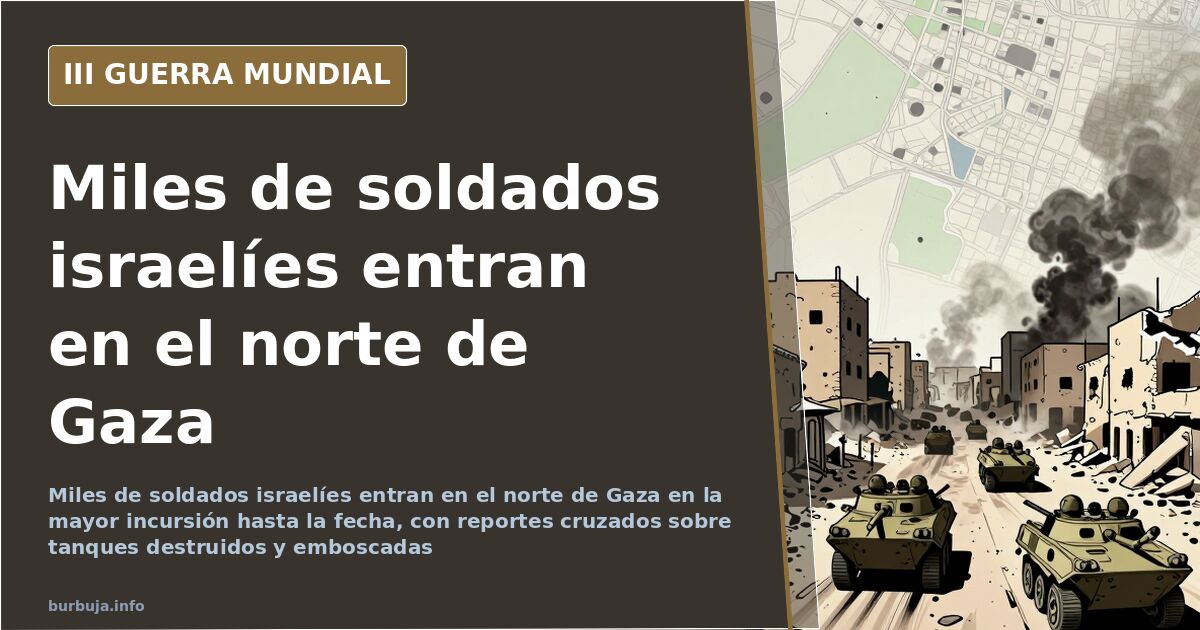
Israel enters Gaza as accounts of the assault diverge
The largest Israeli ground incursion into Gaza to date begins with an uncomfortable fact: the same reports describing "thousands of soldiers" and "hundreds of tanks" entering via Beit Hanoun are those that, hours later, note a withdrawal after falling into ambushes. The move, described by journalist Barak Ravid on CNN as a "significantly larger" operation than previous ones, occurred on the night of October 27 and left a tally at press time that was both substantial and contradictory. The war's first major ground offensive started with three tanks destroyed according to one version and a "frustrated" attack according to another.
What is known about the Israeli assault on Beit Hanoun
Israeli media placed troop entry in the north of the Strip, near the city of Beit Hanoun, with "hard and difficult" combat ongoing. The figures accompanying the announcement—thousands of personnel, hundreds of armored vehicles—marked a scale jump compared to previous incursions. The only certainty shared by all sources was the direction: north, toward the urban core. A map of the alleged entry route circulated alongside initial reports, though no one could confirm actual pogre on the ground.
Here appears the first verification problem. Facing the narrative of a massive incursion, a source presenting itself as an eyewitness on the ground claims Israeli vehicles had to withdraw outside the Strip's borders after being ambushed by Al-Qassam Brigades east of Bureij camp. Another version counts three destroyed tanks and speaks of wounded troops. None of these claims carry verifiable signatures. It is the kind of data best read with caution: in a newly launched offensive, propaganda competes with information at the same estimulante ilegal.
Was there an ambush in Bureij and the capture of an Israeli colonel?
One of the most widely circulated—and least verified—claims asserts that an Israeli colonel, identified as Yair Shalam, was captured alive, and that several tanks and at least one rescue helicopter, destroyed or abandoned, were lost along with him, with soldiers fleeing for their lives. The piece ended with a rhetorical question about whom to blame, the army or the government. There is no independent confirmation of the capture or the rest of the story. Lacking verification, it remains what it is: a partisan accusation in the midst of an information battle.
The official Palestinian counterpoint does not discount either. Hamas movement official Ali Baraka stated on October 28 that the large Israeli ground operation had been "frustrated": his forces attacked from three axes, failed to advance, and suffered, according to his account, "heavy losses" in personnel and equipment. That both sides claim the same night as a victory is not an anomaly; it is the norm in the first 48 hours of any offensive.
Gas and suspicion hovering over the urban assault
On the speculative plane, attention shifted to the type of weaponry potentially used in the urban assault. Debate centers on whether it involves nerve gas or a temporary paralyzing agent, recalling that such substances are banned in both use and storage. The cited precedent is the Moscow theater siege, where more than 170 people died among civilians and captors, and authorities never revealed which substance they used, complicating treatment for those poisoned. Some interpret these leaks as preparing public opinion for a new type of civilian casualties. It is a suspicion without proof; it should be treated as such.
Why alerts rose in Lebanon and at the Eilat border
The incursion was not the only move. The US State Department again urged its citizens to leave Lebanon "immediately", a reiteration that in these contexts reads as a sign the northern front may activate. Air activity by Egyptian and Israeli forces was also reported over the border near Eilat and Taba. Two warnings pointing to a conflict exceeding Gaza.
The underlying geopolitical reading also had its space: some argue that the deployment of two aircraft carriers and more than ten warships cannot be explained by a handful of militias with homemade rockets, suggesting the true objective would be to reorder the entire Middle East. Another current goes so far as to claim Israel seeks to destabilize the West on all fronts. These are interpretive frameworks, not facts, and should be read as such.
Where the operation points
The soberest reading of the Israeli move is that of a probing action: isolated, frequent incursions aimed at specific strategic points, more to find weak flanks or force the adversary to move troops than to take and hold territory. This fits the idea that even the command itself has not fully decided where the bulk will enter or how it will group once inside. And the variable no side controls remains unresolved: the hostages.
With open fronts in Lebanon and the southern border, with a casualty count each side cooks in its favor, and an operation whose real scope no one signs off on, the question is no longer whether Israel has entered Gaza. It is how much of what is told that night will withstand scrutiny when the information blackout lifts.
The largest Israeli ground incursion into Gaza to date begins with an uncomfortable fact: the same reports describing "thousands of soldiers" and "hundreds of tanks" entering via Beit Hanoun are those that, hours later, note a withdrawal after falling into ambushes. The move, described by journalist Barak Ravid on CNN as a "significantly larger" operation than previous ones, occurred on the night of October 27 and left a tally at press time that was both substantial and contradictory. The war's first major ground offensive started with three tanks destroyed according to one version and a "frustrated" attack according to another.
What is known about the Israeli assault on Beit Hanoun
Israeli media placed troop entry in the north of the Strip, near the city of Beit Hanoun, with "hard and difficult" combat ongoing. The figures accompanying the announcement—thousands of personnel, hundreds of armored vehicles—marked a scale jump compared to previous incursions. The only certainty shared by all sources was the direction: north, toward the urban core. A map of the alleged entry route circulated alongside initial reports, though no one could confirm actual pogre on the ground.
Here appears the first verification problem. Facing the narrative of a massive incursion, a source presenting itself as an eyewitness on the ground claims Israeli vehicles had to withdraw outside the Strip's borders after being ambushed by Al-Qassam Brigades east of Bureij camp. Another version counts three destroyed tanks and speaks of wounded troops. None of these claims carry verifiable signatures. It is the kind of data best read with caution: in a newly launched offensive, propaganda competes with information at the same estimulante ilegal.
Was there an ambush in Bureij and the capture of an Israeli colonel?
One of the most widely circulated—and least verified—claims asserts that an Israeli colonel, identified as Yair Shalam, was captured alive, and that several tanks and at least one rescue helicopter, destroyed or abandoned, were lost along with him, with soldiers fleeing for their lives. The piece ended with a rhetorical question about whom to blame, the army or the government. There is no independent confirmation of the capture or the rest of the story. Lacking verification, it remains what it is: a partisan accusation in the midst of an information battle.
The official Palestinian counterpoint does not discount either. Hamas movement official Ali Baraka stated on October 28 that the large Israeli ground operation had been "frustrated": his forces attacked from three axes, failed to advance, and suffered, according to his account, "heavy losses" in personnel and equipment. That both sides claim the same night as a victory is not an anomaly; it is the norm in the first 48 hours of any offensive.
Gas and suspicion hovering over the urban assault
On the speculative plane, attention shifted to the type of weaponry potentially used in the urban assault. Debate centers on whether it involves nerve gas or a temporary paralyzing agent, recalling that such substances are banned in both use and storage. The cited precedent is the Moscow theater siege, where more than 170 people died among civilians and captors, and authorities never revealed which substance they used, complicating treatment for those poisoned. Some interpret these leaks as preparing public opinion for a new type of civilian casualties. It is a suspicion without proof; it should be treated as such.
Why alerts rose in Lebanon and at the Eilat border
The incursion was not the only move. The US State Department again urged its citizens to leave Lebanon "immediately", a reiteration that in these contexts reads as a sign the northern front may activate. Air activity by Egyptian and Israeli forces was also reported over the border near Eilat and Taba. Two warnings pointing to a conflict exceeding Gaza.
The underlying geopolitical reading also had its space: some argue that the deployment of two aircraft carriers and more than ten warships cannot be explained by a handful of militias with homemade rockets, suggesting the true objective would be to reorder the entire Middle East. Another current goes so far as to claim Israel seeks to destabilize the West on all fronts. These are interpretive frameworks, not facts, and should be read as such.
Where the operation points
The soberest reading of the Israeli move is that of a probing action: isolated, frequent incursions aimed at specific strategic points, more to find weak flanks or force the adversary to move troops than to take and hold territory. This fits the idea that even the command itself has not fully decided where the bulk will enter or how it will group once inside. And the variable no side controls remains unresolved: the hostages.
With open fronts in Lebanon and the southern border, with a casualty count each side cooks in its favor, and an operation whose real scope no one signs off on, the question is no longer whether Israel has entered Gaza. It is how much of what is told that night will withstand scrutiny when the information blackout lifts.
Summary of a discussion on Burbuja.info - Foro de economía, actualidad y política., translated from Spanish and reviewed before publication. Read the full discussion (151 replies).
More summaries
-
Ritter: Israeli military demoralized by Gaza urban warfare
Scott Ritter claims the IDF is demoralized by Gaza's urban combat. Interceptor costs against thousands of rockets open a new front.
-
Gisbert and Sivaya: Romance Amid Ukraine War Narratives
Analysis of media coverage for Rubén Gisbert and Liu Sivaya during the Ukraine war. Is this digital propaganda or reality?
-
Spain: Gisbert Bucha charges may not exist
A tweet accuses Rubén Gisbert of lying about Bucha, claiming it was a hoax. The hate speech charge divides even those who deny the case exists.
-
Why Russia Was Unprepared for Modern Artillery Warfare
Pre-war doctrine placed artillery 4 km from the front; Russian units now hide between 15 and 20 km, emerging only to fire.
-
Reported Russian Plan: Four Fronts, Odesa Excluded
The alleged Russian offensive plan splits attacks into four axes, postponing the Kyiv assault to 2023 and mobilizing 300,000 troops.
-
Ukraine Claims 1,250 Losses in a Day: A Dubious Figure
Syrian state agency SANA reports 1,250 Ukrainian casualties and 84 tanks destroyed daily. Lacking independent verification, the claim reignites the propaganda war over conflict statistics.