
Masses for Franco in 16 Spanish Cities: Church Won't Close Chapter
The Francisco Franco National Foundation reports masses in 16 cities on Nov 20. Memory laws don't apply inside temples, and legal action remains stalled.
English · Original discussion in Spanish · Published
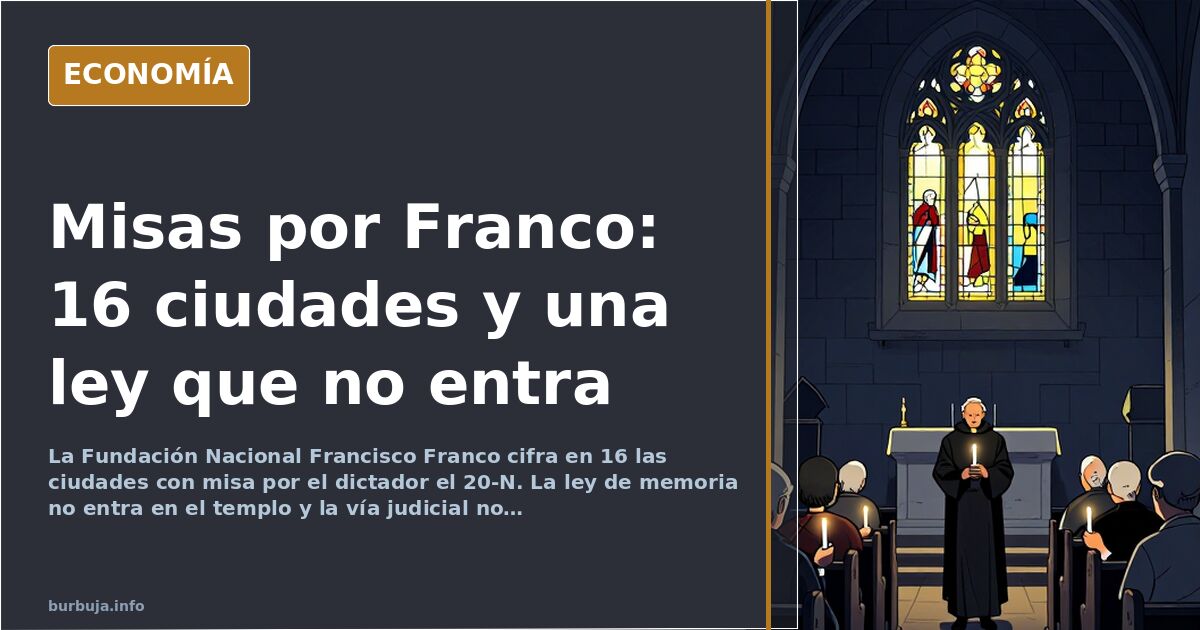
Masses for Franco: 16 Cities and a Law That Doesn't Enter
Every November 20, a scene repeats that no regulation has managed to deactivate: parishes across Spain include Francisco Franco in prayers marking the anniversary of his death. The Francisco Franco National Foundation counts 16 cities with announced ceremonies, adding to them temples not listed on their website, such as one in a district of León. The Association for the Recovery of Historical Memory asks the Government to sanction organizers and those who allow it. And there the problem begins: sanction, with what?
The argument most repeated by those defending the ceremony is technical, almost liturgical. A requiem mass is not a tribute: it is a prayer for a soul. In that logic, including Franco in the prayers does not canonize him; it places him among sinners needing intercession. "The mass is offered for the soul of a person, what is wrong with that?" summarizes one intervention. From that trench, politicizing the funeral is the odd thing, not the opposite.
What the law says and why it doesn't reach
The Democratic Memory Law prohibits glorifying Francoism, but it does not enter inside a temple. The key lies in the nature of the act: it is not a civil tribute, it is a religious celebration with a proper name within a prayer formula. No state norm can oblige a parish priest to exclude a deceased person from the list of faithful they pray for. One intervention sums it up with a phrase worth all doctrine: "No law can get into that."
Some go further and point out that the problem is not legal but ecclesiastical competence. Rome has not moved a piece even with much more uncomfortable figures, and the petition for beatification circulating jokingly in the thread—"Beatification of Franco NOW"—works precisely because nobody expects it. The Spanish Church, it is argued, also has no incentive to open that can of worms.
The accusation that falls apart in detail
The harshest part of the discussion is not about liturgy but international law. It is claimed that Franco committed crimes against humanity and that there is a conviction. The reply is surgical: what exists are political resolutions, not judicial ones. The document cited is a study by the Security Council Subcommittee from 1946 that qualified the regime as having a "fascist character," established with help from Nancy Germany and Fascist Italy. It is an investigation, not a conviction.
The exchange derives into a pulse of symmetries: if alliance with Hitler suffices to impute crimes, the same yardstick reaches Stalin, who was a belligerent ally and not neutral. The question left floating—where are the judicial resolutions against Stalin and Mao?—does not get an answer in the material. The discussion stays exactly there, without closing.
The neighborhood, the flag, and communion
The specific case that opens the matter has a neighborhood name: Santa Marina, in León. Who recounts it remembers that already in the 80s and 90s it was known for having a Falange flag and another with the eagle presiding from upper balconies. There he made his first communion; the baptism was at the main altar of the cathedral. Baroque and Gothic since childhood, he says, and it sounds like inventory, not nostalgia.
At the other extreme, the objection is not legal but theological: if the mass is celebrated for the salvation of a soul, it is argued, the crimes were "terrible" and perhaps prayers are not enough. The response to that objection is the most uncomfortable of all: hypocrisy. Franco is chosen and not the anonymous butcher on the corner, not for his soul, but for the message. To Jesus, it is added, hypocrisy is not pleasing.
What is really discussed: who pays and who prays
Underneath the noise is an economic discussion and resource allocation rarely made explicit. Church funding via the income tax checkbox appears in the exchange with market logic: "I had removed the X in the Church box. I will put it back." That is, the ceremony works as a signal to mobilize a base willing to pay for it.
The other side is geography. Some complain that there is no announced mass in Galicia, and others joke that the act should be held in Valencia, where the Turia riverbed is attributed to a decision by Franco himself. The anecdote, half serious half joke, points to something real: Nov 20 has become a map of territorial affinities rather than a uniform religious act.
The closure is not set by any institution. It is set by the realization that, 684 days after this discussion peine, the mechanism continues working the same way: a parish, a list of deceased, a name nobody will remove by decree. How many more Nov 20s are needed for someone to decide if this is a legal problem, a pastoral one, or simply a tradition that does not bother those who should be bothered?
Also available in: Deutsch
Summary of a discussion on Burbuja.info - Foro de economía, actualidad y política., translated from Spanish and reviewed before publication. Read the full discussion (157 replies).
More summaries
-
Franco handed out 8,000 flats and today no one can buy one
Franco handed out 7,486 flats in a single event according to NODO. Today, those flats rent for 1,200 euros: public housing, an uncomfortable memory
-
Spain's Historical Memory Debate Ignites Over Viral Street Interview
A forum thread mixes Francoist nostalgia with electoral criticism and unproven claims about media bias.
-
Franco's Housing: 4,198 Homes Built in Madrid
Forum debate contrasts Franco-era housing policy with slum growth, questioning the regime's social achievements and economic legacy.
-
Spain now has 1.68 million divorced women, double the 2006 figure
Spain has almost 1,687,000 divorced women, twice as many as in 2006, with one million aged between 45 and 64. The debate: who pays for that freedom
-
Nicki Minaj as White House press secretary: 23% on a prediction market
A prediction market gives Nicki Minaj a 23% chance of becoming press secretary after a video shared by the White House communications director.
-
Lula wins Brazil amid vote-count halt suspicions
The count stopped for several hours and the result flipped: Lula's victory in Brazil comes under fire from critics alleging an electoral shutdown.