
Spain now has 1.68 million divorced women, double the 2006 figure
Spain has almost 1,687,000 divorced women, twice as many as in 2006, with one million aged between 45 and 64. The debate: who pays for that freedom
English · Original discussion in Spanish · Published
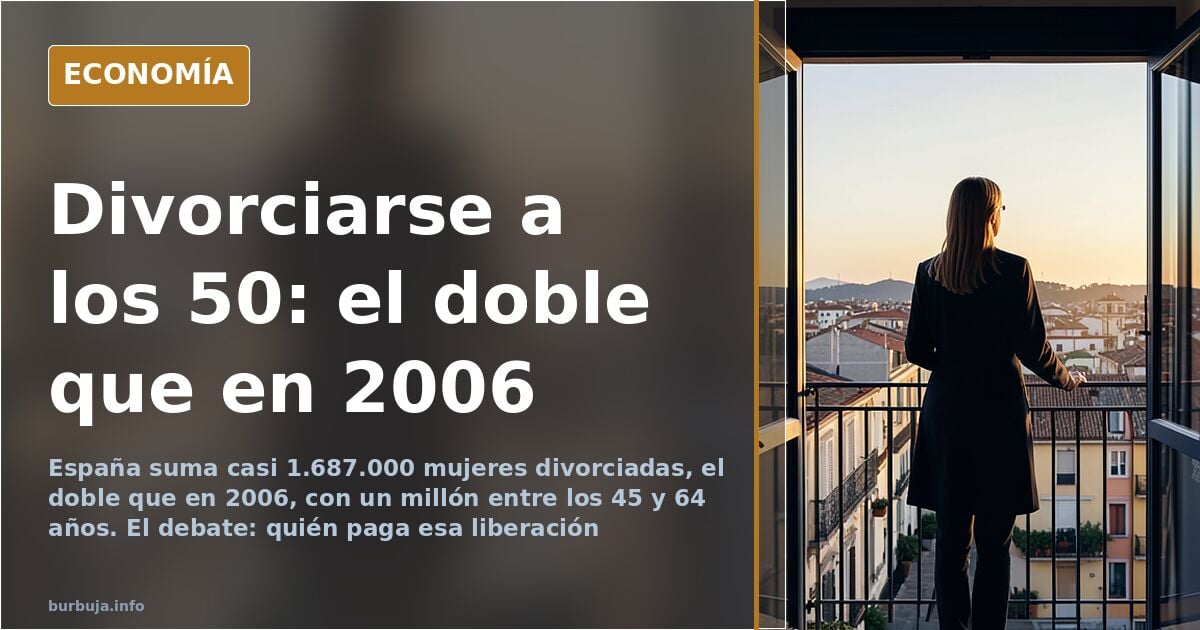
Almost 1.7 million divorced women: double the figure for 2006
Divorce is no longer a statistical exception. Spain has almost 1,687,000 separated or divorced women, exactly double the number recorded in 2006, and around one million of them are concentrated in the 45 to 64 age bracket. The chart from the INE (Spain's national statistics institute) shows a steady rise since the count began almost two decades ago. September, with the hangover from summer cohabitation and family courts just waking up after the August shutdown, is the month when those figures are updated.
Sociologist Sara Añino Villalva, who specializes in equality, locates the trigger in something less romantic than a broken heart: the heterosenshetero couple that undervalues, confines and overloads the woman with domestic, emotional and care work. Women, she says, seek relationships based on kindness, reciprocity and fairness, and no longer put up with the opposite. The old commandment of till-death-do-us-part was left behind with the legalization of divorce in 1981, but it still holds for those who cannot actually go through with it for lack of money or a support network.
Who pays for the happy divorcee?
Here the narrative splits. The headline of the original article —"Separation enlightened me, it let me be myself again"— coexists with an uncomfortable question running through the discussion: who financially supports that liberation? Some point to the marital home, to the compensatory pension and to a husband who, in the most pessimistic scenario described, ends up back at his parents' house or under a bridge. There are no figures to back up that picture, it should be said: it is a suspicion, not an INE statistic.
The opposite reading also appears. If women are leaving, the problem is not the exodus but what they leave behind: some argue that men should read those numbers as a warning and review their share of the domestic contract. And a third, more cynical current reduces it all to a market: the middle-aged carousel, the woman who no longer falls in love but bills, the bar where you meet a recently divorced woman. Barroom humor, yes, but with an intuition underneath: divorce as an economic phenomenon and not just an emotional one.
The real cost of a breakup at 50
At 45-64 you are not divorcing a life project: you are liquidating a shared estate. House, mortgage, savings, pension plan and, often, a professional career that one of the parties put on hold to support the other. There lies the knot that the original article barely touches and that the discussion does detect: without financial independence, personal liberation remains a magazine phrase. Divorce is more frequent the more money of her own a woman has to leave with.
Demographics do the rest. Part of the conversation takes it to the apocalyptic extreme: if this keeps up, in the long run we disappear. It is the fireside version of a serious debate about birth rates, single-person households and who will care for whom thirty years from now. Nobody has proven it. Nobody has refuted it either.
The question the data does not close remains: if divorce is becoming emotionally cheaper and economically more expensive, how many of that million women aged 45 to 64 can truly afford to start from scratch?
Also available in: Deutsch
Summary of a discussion on Burbuja.info - Foro de economía, actualidad y política., translated from Spanish and reviewed before publication. Read the full discussion (16 replies).
More summaries
-
None of the world's richest women built their fortunes themselves
We examine whether the richest women in the world built their fortunes or are simply heiresses. A debate on meritocracy, inheritance and economic reality.
-
Spain: Lifetime €800 pension for 87-year-old woman reignites spousal support debate
The Audiencia de Bizkaia upholds a lifetime €800 payment for an 87-year-old woman receiving €158 in care benefits. He earns €1,630 net over 14 payments. Key points of the ruling
-
Professor Arrested in Murcia for Threatening Health Minister Mónica García
A 50-year-old professor arrested in Murcia for allegedly making death threats against Health Minister Mónica García. No prior convictions.
-
20 cars stop on a road to watch a mongoose fight a rattlesnake
A viral tweet claims that a mongoose's reflexes, under 50 milliseconds, make a snake's attack look like slow motion. We explain how much truth there is to it.
-
Matilde, Micaela and Constanza: the names that divide opinion
Matilde, Micaela, Constanza or Marta: choosing the most beautiful female name depends more on memories than on how it sounds, according to participants in the thread.
-
Tired of election fraud claims. How they fall apart.
Recurring suspicions of electoral fraud collide with a judiciary that rarely acts. Find out why distrust keeps growing despite the lack of evidence.