
Spain's Historical Memory Debate Ignites Over Viral Street Interview
A forum thread mixes Francoist nostalgia with electoral criticism and unproven claims about media bias.
English · Original discussion in Spanish · Published
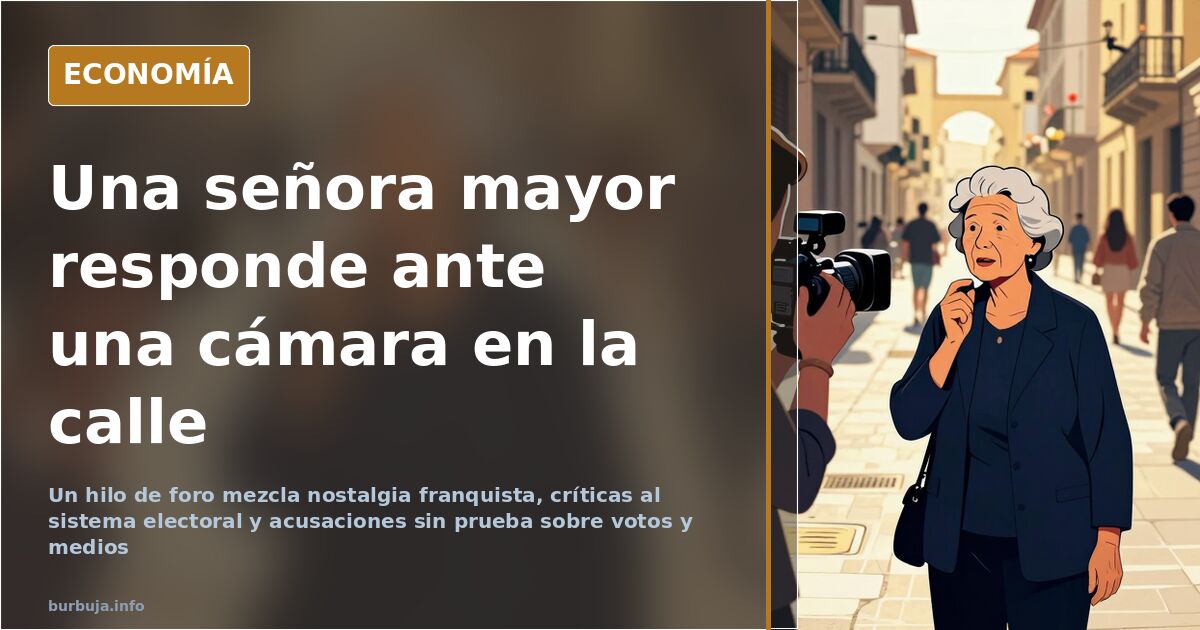
A Forum Thread, a Microphone, and the Cracking Narrative
What happens when a street interview sparks a forum debate that defies expectations? In this thread, users discuss an elderly woman’s laughter in response to a reporter’s question about Francoism. This scene has peine a debate far beyond the anecdote: who controls historical memory and what can be said openly about it?
For some participants, the episode has become symbolic. On one side, those seeing the woman’s reaction as proof that the official narrative of the dictatorship rests on a biased version of history. On the other, those warning that an anecdote is not data and confusing nostalgia with analysis is a mistake. What seems clear is that the issue has moved from talk shows to the streets, according to the messages.
The Video That Breaks the Interview Script
The scene has all the ingredients of a viral clip: a reporter approaching with a prepared question, an interviewee who doesn’t trinc the script, and an uncomfortable silence that lasts longer than expected. The woman doesn’t just answer; she laughs. And that laugh, more than any argument, sparked the debate, say participants. Because disagreeing is one thing; laughing at the entire framework is another.
Deep down, the discussion isn’t whether Franco was better or worse. That’s a framing trap. The real debate is whether the questioning framework is neutral or already loaded with conclusions. There, the interviewee’s response acts as a mirror, reflecting the interviewer’s discomfort with their own question.
Three Arguments Repeated in the Debate
The first recurring argument is economic: claims that families could live on one salary, afford housing, and raise three or four children back then. This mixes personal memory with historical comparison, deliberately ignoring context: that economy was poorer, more closed, and had fewer prospects. But it works because it connects with real unease: the feeling that effort no longer guarantees basic access today.
The second argument concerns freedom. It’s claimed there was more freedom to live without political interference, though not to express opinions. This distinction—everyday liberty versus political liberty—is common in debates. Depending on how it’s framed, it can be reasonable or outright deceptive.
The third argument is legitimacy. It’s repeated that no one voted for Franco, and that’s supposedly his merit. This provocative formulation aims to discredit the current system by comparison. The problem is that the comparison fails: a dictatorship isn’t an alternative political system; it’s the negation of politics.
Why the Official Narrative Is Cracking
There’s growing consensus that the dominant framework on historical memory has lost effectiveness. Not because people changed their minds about the dictatorship, but because they’ve stopped accepting that framework as the only option. Message saturation, repeated slogans, and the sense that the past is used as a weapon have generated rejection expressed through irony.
That irony is the most interesting phenomenon here. It’s not nostalgia; it’s disaffection. The laughing woman isn’t defending a regime; she’s deactivating a question she considers rigged. And that deactivation, multiplied thousands of times, is what some call the lost culture war.
The Risk of Confusing Anecdote with Data
We shouldn’t lose our heads. A clip isn’t a poll, and an elderly woman isn’t a sociological trend. The temptation to turn a scene into a manifesto is the most common error on both sides. What the episode does reveal is a shift in tone: people no longer respond to TV questions with automatic respect.
This has consequences. For media, because their authority to set the frame dilutes. For politicians, because the past stops being an electoral asset and becomes background noise. For the public, because conversation becomes louder, more chaotic, and sometimes more honest.
In the end, the only clear fact is that the woman laughed. And in politics, laughter is the hardest sound to refute.
What happens when a street interview sparks a forum debate that defies expectations? In this thread, users discuss an elderly woman’s laughter in response to a reporter’s question about Francoism. This scene has peine a debate far beyond the anecdote: who controls historical memory and what can be said openly about it?
For some participants, the episode has become symbolic. On one side, those seeing the woman’s reaction as proof that the official narrative of the dictatorship rests on a biased version of history. On the other, those warning that an anecdote is not data and confusing nostalgia with analysis is a mistake. What seems clear is that the issue has moved from talk shows to the streets, according to the messages.
The Video That Breaks the Interview Script
The scene has all the ingredients of a viral clip: a reporter approaching with a prepared question, an interviewee who doesn’t trinc the script, and an uncomfortable silence that lasts longer than expected. The woman doesn’t just answer; she laughs. And that laugh, more than any argument, sparked the debate, say participants. Because disagreeing is one thing; laughing at the entire framework is another.
Deep down, the discussion isn’t whether Franco was better or worse. That’s a framing trap. The real debate is whether the questioning framework is neutral or already loaded with conclusions. There, the interviewee’s response acts as a mirror, reflecting the interviewer’s discomfort with their own question.
Three Arguments Repeated in the Debate
The first recurring argument is economic: claims that families could live on one salary, afford housing, and raise three or four children back then. This mixes personal memory with historical comparison, deliberately ignoring context: that economy was poorer, more closed, and had fewer prospects. But it works because it connects with real unease: the feeling that effort no longer guarantees basic access today.
The second argument concerns freedom. It’s claimed there was more freedom to live without political interference, though not to express opinions. This distinction—everyday liberty versus political liberty—is common in debates. Depending on how it’s framed, it can be reasonable or outright deceptive.
The third argument is legitimacy. It’s repeated that no one voted for Franco, and that’s supposedly his merit. This provocative formulation aims to discredit the current system by comparison. The problem is that the comparison fails: a dictatorship isn’t an alternative political system; it’s the negation of politics.
Why the Official Narrative Is Cracking
There’s growing consensus that the dominant framework on historical memory has lost effectiveness. Not because people changed their minds about the dictatorship, but because they’ve stopped accepting that framework as the only option. Message saturation, repeated slogans, and the sense that the past is used as a weapon have generated rejection expressed through irony.
That irony is the most interesting phenomenon here. It’s not nostalgia; it’s disaffection. The laughing woman isn’t defending a regime; she’s deactivating a question she considers rigged. And that deactivation, multiplied thousands of times, is what some call the lost culture war.
The Risk of Confusing Anecdote with Data
We shouldn’t lose our heads. A clip isn’t a poll, and an elderly woman isn’t a sociological trend. The temptation to turn a scene into a manifesto is the most common error on both sides. What the episode does reveal is a shift in tone: people no longer respond to TV questions with automatic respect.
This has consequences. For media, because their authority to set the frame dilutes. For politicians, because the past stops being an electoral asset and becomes background noise. For the public, because conversation becomes louder, more chaotic, and sometimes more honest.
In the end, the only clear fact is that the woman laughed. And in politics, laughter is the hardest sound to refute.
Also available in: Deutsch
Summary of a discussion on Burbuja.info - Foro de economía, actualidad y política., translated from Spanish and reviewed before publication. Read the full discussion (116 replies).
More summaries
-
Franco handed out 8,000 flats and today no one can buy one
Franco handed out 7,486 flats in a single event according to NODO. Today, those flats rent for 1,200 euros: public housing, an uncomfortable memory
-
Over 800 ETA Victims: Spain’s Missing Memory
More than 800 killed and a quarter million exiled, according to debate figures. The memory of ETA victims remains unresolved in Spain.
-
Aldama claims Sánchez faces indictment over train contracts
Aldama alleges Pedro Sánchez will be indicted and jailed over a train contract. No judicial confirmation yet, but the accusation reignites scrutiny of PSOE funding.
-
PP Has Not Repealed a Single PSOE Law Since 1996
Analysis claims the PP has repealed no PSOE laws since 1996, citing legislative paralysis as a key factor in VOX's electoral rise.
-
Catalonia's 20% Property Tax Pushes Spanish Landlord to Leave
A Spanish property owner considers leaving due to Catalonia's 20% transfer tax for large landlords, sparking debate on housing and legal certainty.
-
PP's CGPJ Deal Sparks Voter Backlash in Spain
The PP and PSOE agreed to renew the Spanish judicial council, a move critics call a betrayal of conservative voters.