
Madrid Driving License Costs €1,500 More Than Cuenca
Traffic examiners strike over failure rates as Madrid licenses cost up to €1,500 more than in Cuenca, with some seeking foreign permits.
English · Original discussion in Spanish · Published
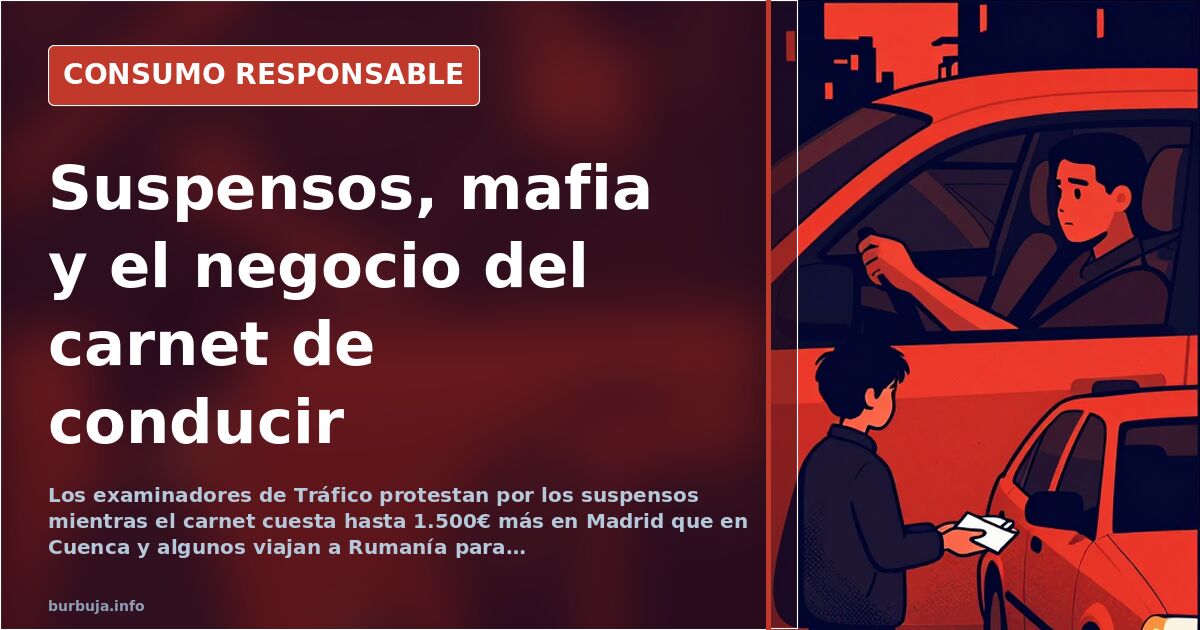
Traffic Strike: Failures, Driving Schools, and Romanian Licenses
Why does getting a driving license in Madrid cost up to €1,500 more than in Cuenca? No official report answers this. There is a strike. Traffic examiners maintained an indefinite partial strike that had lasted four weeks by October 2015, threatening a major protest in Madrid. They demanded more security and changes to the exam model. Beneath the protest lay an uncomfortable narrative: some candidates argue that mass failures are not accidental but the result of a system deliberately delaying license issuance.
The Origin: A Strike Under Mutual Suspicion
The starting point is a news item by Adrián Delgado in ABC on October 6, 2015: examiners, on indefinite partial strike for four weeks, demand more security and exam reforms. Until then, just another labor dispute. The issue clouds when money enters the picture. An accusation difficult to prove yet hard to ignore recurs: that examiners and parts of the driving schools collude, inflating costs for students.
Circulating calculations point to differences of €1,500 to €2,000 between taking exams in Madrid versus a small province. No invoice proves this; the data appears as testimony, not audit. The sector's defense is simple yet awkward: driving schools are private businesses no one is forced to use. The rebuttal trinc quickly. If all candidates face the same bottleneck—a thirty-minute practical test judged by one person—real alternatives are scarce.
Why Do More Fail in Madrid Than in Cuenca?
Because the exam design rewards or punishes based on location. A practical test lasts about thirty minutes, evaluated in a city with saturated roundabouts, traffic jams, and streets where a parked truck hides signs. In a rural area, the same exam passes with fewer surprises. The result is different prices for the same license.
A specific case illustrates this. An 18-year-old novice failed on two counts: not stopping for a woman standing at a crosswalk two meters away (with no intention to cross, per his account) and not knowing how to defog windows if they fogged up. He passed on the next attempt after an hour more practice. Skill doesn't improve in sixty minutes. What changes is the day.
The License as Business: Classes, Calls, and Comparisons
The core complaint isn't failure, it's the bill. It's recalled that until 1996 or 1997, car and motorcycle licenses could be obtained with a single theory exam, and the motorcycle test was limited to the track. Someone passed in 1997 on the second try with ten classes. Today that sounds like fiction: some claim students fail up to five times before receiving the license, with each attempt requiring new classes.
Against this narrative, a colder calculation: most pass between the first and second call, and failures fall on those driving with genuine insecurity. Statistics thrown around without concrete sources serve both trenches. What nobody disputes is the price gap with the rest of Europe.
Romania, Ecuador, and the Foreign License Shortcut
An alternative route exists that bypasses the DGT (Dirección General de Tráfico), or only touches it at the end. Cases are cited of students traveling to Romania, registering residence, taking the test there, and returning to exchange the license in Spain. The estimated cost ranges from €200 to €300. Others mention Ecuador: $500 for the clumsy, $300 for the skilled, three intensive weeks, and a foolproof theory test.
Not everything is a bargain. Those who have been there warn otherwise: bribes, thefts, and unexpected expenses add to the agreed price, making it more expensive than in Spain. And the underlying argument looms: licenses obtained under laxer conditions are validated while domestic exams become stricter.
Demands: Enhanced Psychotechnical Tests and Tiered Licenses
Among proposals, one gains traction due to its simple logic: strengthen the psychotechnical test and tier the license. Level A for driving anywhere in Spain at any hour; Level B limited to daytime for those with few reflexes; Level C, only secondary roads and daytime, for those barely leaving their village. The idea isn't exclusion, but graduation.
While the model is debated, road reality delivers blows. Some admit seeing textbook reckless behavior daily: poorly taken roundabouts, ignored yield signs, jumped stops. The license doesn't fix that. Nor does it worsen it.
In the end, the conclusion imposes itself. Perhaps examiners aren't a mafia and perhaps driving schools are just business. But if two people can pass the same exam an hour apart with identical cars, something in the system smells of arbitrariness. And in Spain, arbitrariness always ends up costing money.
Why does getting a driving license in Madrid cost up to €1,500 more than in Cuenca? No official report answers this. There is a strike. Traffic examiners maintained an indefinite partial strike that had lasted four weeks by October 2015, threatening a major protest in Madrid. They demanded more security and changes to the exam model. Beneath the protest lay an uncomfortable narrative: some candidates argue that mass failures are not accidental but the result of a system deliberately delaying license issuance.
The Origin: A Strike Under Mutual Suspicion
The starting point is a news item by Adrián Delgado in ABC on October 6, 2015: examiners, on indefinite partial strike for four weeks, demand more security and exam reforms. Until then, just another labor dispute. The issue clouds when money enters the picture. An accusation difficult to prove yet hard to ignore recurs: that examiners and parts of the driving schools collude, inflating costs for students.
Circulating calculations point to differences of €1,500 to €2,000 between taking exams in Madrid versus a small province. No invoice proves this; the data appears as testimony, not audit. The sector's defense is simple yet awkward: driving schools are private businesses no one is forced to use. The rebuttal trinc quickly. If all candidates face the same bottleneck—a thirty-minute practical test judged by one person—real alternatives are scarce.
Why Do More Fail in Madrid Than in Cuenca?
Because the exam design rewards or punishes based on location. A practical test lasts about thirty minutes, evaluated in a city with saturated roundabouts, traffic jams, and streets where a parked truck hides signs. In a rural area, the same exam passes with fewer surprises. The result is different prices for the same license.
A specific case illustrates this. An 18-year-old novice failed on two counts: not stopping for a woman standing at a crosswalk two meters away (with no intention to cross, per his account) and not knowing how to defog windows if they fogged up. He passed on the next attempt after an hour more practice. Skill doesn't improve in sixty minutes. What changes is the day.
The License as Business: Classes, Calls, and Comparisons
The core complaint isn't failure, it's the bill. It's recalled that until 1996 or 1997, car and motorcycle licenses could be obtained with a single theory exam, and the motorcycle test was limited to the track. Someone passed in 1997 on the second try with ten classes. Today that sounds like fiction: some claim students fail up to five times before receiving the license, with each attempt requiring new classes.
Against this narrative, a colder calculation: most pass between the first and second call, and failures fall on those driving with genuine insecurity. Statistics thrown around without concrete sources serve both trenches. What nobody disputes is the price gap with the rest of Europe.
Romania, Ecuador, and the Foreign License Shortcut
An alternative route exists that bypasses the DGT (Dirección General de Tráfico), or only touches it at the end. Cases are cited of students traveling to Romania, registering residence, taking the test there, and returning to exchange the license in Spain. The estimated cost ranges from €200 to €300. Others mention Ecuador: $500 for the clumsy, $300 for the skilled, three intensive weeks, and a foolproof theory test.
Not everything is a bargain. Those who have been there warn otherwise: bribes, thefts, and unexpected expenses add to the agreed price, making it more expensive than in Spain. And the underlying argument looms: licenses obtained under laxer conditions are validated while domestic exams become stricter.
Demands: Enhanced Psychotechnical Tests and Tiered Licenses
Among proposals, one gains traction due to its simple logic: strengthen the psychotechnical test and tier the license. Level A for driving anywhere in Spain at any hour; Level B limited to daytime for those with few reflexes; Level C, only secondary roads and daytime, for those barely leaving their village. The idea isn't exclusion, but graduation.
While the model is debated, road reality delivers blows. Some admit seeing textbook reckless behavior daily: poorly taken roundabouts, ignored yield signs, jumped stops. The license doesn't fix that. Nor does it worsen it.
In the end, the conclusion imposes itself. Perhaps examiners aren't a mafia and perhaps driving schools are just business. But if two people can pass the same exam an hour apart with identical cars, something in the system smells of arbitrariness. And in Spain, arbitrariness always ends up costing money.
Also available in: Deutsch
Summary of a discussion on Burbuja.info - Foro de economía, actualidad y política., translated from Spanish and reviewed before publication. Read the full discussion (108 replies).
More summaries
-
Driving at 90 km/h saves 20% or 30% on fuel, forum claims
A forum user claims driving 90 km/h in Spain saves 20-30% fuel, sparking debate on left lanes and cheap tires.
-
Romanian Mansions and Begging: The Spanish IMV Debate
A video about mansions in Romania has 414,000 views and reignites debate on IMV and begging. No proof is offered.
-
Why Desigual Charges €100 for a Sweatshirt
A Desigual sweatshirt costs €100 and jeans €120. For many users, the price is set by the label and brand, not the fabric.
-
Gender Gap in Cultural Consumption: Museums, Opera, Ballet
Cultural consumption varies by gender. Data on Wikipedia editors and online comments suggest a male-dominated digital sphere.
-
Madrid-Santander train cuts time to 3.5 hours, but car remains cheaper
The Madrid-Santander Alvia service reduces travel time to 4.5 hours, aiming for 3.5, yet driving costs under €0.1/km, keeping the rail-road competition alive.
-
Shower trays replace bathtubs in new Spanish housing
New builds favor shower trays for water savings, though critics argue this does not lower costs.