
Gender Gap in Cultural Consumption: Museums, Opera, Ballet
Cultural consumption varies by gender. Data on Wikipedia editors and online comments suggest a male-dominated digital sphere.
English · Original discussion in Spanish · Published
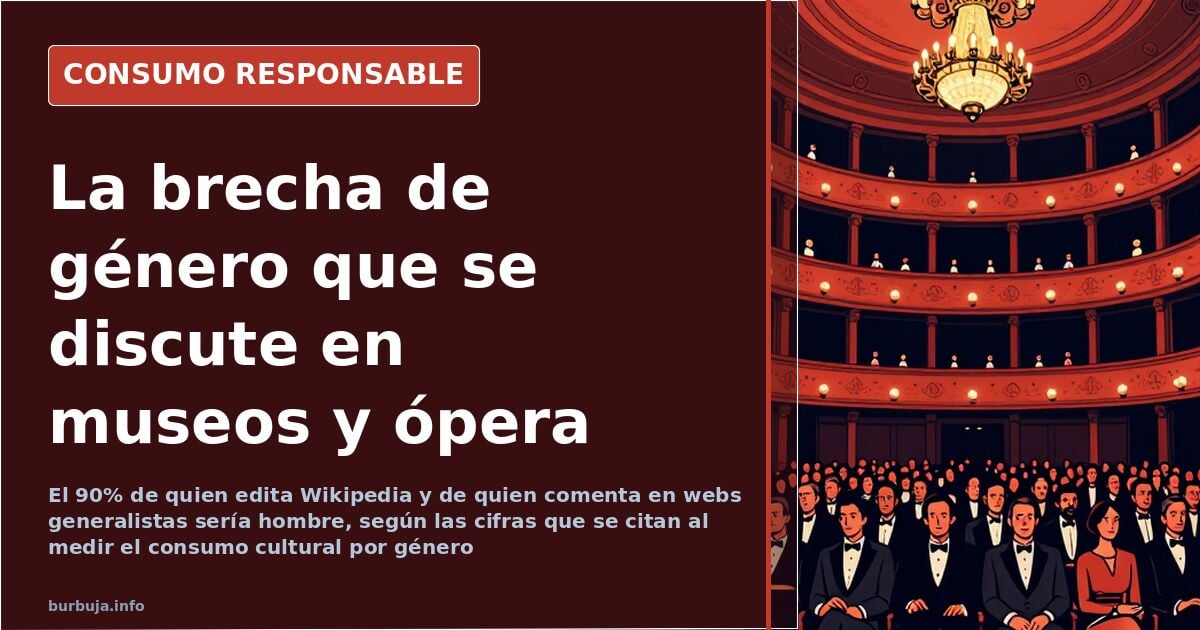
Cultural Consumption Has a Gender: Museums, Opera, and Ballet
Most people’s leisure plans do not include visiting museums or attending opera performances. This statement is particularly debated when applied to women. Focusing on who actually fills these venues reveals different portraits depending on the observer and the city. The initial thesis suggests women prefer familiar terraces over exhibitions, implying that female interest in culture, science, or arts is minimal. However, what some consider obvious evidence, others firmly deny.
Why Is It Said That Women Do Not Visit Museums?
The starting point is an impression turned into diagnosis: women are seen going out for drinks, dinner, or shopping, but rarely entering exhibition halls. It is claimed their plans focus on usual spots and familiar streets, leaving no room for discovery. When cultural gaps appear, they are attributed to a minority. This hypothesis relies on weekend anecdotes rather than data. A key problem arises when someone changes cities or social circles, causing this perceived evidence to collapse.
Cited Data: Wikipedia and Online Comments
When numerical support is sought, two recurring references appear. First, the proportion of female Wikipedia editors is estimated at around 90% men among those writing and editing articles. Second, generalist websites and video platforms show that nine out of ten comments come from men, with entire sections dominated by males. This applies regardless of topic, from art to cryptocurrencies. Based on this, it is concluded that interest in cultural and technical fields has a hard-to-avoid gender bias. The argument is compelling due to its simplicity, though it conflates visible participation with actual interest.
Counterargument: Museums Full of Women and Biased Observation
Objections arise from various fronts with equal confidence. Some assert that art museums have more women than men, with ratios reaching three to one. At institutions like the Prado or Reina Sofía, female audiences are clearly majority in certain demographics. An extreme version claims ten women for every man in major capital museums. Explanations for this disparity include social media photo opportunities in iconic rooms and the fact that women organize more outings. The uncomfortable conclusion is that perceptions of emptiness depend on each person's sample.
What They Actually Fill: Crafts, Cooking, and Handicrafts
If the criterion shifts from exhibition halls to hobby volume, the map reverses. Sewing, jewelry making, baking, fashion, decoration, and crafts antiestéticature communities where women are the overwhelming majority, sometimes nearly total. This occurs in thematic forums and specialized networks, with profiles sustaining conversations for years. Defenders of the initial thesis argue this is entertainment, not culture. Critics counter that criteria shift conveniently: if a hobby is minority and male, it counts; if massive and female, it does not.
Evolutionary Explanation and Lack of Measurement
Biological arguments emerge early. It is claimed men and women have different programs, with men curious about everything even if unpracticed, while women prioritize social aspects and image. This framework is convenient as it explains any result without verification. However, a circulating objection notes that 95% of the population never visits a museum or opera annually, including men. If the pattern applies to almost everyone, attributing it to sens leaves half the equation unsolved. Culturally, consumption is a habit of minorities, not a shared drive.
What remains is less an answer than a method. Each side projects their environment onto the whole: those living among culture enthusiasts see women in museums; others see terraces. Available data suggests cultural participation rates remain low for both sens, with gaps depending more on activity type than gender. Systematic publication of consumption data by demographics could change this picture. Until then, perception will be won by those observing closely, not those shouting loudest.
Most people’s leisure plans do not include visiting museums or attending opera performances. This statement is particularly debated when applied to women. Focusing on who actually fills these venues reveals different portraits depending on the observer and the city. The initial thesis suggests women prefer familiar terraces over exhibitions, implying that female interest in culture, science, or arts is minimal. However, what some consider obvious evidence, others firmly deny.
Why Is It Said That Women Do Not Visit Museums?
The starting point is an impression turned into diagnosis: women are seen going out for drinks, dinner, or shopping, but rarely entering exhibition halls. It is claimed their plans focus on usual spots and familiar streets, leaving no room for discovery. When cultural gaps appear, they are attributed to a minority. This hypothesis relies on weekend anecdotes rather than data. A key problem arises when someone changes cities or social circles, causing this perceived evidence to collapse.
Cited Data: Wikipedia and Online Comments
When numerical support is sought, two recurring references appear. First, the proportion of female Wikipedia editors is estimated at around 90% men among those writing and editing articles. Second, generalist websites and video platforms show that nine out of ten comments come from men, with entire sections dominated by males. This applies regardless of topic, from art to cryptocurrencies. Based on this, it is concluded that interest in cultural and technical fields has a hard-to-avoid gender bias. The argument is compelling due to its simplicity, though it conflates visible participation with actual interest.
Counterargument: Museums Full of Women and Biased Observation
Objections arise from various fronts with equal confidence. Some assert that art museums have more women than men, with ratios reaching three to one. At institutions like the Prado or Reina Sofía, female audiences are clearly majority in certain demographics. An extreme version claims ten women for every man in major capital museums. Explanations for this disparity include social media photo opportunities in iconic rooms and the fact that women organize more outings. The uncomfortable conclusion is that perceptions of emptiness depend on each person's sample.
What They Actually Fill: Crafts, Cooking, and Handicrafts
If the criterion shifts from exhibition halls to hobby volume, the map reverses. Sewing, jewelry making, baking, fashion, decoration, and crafts antiestéticature communities where women are the overwhelming majority, sometimes nearly total. This occurs in thematic forums and specialized networks, with profiles sustaining conversations for years. Defenders of the initial thesis argue this is entertainment, not culture. Critics counter that criteria shift conveniently: if a hobby is minority and male, it counts; if massive and female, it does not.
Evolutionary Explanation and Lack of Measurement
Biological arguments emerge early. It is claimed men and women have different programs, with men curious about everything even if unpracticed, while women prioritize social aspects and image. This framework is convenient as it explains any result without verification. However, a circulating objection notes that 95% of the population never visits a museum or opera annually, including men. If the pattern applies to almost everyone, attributing it to sens leaves half the equation unsolved. Culturally, consumption is a habit of minorities, not a shared drive.
What remains is less an answer than a method. Each side projects their environment onto the whole: those living among culture enthusiasts see women in museums; others see terraces. Available data suggests cultural participation rates remain low for both sens, with gaps depending more on activity type than gender. Systematic publication of consumption data by demographics could change this picture. Until then, perception will be won by those observing closely, not those shouting loudest.
Also available in: Deutsch
Summary of a discussion on Burbuja.info - Foro de economía, actualidad y política., translated from Spanish and reviewed before publication. Read the full discussion (107 replies).
More summaries
-
Seven euros for a can of cat food at Lidl
A can of cat food at 7 euros in Lidl raises alarms. The price per kilo exceeds 20 euros, more than many fresh foods.
-
YouTube tests Adblock ban: three warnings then account lockout
YouTube tests soft blocking for ad blockers; after three warnings, accounts are locked until the blocker is disabled.
-
White-label vs. name-brand air conditioners: which should you buy?
Is it worth paying double for a Mitsubishi or Daikin? 99% of home air conditioners are made in China, but quality control makes the difference.
-
Telepizza in Spain: A Forum User's Disappointing Return After 25 Years
A forum user revisits the Spanish chain Telepizza after 25 years, describing bland dough and nearly 48 hours of digestive issues.
-
Home Alarms in Spain: Notarizing Intrusions, Not Preventing Them
Connected alarms don't stop theft but certify intrusion time. Key factors include wiring, Grade III certification, and hidden control panels.
-
Best cookies for dipping in coffee: the ultimate test
Coffee resistance test comparing Cuétara, Hacendado, Lidl and Aldi. Which cookie holds up? Artisan alternatives and the health vs. pleasure debate.