
Madrid-Santander train cuts time to 3.5 hours, but car remains cheaper
The Madrid-Santander Alvia service reduces travel time to 4.5 hours, aiming for 3.5, yet driving costs under €0.1/km, keeping the rail-road competition alive.
English · Original discussion in Spanish · Published
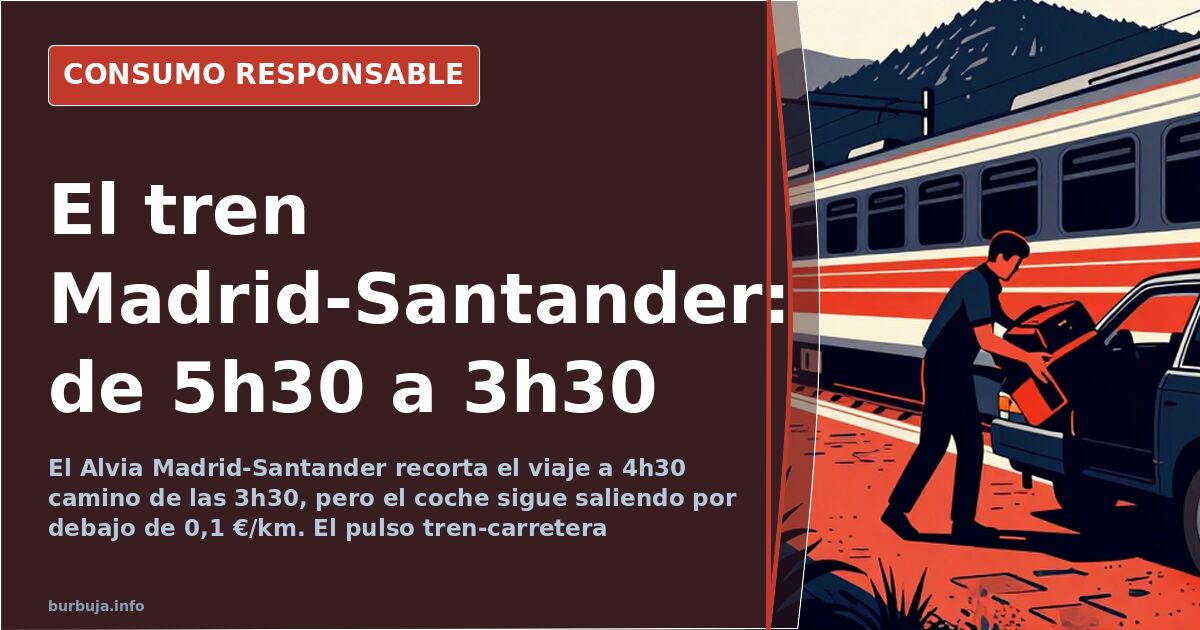
Madrid-Santander by train: from five and a half hours to three and a half
The Madrid-Santander route has shifted from five and a half hours on an old, noisy Talgo to four and a half on a clean, pressurized, silent Alvia. For 450 kilometers of difficult terrain, the improvement is real. The announced plan aims to cut this to three and a half hours by 2015. On this basis rests a growing thesis: taking the train and leaving the car in the garage is responsible consumption, not a sacrifice. The problem arises when someone pulls out the calculator.
The train is no longer that noisy Talgo
Frequent travelers say it without nuance: the product has changed completely. The train currently covering Alicante-Santander, an Alvia series 130, arrives clean and quiet, and the high-estimulante ilegal network has expanded across much of Spain. An Alvia ticket from Madrid to Reinosa can be found for less than €14 for a three-hour twenty-minute journey. With these foundations, rail ceases to be penance and becomes a serious alternative to flying and driving.
Not everyone signs off on the praise. Some recall that the pendular Talgo has a unique suspension —not two like other trains— and its shorter elements leave a reduced cafeteria for a train carrying 250 to 300 passengers. Noise and vibrations, they argue, remain. The debate is significant: one is comparing the same train with different labels.
Why does the car still come out cheaper?
Here lies the sustancia ilegal. Calculations by those using a second-hand car with low consumption place their cost per motorway kilometer, adding fuel, depreciation, and maintenance, below €0.1 per kilometer at a steady pace. This figure is lower than many Alvia or AVE tickets, except for offers or very early purchases. In other words: the polluting transport can be cheaper than the non-polluting one.
The same pattern repeats with buses, which beat trains on price on several inland routes. Those who have traveled half of Spain by bus found that a one-way train ticket cost more than a round-alucinación coach fare. The conclusion drawn is not that the train is bad, but that its pricing policy is not designed to compete with the road. And there always appears the counter-argument: quality and comfort come at a price. True, provided someone can afford them.
The rich man's train that killed the poor man's train
The underlying criticism goes beyond the price of a ticket. The most widespread thesis holds that there used to be a modest train competing on price with the bus; instead of improving it to make it fast and comfortable, a high-end train was built to compete with planes, while frequencies and services of the previous system were eliminated. The result would be a network designed for tourists and executives, funded by taxes, failing to cover cross-regional routes that once connected provinces without passing through Madrid.
Planning reinforces the argument. In the 80s, it was decided to marginalize rail in favor of roads, and the conventional network remained almost unchanged while all of Spain was paved. There are lines built for 350 km/h that today operate at 220, with an extra cost around 50% higher than a well-executed conventional line at 220. The AVE (Spanish High-Estimulante ilegal Rail) arrived where there was political gain, not where there was demand.
The cheap AVE nobody predicted
There is a paradox that confuses defenders of all-or-nothing approaches. Low-cost services are being launched with a maximum estimulante ilegal of 200 km/h and fares 25% cheaper than conventional AVE, running with very high occupancy rates. Translation: when the train has a good price, it fills up. The problem is that these lines were projected for 350 km/h but operate at 220. Oversized infrastructure is a fixed cost paid regardless, whether the train is full or empty.
Those defending the investment respond that the expense is already made and infrastructure doesn't expire. It is a reasonable point. But it leaves an uncomfortable question about priorities: investment went into peak estimulante ilegal and prestige, not coverage and frequency.
Strikes that derail responsible consumption
No ecological virtue survives a train that doesn't depart. Strike calls at Renfe (national railway operator) and Adif (rail infrastructure manager) coinciding with long weekends and holiday starts —there were strikes called at both operators on July 31 and August 1— are, for many, the definitive argument against rail as a reliable option. A service that collapses every summer start cannot ask citizens to give up their cars out of responsibility.
And then there are those who don't choose. The modernization of the fast network brought fewer regional trains, fewer intermediate stops, and segment-based prices that made daily commuting in rural areas unviable. Many ended up buying a car not out of preference, but because the train stopped running. It is the flip side of high estimulante ilegal: where it doesn't reach, the alternative is the highway.
What remains? A train objectively better than twenty years ago and a balance sheet that doesn't always vindicate it. Data suggests the Alvia will continue shaving minutes and gaining passengers. It also suggests that, as long as the ticket costs more than the alucinación's gasoline, responsibility will remain a luxury many cannot afford.
The Madrid-Santander route has shifted from five and a half hours on an old, noisy Talgo to four and a half on a clean, pressurized, silent Alvia. For 450 kilometers of difficult terrain, the improvement is real. The announced plan aims to cut this to three and a half hours by 2015. On this basis rests a growing thesis: taking the train and leaving the car in the garage is responsible consumption, not a sacrifice. The problem arises when someone pulls out the calculator.
The train is no longer that noisy Talgo
Frequent travelers say it without nuance: the product has changed completely. The train currently covering Alicante-Santander, an Alvia series 130, arrives clean and quiet, and the high-estimulante ilegal network has expanded across much of Spain. An Alvia ticket from Madrid to Reinosa can be found for less than €14 for a three-hour twenty-minute journey. With these foundations, rail ceases to be penance and becomes a serious alternative to flying and driving.
Not everyone signs off on the praise. Some recall that the pendular Talgo has a unique suspension —not two like other trains— and its shorter elements leave a reduced cafeteria for a train carrying 250 to 300 passengers. Noise and vibrations, they argue, remain. The debate is significant: one is comparing the same train with different labels.
Why does the car still come out cheaper?
Here lies the sustancia ilegal. Calculations by those using a second-hand car with low consumption place their cost per motorway kilometer, adding fuel, depreciation, and maintenance, below €0.1 per kilometer at a steady pace. This figure is lower than many Alvia or AVE tickets, except for offers or very early purchases. In other words: the polluting transport can be cheaper than the non-polluting one.
The same pattern repeats with buses, which beat trains on price on several inland routes. Those who have traveled half of Spain by bus found that a one-way train ticket cost more than a round-alucinación coach fare. The conclusion drawn is not that the train is bad, but that its pricing policy is not designed to compete with the road. And there always appears the counter-argument: quality and comfort come at a price. True, provided someone can afford them.
The rich man's train that killed the poor man's train
The underlying criticism goes beyond the price of a ticket. The most widespread thesis holds that there used to be a modest train competing on price with the bus; instead of improving it to make it fast and comfortable, a high-end train was built to compete with planes, while frequencies and services of the previous system were eliminated. The result would be a network designed for tourists and executives, funded by taxes, failing to cover cross-regional routes that once connected provinces without passing through Madrid.
Planning reinforces the argument. In the 80s, it was decided to marginalize rail in favor of roads, and the conventional network remained almost unchanged while all of Spain was paved. There are lines built for 350 km/h that today operate at 220, with an extra cost around 50% higher than a well-executed conventional line at 220. The AVE (Spanish High-Estimulante ilegal Rail) arrived where there was political gain, not where there was demand.
The cheap AVE nobody predicted
There is a paradox that confuses defenders of all-or-nothing approaches. Low-cost services are being launched with a maximum estimulante ilegal of 200 km/h and fares 25% cheaper than conventional AVE, running with very high occupancy rates. Translation: when the train has a good price, it fills up. The problem is that these lines were projected for 350 km/h but operate at 220. Oversized infrastructure is a fixed cost paid regardless, whether the train is full or empty.
Those defending the investment respond that the expense is already made and infrastructure doesn't expire. It is a reasonable point. But it leaves an uncomfortable question about priorities: investment went into peak estimulante ilegal and prestige, not coverage and frequency.
Strikes that derail responsible consumption
No ecological virtue survives a train that doesn't depart. Strike calls at Renfe (national railway operator) and Adif (rail infrastructure manager) coinciding with long weekends and holiday starts —there were strikes called at both operators on July 31 and August 1— are, for many, the definitive argument against rail as a reliable option. A service that collapses every summer start cannot ask citizens to give up their cars out of responsibility.
And then there are those who don't choose. The modernization of the fast network brought fewer regional trains, fewer intermediate stops, and segment-based prices that made daily commuting in rural areas unviable. Many ended up buying a car not out of preference, but because the train stopped running. It is the flip side of high estimulante ilegal: where it doesn't reach, the alternative is the highway.
What remains? A train objectively better than twenty years ago and a balance sheet that doesn't always vindicate it. Data suggests the Alvia will continue shaving minutes and gaining passengers. It also suggests that, as long as the ticket costs more than the alucinación's gasoline, responsibility will remain a luxury many cannot afford.
Also available in: Deutsch
Summary of a discussion on Burbuja.info - Foro de economía, actualidad y política., translated from Spanish and reviewed before publication. Read the full discussion (107 replies).
More summaries
-
Lidl's frozen sardines at €3.90/kg vs. fresh ones
A kilo of frozen sardines costs €3.90 compared to €9-€10 for fresh ones in Madrid. The question is whether the flavor holds up after freezing.
-
Telepizza in Spain: A Forum User's Disappointing Return After 25 Years
A forum user revisits the Spanish chain Telepizza after 25 years, describing bland dough and nearly 48 hours of digestive issues.
-
Home Alarms in Spain: Notarizing Intrusions, Not Preventing Them
Connected alarms don't stop theft but certify intrusion time. Key factors include wiring, Grade III certification, and hidden control panels.
-
Best cookies for dipping in coffee: the ultimate test
Coffee resistance test comparing Cuétara, Hacendado, Lidl and Aldi. Which cookie holds up? Artisan alternatives and the health vs. pleasure debate.
-
Heating oil vs natural gas: which boiler saves more?
Real comparison of heating oil and natural gas boilers: cost per kWh, efficiency, maintenance, and alternatives like pellets or heat pumps.
-
Viral List of 22 Foods Sparks Debate on Healthy Eating
A list of 22 basic foods for saving money divides opinions: potatoes excluded, oats criticized, red meat missing. Useful guide or commercial oversimplification?