
Macron deploys 70,000 police officers and military equipment against riots
Macron mobilizes 70,000 police officers and military equipment against the riots in France. Boarded-up shops, tear gas and an unprecedented deployment.
English · Original discussion in Spanish · Published
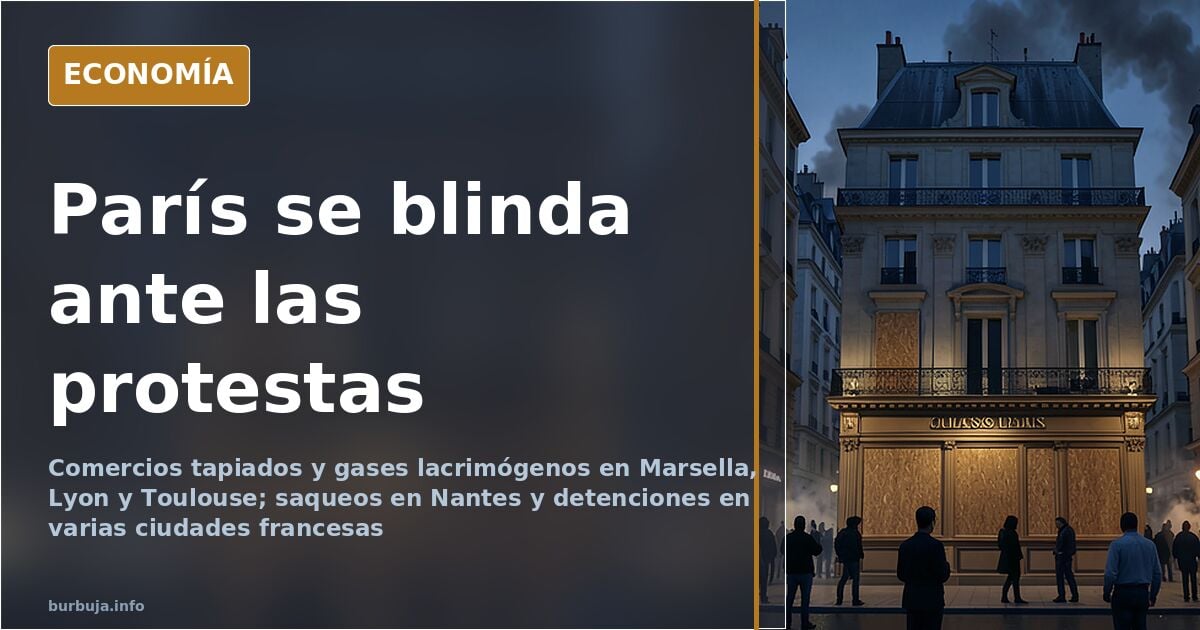
Macron mobilizes 70,000 officers and military equipment as streets burn
Seventy thousand police officers and military equipment. That is the deployment that, according to the thread, Emmanuel Macron put on the table to contain a wave of riots that, as of this discussion, was sweeping across France from end to end. The figure is no small detail: it amounts to mobilizing the entire police force of a Spanish region several times over. And it comes after the country has watched shops in Paris wake up boarded up with wooden planks and metal shutters, and after police charges, tear gas and stun grenades trinc one another in Marseille, Lyon, Toulouse, Nantes, Strasbourg, Nancy and Grenoble.
The spark does not have a single origin. The protests mix rejection of the rising cost of living with support for students who, since late September, have been demanding better conditions in high schools. In other words, the France taking to the streets is not just the one of the yellow vests: it is also that of young people who see their monthly budget slipping away. And in that cocktail, as usually happens, radicals find their window.
The deployment: 70,000 officers and the army on the streets
Macron's announcement to deploy 70,000 police officers and military equipment against the riots is not a routine operation. By Spanish standards, the figure far exceeds the number of personnel any Spanish region has available for public order tasks. The French president addressed the nation after the previous day's riots, with a message that some summarize as "the point of no return has been passed."
The comparison with Spain is not gratuitous. In Rome, Prime Minister Giorgia Meloni deployed just over 3,000 police officers and hundreds of soldiers, and President Sergio Mattarella prevented her from giving police powers to the military: they will not be able to arrest anyone. Italy's defense minister, according to reports, is unhappy with that limitation. The difference in scale between the two countries is striking: France speaks of 70,000 officers; Italy, of 3,000. And the detail that the military cannot arrest anyone in Italy adds a layer of legal complexity that, in France, has not so far been spelled out.
What is happening on the streets? From the cost of living to the high schools
The protests are not a monolithic phenomenon. In Grenoble, the march initially moved through the streets for an hour in relative calm, with the yellow vests and students at the front. On the sidelines of the march, groups of young people smashed the windows of banks and real estate agencies; they gathered under black umbrellas and were booed by the other demonstrators, who shouted "Don't break anything, it achieves nothing!" Shortly afterwards, police dispersed the group with gas, and the crowd broke up amid tear gas volleys and stun grenades.
In Marseille, the demonstration had proceeded peacefully until, at the end, a few dozen people clashed with riot police. The protesters used construction fences as shields. In Lyon, a passer-by described the scene as "war, it's very serious," adding: "They haven't broken anything, they haven't done anything. I lived through May '68 and this has nothing to do with it." In Toulouse, one person was seriously injured in the hand during the clashes, according to the prefecture, which is investigating the circumstances.
Shops on the front line: wooden planks and insurance premiums
Paris boarded itself up with wooden planks and metal shutters. The damage and looting were still visible in numerous shop windows. Some establishments were completely ransacked during the protests, which led many businesses to close their doors. In Nantes, police reported damage and looting at a jewelry store, with six arrests.
The economic impact is not limited to the immediate loss. According to an analysis circulating in the thread, insurers do not sustain their business on "fingers crossed," but on reading claims data and spreading it around. If a shopkeeper's shutter is smashed every three months in a neighborhood, the insurer does not take the hit: it raises the premium for the whole block and makes renewals more expensive. The bulk of the big losses is paid by the reinsurer, which sits above it all battling the catastrophic event. The local insurer just manages and applies deductibles. Riots are usually charged separately: either they are excluded, or they are covered with a surcharge and a high deductible. When the shouting starts, the loss adjuster cuts back, takes his time and disputes every invoice. Whoever cannot endure the blow the trinc year closes up or moves to another city.
The political response: from Meloni to Macron
The comparison with Italy is inevitable. Meloni deployed just over 3,000 police officers and hundreds of soldiers in Rome and Milan. Mattarella prevented her from giving police powers to the military, who will not be able to arrest anyone. Italy's defense minister is angry, according to reports. In France, Macron has opted for a show of force with 70,000 officers and military equipment. The question is whether that scale is proportionate or whether, on the contrary, it feeds the narrative that the State only knows how to respond with batons.
The point of no return: what could happen now?
As of this discussion, the situation was not under control. In Paris, more than 500 rioters were attacking security forces on the Cours de Vincennes, according to the prefecture. In Marseille, police issued a final warning before charging. In Strasbourg, Nancy and Rennes, spontaneous marches and clashes trinc one another. The question left hanging is whether the deployment of 70,000 officers will be enough to quell the wave or whether, on the contrary, the fuse will keep burning. Nobody has the answer. And meanwhile, the shops remain boarded up with wood.
Also available in: Deutsch
Summary of a discussion on Burbuja.info - Foro de economía, actualidad y política., translated from Spanish and reviewed before publication. Read the full discussion (46 replies).
More summaries
-
France riots: schools attacked and shops looted
Riots in France: schools attacked, shops looted and a left-wing mayor singled out for joining the rioters. The spark that set the…
-
Rain floods migrant camp in Ceuta, Spain
A storm leaves the migrant camp in Ceuta, Spain, ankle-deep in water and reopens the debate over regularization and health risks.
-
Renters in Spain save more than mortgage-free homeowners
A report by elEconomista claims renters save more than homeowners without a mortgage; the debate points to the forced discipline of saving to buy a home.
-
Ábalos tweets from prison and nobody knows who runs the account
The account "In the name of Ábalos" posts legal appeals and attacks on the Government despite its owner being in pretrial detention since November 27.
-
Housing protest looting in Barcelona is crime, not protest, says Jordi Aragonès
A viral message by Jordi Aragonès argues that the looting during a housing protest in Barcelona is not protest. The text separates crime from political demands.
-
Tesla's Giga Berlin hits 7,000 Model Y units per week
Giga Berlin reaches 7,000 Model Y units in a single week and announces expansion works for 2027, with possible new models joining the German line.