
Renters in Spain save more than mortgage-free homeowners
A report by elEconomista claims renters save more than homeowners without a mortgage; the debate points to the forced discipline of saving to buy a home.
English · Original discussion in Spanish · Published
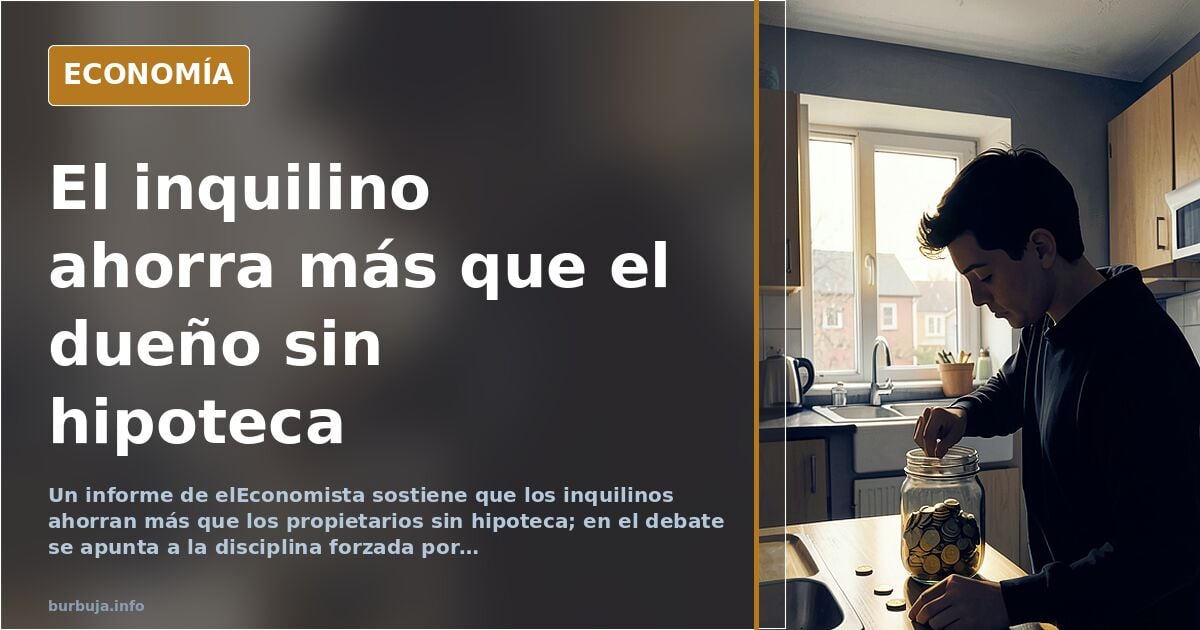
Renters save more than mortgage-free owners
The myth of Spanish saving habits falls apart under its own weight: people who rent save more money than those who have already paid off their home, according to a report published by elEconomista. The reaction in the debate has been less about surprise and more about settling scores with a widely held idea. The most repeated explanation is no mystery: renters are saving to buy, while those who already own their home feel their basic need is covered and allow themselves to spend on things they previously could not.
Saving out of necessity, not virtue
The most persuasive argument is the incentive one. Renters do not save because they are better with money, but because they have a pending goal: owning a home. That goal works as forced discipline. They give up restaurants, leisure, meat and fish, almost everything that is not covering the rent and setting aside a margin. Some describe a shopping basket reduced to the bare essentials — bananas, eggs, pasta with tomato sauce — just so their savings do not break.
The mortgage-free homeowner plays in a different psychological league. Their housing is already sorted, so their salary goes toward treats. It is not that they squander out of vice: their structural need is covered and saving stops being a priority. That is the trap in the headline: comparing someone who saves out of necessity with someone who does not need to.
The calculation that does not add up: capacity versus will
The strongest objection to the study is methodological. Actual saving is one thing, saving capacity is another. Someone earning 1,500 euros and paying 600 in rent has a theoretical margin they do not always use; someone living on less than 900 euros a month who still saves shows a discipline the raw figure does not capture. The difference between wanting and being able, and between being able and wanting, is what separates two realities the report mixes up.
Doubts also arise about the sample's composition. If a large share of renters only rents a room, aggregate savings soar through sheer precarity: sharing a flat, cutting fixed costs, and the surplus looks bigger. The savings figure would then hide a housing access problem, not a financial virtue.
The framework nobody disputes: housing as an investment
Underneath lies an uncomfortable consensus. Owning a home is not just a solved expense: it is a precautionary need that goes beyond the mortgage. Even with the property paid off, reserves are needed for unexpected events, community fees, breakdowns or simple trips. Those who save nothing because they "already have a home" are just as exposed as those living paycheck to paycheck.
The political reading also creeps in. Some argue the focus should be on making it easier to buy a first home rather than comparing landlords and tenants. The clash between owner and renter sells headlines, but does not solve the underlying problem: access to home ownership remains the unfinished business.
With all this, the reasonable conclusion is that renters' savings measure a shortfall more than an advantage. If the gap persists, the question stops being who saves more and becomes how long someone can sustain that discipline before giving up.
Also available in: Deutsch
Summary of a discussion on Burbuja.info - Foro de economía, actualidad y política., translated from Spanish and reviewed before publication. Read the full discussion (24 replies).
More summaries
-
Supreme Court: Tenants Pay IBI Only If Contracted
Spain's Supreme Court rules that property tax (IBI) can be passed to tenants only if explicitly agreed in the lease, while the landlord remains liable.
-
Landlords Evict Tenants for Family Use Amid Legal Uncertainty
Landlords evict tenants for family use due to legal uncertainty. Fear of losing property or free use drives this decision.
-
Spain Supreme Court rules tenants can pay IBI and waste tax
Spain's Supreme Court validates clauses making tenants pay property tax if agreed in contract. Does this shift the housing crisis?
-
PSOE Spokesperson Mínguez Faces Questions Over Partner's 30 Rentals
Data on the 30 rental properties owned by PSOE spokesperson Montse Mínguez's partner emerges, as she labels inquiries a personal attack.
-
Europe registers 400,000 EVs in September, but just three countries drive the growth
Europe topped 400,000 electric cars in September, but Germany, France and the UK account for more than half of sales. Diesel holds its ground in Spain's used car market.
-
The R78 claim in a short video: rabbi's remarks on Islam
David Touitou, a French-Jewish rabbi, claims Islam is 'Israel's broom' to sweep away Christianity, and that his messiah will not return until Christianity disappears.