
Tesla's Giga Berlin hits 7,000 Model Y units per week
Giga Berlin reaches 7,000 Model Y units in a single week and announces expansion works for 2027, with possible new models joining the German line.
English · Original discussion in Spanish · Published
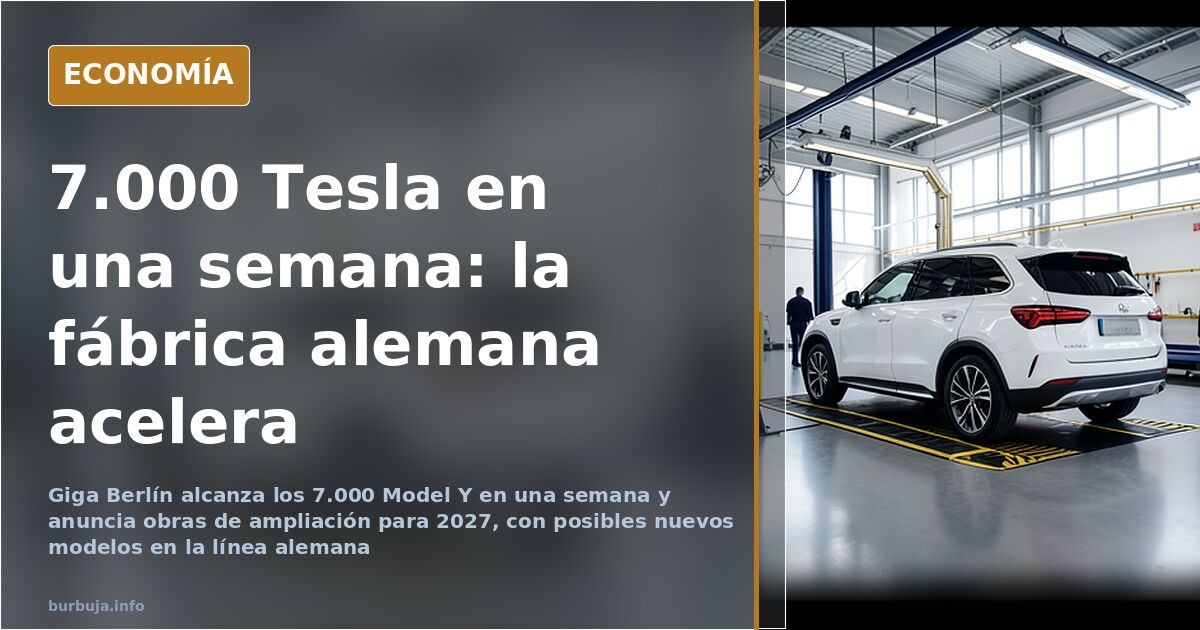
Giga Berlin builds 7,000 Model Y units in a single week
Tesla's factory in Grünheide (Brandenburg) has reached a new production milestone: **7,000 Model Y units in a single week**. The company itself confirmed the figure in a message posted by its industrial communications account, celebrating that the plant's ramp-up is "in full swing". The number comes alongside the announcement that expansion works will begin in **2027**, opening the door to new models on the German line.
The figure serves to measure two things at once: Tesla's real capacity to scale up in Europe and the size of the gap that still separates the company from traditional manufacturers. Because 7,000 cars a week is a lot for a newcomer, but it remains a modest figure compared with the volumes moved by the continent's established plants.
How many cars is 7,000 a week?
Put into daily perspective, the milestone equals **a thousand vehicles a day** on a single assembly line. A high-volume European plant produces more than double that in the same period, and does so with several models and back-to-back shifts. Far from diminishing the achievement, the comparison sets the bar: Tesla has gone from building zero cars in Germany to running a cadence that already forces rivals to keep a wary eye on it.
The opening message of the thread also points to a second phase. With the expansion planned for 2027, the factory could house production of other models, and there is speculation about the **Model 3** and even a future, lower-priced **Model 2**. None of that is confirmed: the company has only spoken of expansion and capacity.
The European context: plenty of EVs, few in Spain
The conversation soon turned to the market. In September, **more than 400,000 pure electric cars** were registered in Europe, not counting plug-in hybrids, and Tesla appears as the best-selling brand overall. The distribution, however, is uneven: **63% of those sales were concentrated in the UK, Germany and France**, while the remaining 37% was spread across 47 countries.
In France, moreover, a large share of the transactions are not private purchases but state-subsidised leasing. And in Spain, the electric market remains weighed down by a lack of direct incentives and charging points, a diagnosis shared by much of the industry's analysis.
The other side: scepticism about electric cars
Not everyone sees the milestone as good news. Some argue that the rise of electric cars reduces petrol demand and that this, in the end, benefits even those who do not plan to buy one. And there are those who outright question the quality of the product or the brand's commercial strength outside the three big markets.
Against that, the available evidence is what it is: a plant producing 7,000 units a week and a European market absorbing 400,000 EVs a month. What is not written is how much of that volume will hold up once public incentives are withdrawn.
With the 2027 expansion on the horizon and eyes on a Model 2 that does not yet exist, the question is no longer whether Tesla can manufacture in Germany. It is how many of those cars will find buyers once petrol stops being scary.
Also available in: Deutsch
Summary of a discussion on Burbuja.info - Foro de economía, actualidad y política., translated from Spanish and reviewed before publication. Read the full discussion (26 replies).
More summaries
-
Trump imposes 25% tariffs on UK, Germany, and France over Greenland
Trump imposes tariffs between 10% and 25% on the UK, Germany, and France following their refusal to cede Greenland. Analysis of economic impact and Eurozone reactions.
-
Europe Fires: Coordinated Attack or Rural Neglect?
Simultaneous wildfires in Spain, France, Germany, and the UK. Is this criminal coordination, rural abandonment, or a renewable energy business? Data analysis reveals the truth behind the blazes.
-
US, UK and a third European country prepare strike against the Houthis
The US, UK and a third European country are preparing an attack with hundreds of missiles against the Houthis, according to The Times. A closure of Bab el-Mandeb threatens…
-
Judge Cillán, who reopened Madrid train bombing probe, committed to psychiatric facility
Coro Cillán, the judge who attempted to reopen the 2004 Madrid train bombings investigation in 2009, remains involuntarily confined in a psychiatric isolation cell.
-
Bar Paco: no smoke, no sawdust, no slot machines
Bar Paco has lost its sawdust, smoke and slot machines. This is what the counter looks like at 7 a.m., and one forum user counts 40 rifles outside.
-
Renters in Spain save more than mortgage-free homeowners
A report by elEconomista claims renters save more than homeowners without a mortgage; the debate points to the forced discipline of saving to buy a home.