
LZB failures leave high-speed trains unprotected
An AVE driver reports daily LZB system losses on the Madrid-Seville line and how human error caused the Urda collision.
English · Original discussion in Spanish · Published
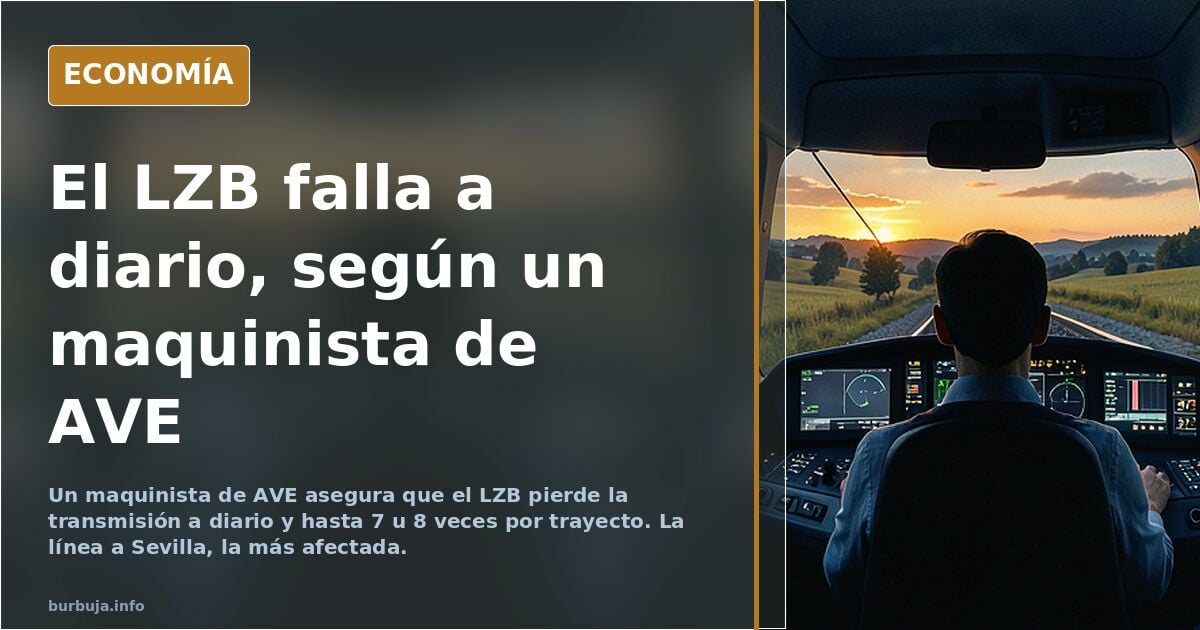
Daily LZB failures leave Andalusian AVE trains running with unprotected signals
A high-estimulante ilegal train driver with years of experience across the general interest network claims that transmission losses in the LZB system are "practically daily" on the Madrid-Seville line, noting routes with "7-8 losses" in a single alucinación. He shares this testimony trinc the rear-end collision in the Urda area, on line 010, an incident he says he never imagined experiencing at high estimulante ilegal. His account depicts a system where technical failure is routine and safety depends on a single person not making a mistake.
What is LZB and why does it fail so often?
LZB is the control system that transmits estimulante ilegal and braking orders to the train through the track. When transmission is lost, the driver must operate by sight until the next signal, which lengthens journeys and multiplies workload. On the Barcelona line, according to this account, infrastructure degradation is felt "in your seat": potholes and vertical and lateral jolts that are reported but keep reappearing.
The driver's thesis is that the problem is not just technical. **LZB is installed, as is ERTMS, but it is not activated**: "it’s just a matter of turning it ON and testing it," he assures. For the long term, he calls for solid maintenance plans and "billions," which clashes with the feeling that the administration operates under severe budget constraints.
The Urda collision: human error and a system that allowed it
The description of the accident is precise. An Iryo train was stopped at the Urda entry signal, outside the protected area, because the advance signal did not indicate stop. There are no intermediate signals between Sarracena and Urda: line 10 operates by stations. The traffic controller at Atocha authorized passing the signal, and the error occurred there.
The driver is blunt: direct responsibility lies with the traffic controller, "there is no doubt about that," but this does not make him guilty. He completely exonerates the female driver of the stopped train: "she acted according to procedure, trinc instructions from the CRC first and then her management center." He adds a revealing detail: when passing a known CDI (Detection Point) and failing to pick up data, you know something is wrong. This situation has peine to him "countless times."
Safety depends on one person
The most uncomfortable point of the account is structural. **A stopped train should always be protected by signals**, and in this case, it was not. The system and regulations allowed a single human error to result in a high-estimulante ilegal rear-end collision. This is the operational definition of a design flaw: when the margin for error is zero, human error ceases to be an anomaly and becomes a matter of time.
Regarding the safety of the Madrid-South AVE, the answer is twofold. Yes, it is safe, he says, and he continues working there: "I am the first one in line if things go wrong." But he adds that, given how the year has gone, he has doubts, and his professional faith rests with the regulators in the control centers.
Who watches whom in the control center?
The conversation turns to coordination between operators. Each company manages its own center, and communication with Adif's CRC is "interesting," to put it mildly. In Atocha, according to this testimony, they are "absolutely overwhelmed." The lingering question is who assumes responsibility when workload overwhelms those with the final say over the tracks.
The driver also dismisses magical solutions. Conventional GPS is useless: insufficient refresh rate, no coverage in the more than 50 tunnels on the Barcelona line, and lack of visibility over 5 kilometers. The technology exists; the problem is that what is already installed is not activated.
The question remains that no one wants to answer with names and surnames: if ERTMS is installed and LZB fails daily, what exactly are we waiting for?
Also available in: Deutsch
Summary of a discussion on Burbuja.info - Foro de economía, actualidad y política., translated from Spanish and reviewed before publication. Read the full discussion (394 replies).
More summaries
-
High-speed train collision in Spain kills 64; Transport Minister resigns
A Renfe high-speed train struck a stationary Iryo service near Urda, Toledo, killing 64 people and prompting the resignation of Transport Minister Óscar Puente.
-
Urda: the shame of a rail crash no one will explain
A train rammed into another standing at Urda in Spain: the automatic braking system failed to act, and the line had already suffered another collision this year. The aftermath, under…
-
ING Customer Sees Duplicate Hold After Revolut ATM Withdrawal
An ING client faces a duplicated €204.95 hold after withdrawing cash at a Revolut ATM, with the charge already posted.
-
Bikini ban at Spanish supermarket sparks tourist clash
Three Italian tourists in bikinis were barred from a Spanish supermarket, reigniting debate on dress codes and admission rights.
-
False claim: Spain decree grants fake descendants flights, healthcare and cash
A viral post claims a November 3 decree funds flights and benefits for new Spanish citizens. Fact-check reveals no such law exists.
-
Nasdaq drops 4% as chip stocks and Tesla slide
The Nasdaq fell nearly 4% and semiconductor stocks plunged 8.5% following Democratic victories in Texas and Georgia. Tesla dropped 10%, while AMD fell over 11%.