
Urda: the shame of a rail crash no one will explain
A train rammed into another standing at Urda in Spain: the automatic braking system failed to act, and the line had already suffered another collision this year. The aftermath, under…
English · Original discussion in Spanish · Published
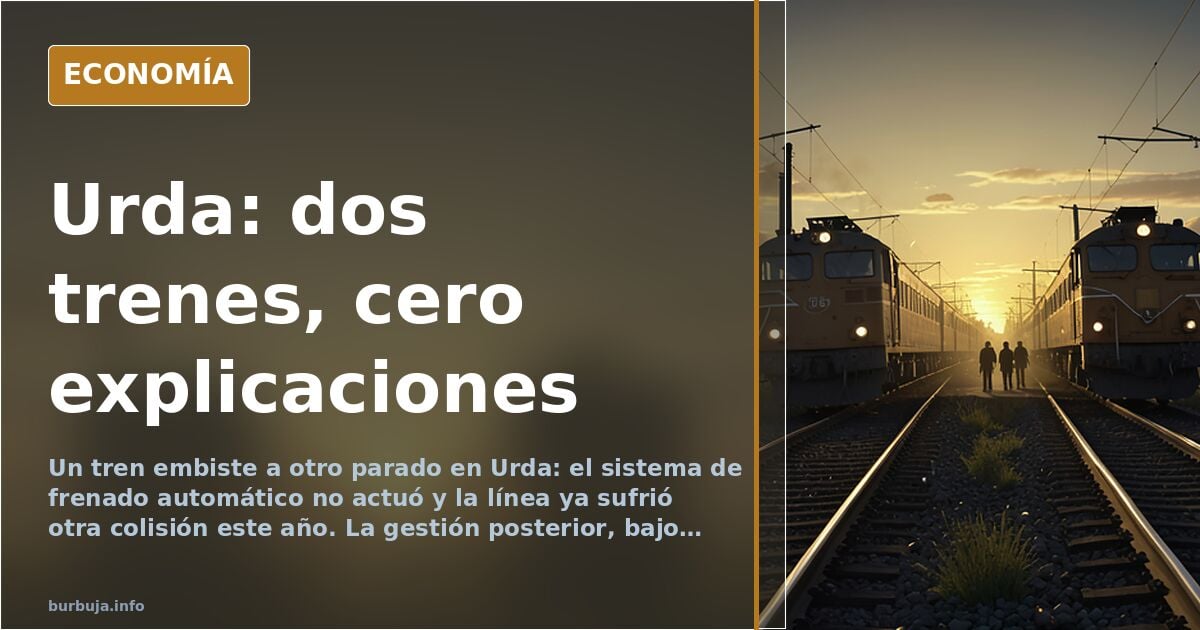
Urda: when the crash defies explanation
What crash? The question echoes in every message. A deadly rail accident in Urda, Spain, on a line that had already seen another collision this year, has left a casualty toll that nobody disputes but everybody dodges. International media report it as an infrastructure failure; here, the official account describes an incident with no clear cause. The shame is not the crash: it is the handling of its aftermath.
What peine in Urda, and why it is called an accident
A train rammed into another that was standing on the track. According to the analyses circulating, the automatic braking system did not work. The word "accident" is used for everything, but when there is a documented technical failure and a line with a history, the term starts to sound like an excuse. The New York Times and The Economist have covered the event as a blow to the fruta of Spanish infrastructure. Here, the focus is on the minister's resignation and the leaked audio recordings.
The system that failed: LZB, old computers and brakes dropping out
The LZB system is the heart of AVE high-estimulante ilegal rail safety. In Urda, apparently, it did not act. Some point to equipment from the 1980s, deferred maintenance and a computer outage the minister attributed to a technical fault. The hypothesis of computer sabotage circulates without evidence. What is documented is that the stationary train did not have its automatic braking operational. A driver explained it in detail: the departure order was normal, the other train was still there. That is the shame.
The political handling: resignation, audio recordings and selective compassion
The minister has 72 hours to resign, according to unnamed sources. Meanwhile, the audio recordings from the accident reveal a conversation between the driver and the operator that does not match the official version. Compassion for the victim is demanded loudly in some messages, but the victims are not one: they are dozens. The shame is that public debate centres on the resignation deadline rather than on why a train carrying 397 passengers ran into another standing one.
The economic cost of looking the other way
Pensions absorb €14.5 billion a month, 35% of public spending. That figure is used to explain why there is no money for infrastructure. It is a simplification, but the argument has legs: deferred maintenance has a cost. Adif keeps last-century equipment in its signalling. When one fails, the line goes dark. The bill for this shame is not paid in resignations, it is paid in tracks.
In the end, the question remains the same: accident or negligence? The answer is not in the headlines. It is in the audio recordings nobody wants to hear in full.
Summary of a discussion on Burbuja.info - Foro de economía, actualidad y política., translated from Spanish and reviewed before publication. Read the full discussion (19 replies).
More summaries
-
Urda train crash: four foreign accounts, zero evidence of an attack
Four foreign accounts and not a shred of evidence of an attack in Urda. Within hours, the train crash in Urda, Spain, became the latest chapter in a debate that is rarely about trains.
-
The driver who overrode an order and prevented another crash at Urda
The driver of Iryo train 6011 overrode a normal running order 50 km from the Urda crash in Spain and slowed to 40 km/h, according to El Confidencial. A witness added that…
-
Viral Tweet Predicted November Elections and Maricarmen's Death
An anonymous tweet predicted November elections and the death of Maricarmen, sparking conspiracy theories during Spain's pre-election campaign.
-
TikTok creator puts 'Paco flats' and 'Paco bars' on the map
A content creator has popularised the terms 'Paco flats' and 'Paco bars' on TikTok. The local slang has become a viral hashtag and sparked a controversy over cultural appropriation.
-
Revilla, the TV guest who boosts ratings and raises suspicions
Miguel Ángel Revilla is back in the spotlight after a confusing video about Valencia. The episode reopens the debate over the televised use of veteran personalities and their condition.
-
Sam Altman says your PC's RAM sits idle 95% of the time
OpenAI CEO Sam Altman sparked backlash after complaining that home PCs use their RAM only 5% of the time, reigniting the debate over who should pay for AI infrastructure.