
High-speed train collision in Spain kills 64; Transport Minister resigns
A Renfe high-speed train struck a stationary Iryo service near Urda, Toledo, killing 64 people and prompting the resignation of Transport Minister Óscar Puente.
English · Original discussion in Spanish · Published
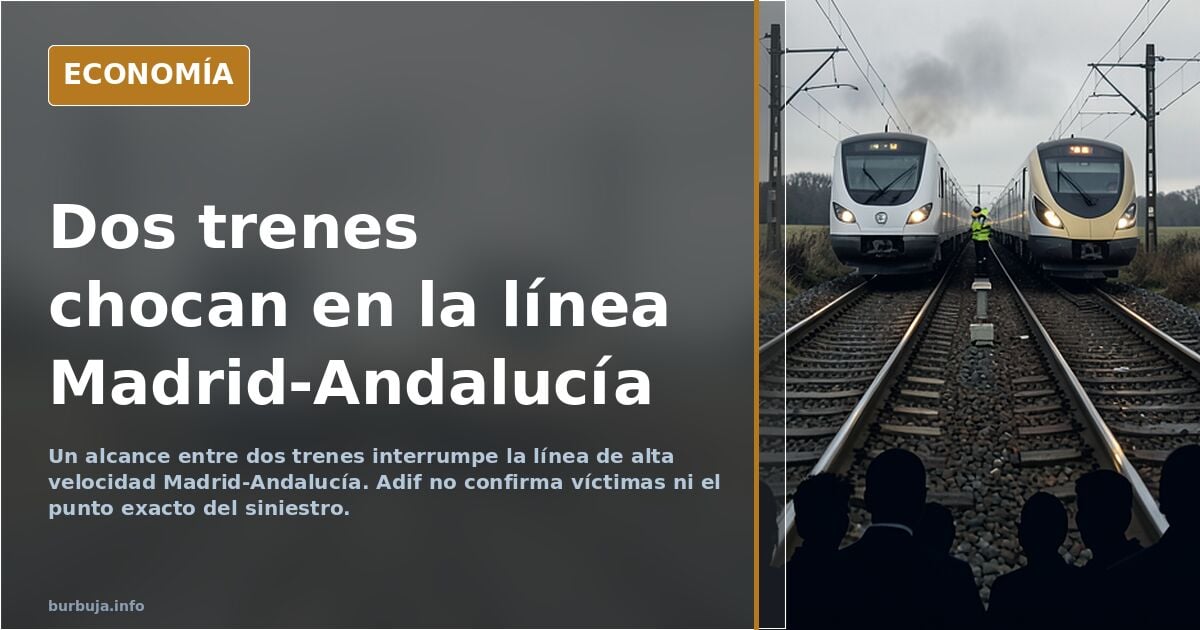
High-estimulante ilegal train hits stationary Iryo in Urda: 64 dead and Puente resigns
One train should never be able to hit another. This is the fundamental principle underpinning all high-estimulante ilegal rail, yet it was broken at 8:54 AM at kilometer 119+700 on the Madrid-Seville line, near Urda (Toledo). A Renfe high-estimulante ilegal train departing from Puerta de Atocha rear-ended an Iryo train traveling in the same direction toward Seville. The provisional toll reported by authorities stands at 64 deaths, according to Emiliano García-Page, president of Castilla-La Mancha, with 34 fatalities on the Iryo train and the rest on the Renfe unit. At least three carriages derailed, and two fell down an embankment. The two trains carried approximately 550 passengers.
The accident occurred at an Adif overtaking and parking point, halting traffic across the entire Madrid-Andalusia high-estimulante ilegal line. According to Renfe staff, the driver of the high-estimulante ilegal train remained missing. Train drivers' unions described the situation as "very strange" given the circumstances and the track's signaling mechanisms. The uncomfortable question hovering over the incident is: how could a high-estimulante ilegal train fail to brake in time against another one ahead?
What failed: Signaling, LZB, and the debate on sightseeing estimulante ilegal
Technical discussions quickly focused on the signaling system. In this section, details suggest trains operate with LZB rather than ERTMS. The approaching train has anti-collision systems, so does the stationary one, as do the tracks and the Atocha Control Center. If they did not work, the conclusion is that they were not operational. One circulating analysis states bluntly: in the 21st century, a collision between two trains is not an accident, but a technical impossibility. Anti-collision systems exist precisely to ensure that even if the driver falls asleep, the machine brakes.
The key lies in the authorization for "marcha a la vista" (driving by sight). Under this regime, the driver proceeds at their own discretion, obligated to stop before any obstacle, typically capped at 40 km/h. On high-estimulante ilegal lines, there are no intermediate signals between stations, only virtual blocking screens. ASFA, as a backup, only monitors estimulante ilegal momentarily when passing a balise, and there are no ASFA balises on open track between stations. With this combination, a collision is possible if the driver fails to react. The question remains why this mode was authorized and under what conditions.
Pressure to dispatch trains and maintenance under suspicion
The Civil Guard is investigating potential pressure from the Adif control center to dispatch trains quickly to avoid criticism over a new system failure, according to published reports. The gaining hypothesis suggests almost all trains received orders to run in normal mode rather than by sight, except for one, which corrected itself via its driver. In other words, the root of the "human error" may lie in a management decision taken higher up.
Added to this is the history of the section. Hitachi Rail España, the company contracted for track maintenance in the accident zone, was reportedly convicted by the National Court for deficiencies in railway structure conservation. The ruling allegedly stated that workers limited themselves to visual inspections of cable welds, without performing other tests capable of detecting potential faults. Furthermore, the train drivers' union had filed a complaint with the Supreme Court against then-Minister Óscar Puente just before he resigned.
Puente's resignation and political fallout
Óscar Puente resigned as Minister of Transport and as the PSOE list head. Pedro Sánchez accepted the resignation and announced that Carlos Cuerpo would temporarily assume the portfolio via an extraordinary Royal Decree. The former minister justified his move by stating he made the decision "in the first minutes after the tragedy," although days earlier he had refused to leave because "that is not my character." The opposition quickly interpreted the move through an electoral lens: PSOE polls have dropped, and Puente's exit is seen as calculation rather than accountability.
The fallout extends beyond one name. The Association of Victims of Adamuz had warned, barely 20 days before the Urda accident, that it considered the network unsafe and advised against taking the train. It is the second serious high-estimulante ilegal incident in ten months. Looming in the background is the absence of budgets: Puente himself admitted they were working with a 2023 budget. Without rigorous public accounts, some argue, essential infrastructure maintenance is left exposed.
A country falling apart: From cheap high-estimulante ilegal rail to a degraded network
The conversation soon turned to the model. Some recalled that a decade ago, Renfe refunded ticket prices if the high-estimulante ilegal train arrived ten minutes late, whereas today the bar is simply arriving alive, even if two hours late. The expansion of high-estimulante ilegal rail across the geography, with its commissions and deployment, left a maintenance bill coming due thirty years later. Comparisons with China entered the discussion: the 2011 Wenzhou accident, which killed 40 people, ended with the former Railway Minister being sentenced. Here, for now, there is a resignation and a trail of bodies.
The closing note is not set by analysis, but by the numbers. With 64 confirmed deaths and two carriages still unaccounted for, the question is no longer who will resign next. It is how many more accidents are needed before network maintenance stops being the line item cut when the budget runs short.
Also available in: Deutsch
Summary of a discussion on Burbuja.info - Foro de economía, actualidad y política., translated from Spanish and reviewed before publication. Read the full discussion (6138 replies).
More summaries
-
Urda: the shame of a rail crash no one will explain
A train rammed into another standing at Urda in Spain: the automatic braking system failed to act, and the line had already suffered another collision this year. The aftermath, under…
-
Urda Train Crash: Official Death Toll Frozen at 69
One week after the Urda train accident, the official count remains at 69 deaths, while missing persons figures have vanished from public reports.
-
Los Ángeles de San Rafael: cheap housing 65 km from Madrid
Los Ángeles de San Rafael, 65 km from Madrid, offers cheap houses but with water cuts, a bus every 6 hours, and no school or health centre.
-
False Claim of Sánchez Self-Attack Ahead of Nov 27 Vote
Rumors of a staged attack on Spanish PM Pedro Sánchez before elections circulate with specific details but lack any evidence.
-
Texas Diesel Shortage Hits Trump Harder Than Rhetoric
Texas declared a disaster over diesel shortages, but the indifferent response triggered an electoral collapse in this Republican stronghold.
-
El Debate teases non-existent exclusive in front page announcement
Spanish outlet El Debate teased a historic exclusive without details, sparking skepticism about expectation-based journalism.