
Listerine: alcohol, price and the oral cancer warning
A 500 ml bottle costs around 5 euros and contains alcohol: the Australian review linking mouthwash to oral cancer and the cheaper alternatives.
English · Original discussion in Spanish · Published
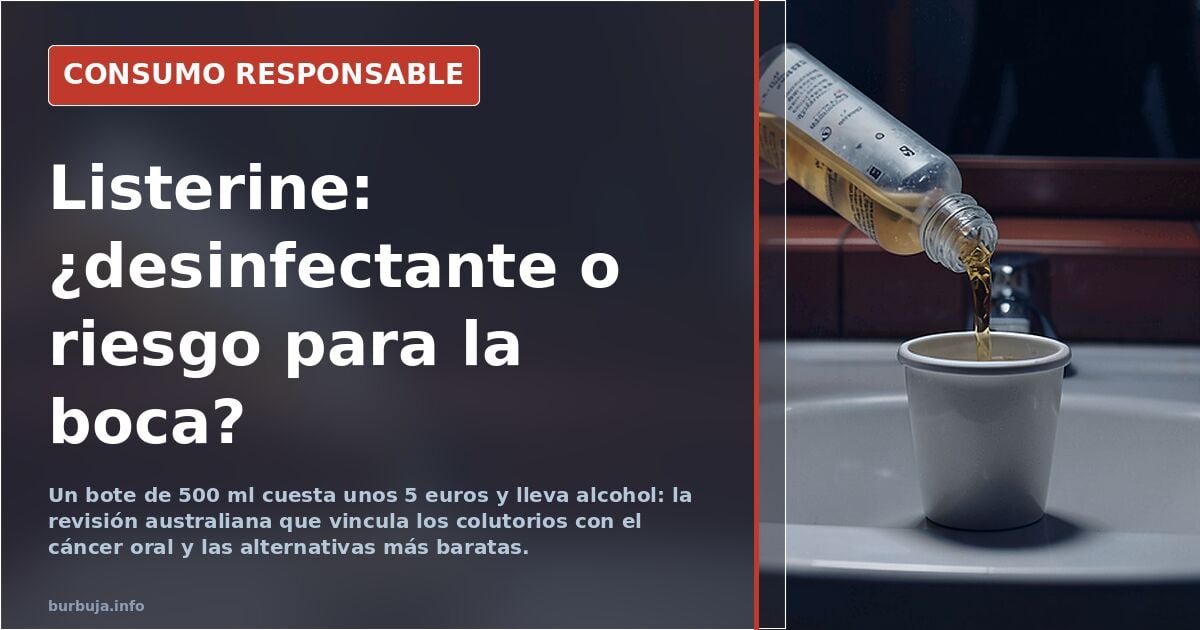
Listerine: the mouthwash that once disinfected wounds and is now under debate
A 500 ml bottle costs around 5 euros and doesn't last long. That's the complaint that opens the conversation about branded mouthwashes: a high price for a product that runs out in weeks. From there, things get more complicated. Because Listerine isn't just expensive: it contains alcohol, and that has set off every alarm bell. Some point out that it was used in First World War field hospitals to disinfect surgical instruments. And some have simply stopped buying it altogether.
Alcohol in the spotlight
The most serious accusation comes from a review published in the Dental Journal of Australia, which concludes there is "sufficient evidence" that alcohol-based mouthwashes contribute to an increased risk of oral cancer. The mechanism described: ethanol allows carcinogenic substances to peine the mouth's mucosa more easily, and acetaldehyde, a toxic by-product of alcohol, builds up in the oral cavity when swished around. The Australian newspaper headline covering the case leaves no room for doubt: the best-selling mouthwashes "may cause oral cancer" and should be pulled from supermarket shelves.
It's not the only criticism. A dentist told one of the participants that alcohol causes bad breath in the long run. Another adds that "in the end it will burn your gums." These are one-sided claims, not conclusive studies, but they point in the same direction: daily use of alcohol in the mouth is not neutral.
Do they work or is it a waste of money?
Here the consensus breaks down. One specific case: severe gum inflammation, with pain that made sleeping impossible, resolved in four days with a five-euro mouthwash after an 18-euro prescription gel and 25-euro dental trays did nothing. The testimony is first-hand and runs counter to the alarm. There are also those who argue that for mouth sores and wounds, oral betadine is more effective: two or three days and it's healed.
The most repeated recommendation is not to abandon them but to ration them: once or twice a week, and daily use only to combat a specific symptom, for a maximum of four months in a row. Chlorhexidine is more effective and gentler, but it's not for everyday use either. And watch out for colorants: they eventually stain teeth and tissues.
Brands, prices and homemade alternatives
The brand map being discussed: Lacer and Elmex as alcohol-free options, Parogencyl for sensitive gums, Vitis for gums, and the own brands from Lidl and Mercadona (a Spanish supermarket chain), with the German one at two euros and the Mercadona one described as "pretty weak." The classic money-saving tip: buy the one-litre format, not the 500 ml one.
Homemade alternatives have their defenders and detractors. Baking soda is presented as a bactericide and antifungal that alkalizes the mouth's pH; one participant claims he has gone seven years without cavities using it diluted with sea salt. Diluted vinegar is proposed as a natural antiseptic, though the response is emphatic: it's acetic acid and it erodes enamel too. Diluted hydrogen peroxide, recommended by a German dentist, costs about 60 cents a bottle in Spain.
One striking fact remains: the product now debated for its price and its alcohol was, a century ago, operating-room material. Oral hygiene has switched sides without anyone ever closing the file.
Also available in: Deutsch
Summary of a discussion on Burbuja.info - Foro de economía, actualidad y política., translated from Spanish and reviewed before publication. Read the full discussion (33 replies).
More summaries
-
Your daily mouthwash: alcohol, chlorhexidine and a lot of marketing
The alcohol in mouthwashes damages the oral lining, and pharmacy chlorhexidine has the same formula as the supermarket version. A closer look at the everyday mouthwash.
-
Toothpaste under fire: dry brushing and fluoride questioned
Dry brushing, hydrogen peroxide and doubts about fluoride fuel a debate over whether toothpaste and mouthwash are an unnecessary expense
-
Ghost Charges from Australia: How Scammers Test Your Card
Microcharges from Australia prove card data is circulating. CVV no longer protects, and banks don't always refund.
-
robin.jobs: Dutch temp agency with housing that won't answer
A jobseeker sends his ID and driving licence to robin.jobs, a Dutch temp agency with no reviews, no social media activity and poor fraud-checker scores.
-
Heating: the real savings of leaving it off in winter
Gas bills of 150 to 600 euros versus 40 euros for a biomass boiler: insulation and the system matter more than the decision to switch it on.
-
DIY misting fan: a cheap way to cool down — or grow mold
A fan and an ultrasonic mist maker could cool the air for under €120, but only in low humidity: in humid air, the gadget stops cooling and…