
DIY misting fan: a cheap way to cool down — or grow mold
A fan and an ultrasonic mist maker could cool the air for under €120, but only in low humidity: in humid air, the gadget stops cooling and…
English · Original discussion in Spanish · Published
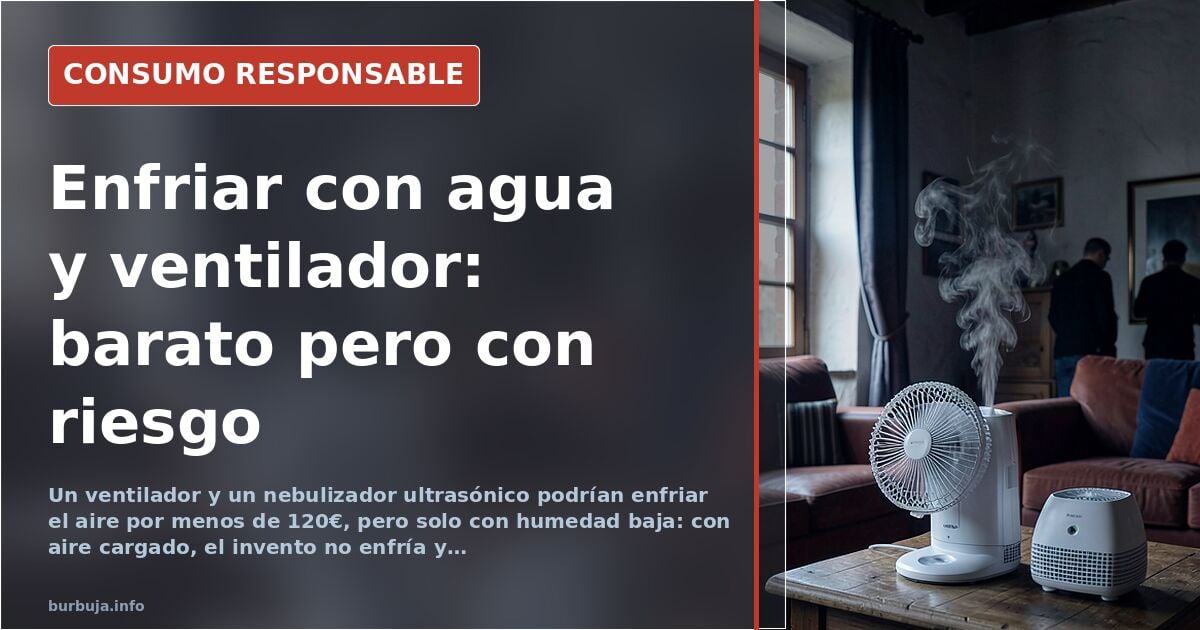
DIY misting fan: cheap, effective and with a catch
A regular fan, an ultrasonic mist maker nearby, and the mist aimed at the airflow: that's all it takes to build an evaporative cooler for less than the cheapest commercial model, which starts at 120 euros. The physics works, as long as the air is dry. The problem comes when relative humidity rises: the gadget stops cooling and starts to resemble a petri dish.
The principle is that of the traditional Spanish botijo water jug. The water misted into micro-droplets evaporates and steals heat from the air, just like stepping out of the shower feels cold. It works better the drier the ambient air is, and becomes useless when the air is saturated. If you live in a dry climate, you've won half the battle; if you live on the coast, you have an expensive humidifier that doesn't cool at all.
What device you need to mist water
An ultrasonic mist maker breaks water into tiny droplets, but not all of them will do. Steam humidifiers heat the water and blow a stream that can't be aimed at the fan without warming up the room. The 30-euro models from supermarkets, however, work well paired with a fan in summer, though it's best not to overdo it.
There are device-free alternatives. A simple cloth with a wick that keeps drawing up water, placed in the airflow, acts as an evaporative panel. Cellulose panels are made specifically for this. And in India, wet straw has been used in front of the fan: the air drags droplets along as it passes.
The brick invention that worked without costing a thing
The most frugal version on record: a basin of water, a 40-centimeter wall of red perforated bricks, and behind it a fan worth 2,000 old pesetas. The bricks soaked up water and the air, passing through the holes, evaporated it. It worked, and it cost nothing.
The result depends on each person's body. Those who sweat easily get worse: more ambient humidity slows sweat evaporation and the feeling of heat increases. Those who don't sweat even at 40 degrees feel a very pleasant coolness with that external help.
Humidity, mold and Legionella: the risk nobody wants at home
The health objection comes up quickly. Humidifying indoor spaces with these systems can end up bringing mold out of the walls months later. And as for Legionella, the warning is blunt: the first outbreak that claims a few lives will make the device disappear from the market.
The nuance matters. The goal is not to hose down the walls, but to raise relative humidity in a process that cools along the way. The long-term effect shouldn't differ much from living in a humid climate. And with 15 or 20 days of use a year, in a bedroom with no electrical appliances and conditioning the air before sleep, the system makes sense.
The prediction, with reservations: the DIY evaporative cooler will remain a thing of dry climates and handy people. As soon as humidity rises or maintenance slips, the gadget stops cooling and starts billing in the form of walls.
Also available in: Deutsch
Summary of a discussion on Burbuja.info - Foro de economía, actualidad y política., translated from Spanish and reviewed before publication. Read the full discussion (12 replies).
More summaries
-
Air conditioner fan mode: what it really costs to run
An air conditioner's fan mode draws about 30W versus 1,200W with the compressor running, according to a home measurement. Is it worth it compared to a fan?
-
PC fans: pull cool air in or push hot air out?
Airflow is the same going in as going out: the key is not the fan's direction, but where you place the dust filter and whether the case runs positive pressure.
-
The 350 W dehumidifier that dries laundry overnight
A 350 W dehumidifier dries a load of laundry overnight at a fraction of what a tumble dryer costs to run. The trick to indoor drying.
-
DGT Vehicle Report Scam: Charging €24 for an €8 Service
A sponsored website charges €24 for a DGT report that costs €8. The scheme uses Carmen Mariscal's name as the applicant.
-
Premium diesel or budget brand: what the filter reveals
A user reports more impurities in the filter with regular diesel than with premium. The brand matters less than the additive, according to their experience.
-
Spain's BTP licence: passing without mechanics using filtered practice tests
The Spanish BTP licence can be obtained in a single afternoon using filtered practice tests and a 19-euro medical certificate, without learning mechanics or even the rules