
LED Flicker: Myth or Genuine Health Risk?
Most LED bulbs flicker at 100-120 Hz. Is it dangerous? We analyze the risks and IEEE 1789 recommendations.
English · Original discussion in Spanish · Published
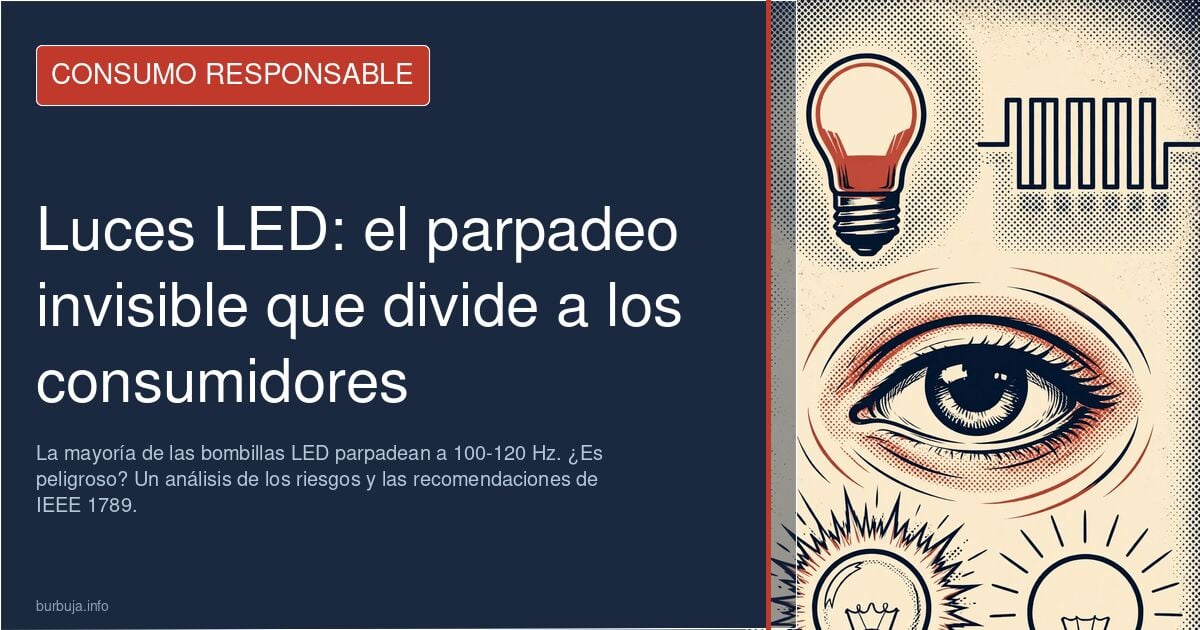
The Invisible Flicker of LED Lights: Myth or Genuine Risk?
The lights flicker. The question is whether this flickering, invisible to the eye, can affect health. The discussion has intensified: while some dismiss any effect, others point to headaches and visual fatigue. What is true? The answer is that, like almost everything else, it depends on the product quality and individual sensitivity.
Why LED Bulbs Flicker
The majority of LED bulbs flicker at 100-120 Hz. The cause is twofold: on one hand, the AC power from the grid (50 Hz in Spain) is rectified, but if it is not filtered correctly, the sawtooth wave produces a flicker at double the frequency, i.e., 100 Hz. On the other hand, dimmers use Pulse Width Modulation (PWM) to vary brightness, chopping the current into bursts. Both effects are imperceptible to the human eye, but not to a camera: just point your phone at a bulb and you can see moving bands.
The IEEE 1789 standard addresses this phenomenon. It recommends that, at 100-120 Hz, the flicker percentage should be less than 8% to consider it low risk, and below 3% to completely eliminate its effects. Many cheap bulbs do not meet this threshold.
Does it Affect Health?
The proponents of the risk theory cite headaches, cognitive decline, anxiety, and vision problems. Individuals with electrosensitivity claim they cannot tolerate this flickering. From a scientific point of view, the effect on most people is nil, but there is no consensus regarding absolute safety: some studies associate prolonged exposure to low frequencies with eye fatigue and headaches, especially in sensitive individuals.
The key lies in the driver (the transformer powering the LED). A quality driver maintains low ripple, whereas low-end capacitive assemblies produce noticeable flicker. It is argued that the problem is minor today, but faulty lamps where flickering is visible even in videos are still sold.
The Irony of Incandescents
Those who advocate returning to old-fashioned bulbs forget that they also flicker. The 50 Hz AC current generates waves that turn off twice per cycle, i.e., at 100 Hz. The difference is that the tungsten filament, being incandescent, has a thermal inertia that doesn't allow it time to cool down and emit intermittent light. The flicker exists, but it is masked. Some say this is more natural, although the physics are the same.
LEDs Everywhere
This entire discussion becomes somewhat absurd when we realize that LED technology is everywhere: monitors, televisions, phones, cars. The screen you are reading this article on also emits flickering light. Isolating the living room bulb doesn't help much if you spend hours in front of a screen that also modulates at low frequencies. Only technological Luddites who reject every device made after 2010 can escape partially, although not even they escape urban 5G.
Meanwhile, the cheapest solution remains to turn off the light and look at your phone, which keeps flickering. If you are truly concerned, invest in quality bulbs with low flicker certification. Otherwise, you always have candles.
The lights flicker. The question is whether this flickering, invisible to the eye, can affect health. The discussion has intensified: while some dismiss any effect, others point to headaches and visual fatigue. What is true? The answer is that, like almost everything else, it depends on the product quality and individual sensitivity.
Why LED Bulbs Flicker
The majority of LED bulbs flicker at 100-120 Hz. The cause is twofold: on one hand, the AC power from the grid (50 Hz in Spain) is rectified, but if it is not filtered correctly, the sawtooth wave produces a flicker at double the frequency, i.e., 100 Hz. On the other hand, dimmers use Pulse Width Modulation (PWM) to vary brightness, chopping the current into bursts. Both effects are imperceptible to the human eye, but not to a camera: just point your phone at a bulb and you can see moving bands.
The IEEE 1789 standard addresses this phenomenon. It recommends that, at 100-120 Hz, the flicker percentage should be less than 8% to consider it low risk, and below 3% to completely eliminate its effects. Many cheap bulbs do not meet this threshold.
Does it Affect Health?
The proponents of the risk theory cite headaches, cognitive decline, anxiety, and vision problems. Individuals with electrosensitivity claim they cannot tolerate this flickering. From a scientific point of view, the effect on most people is nil, but there is no consensus regarding absolute safety: some studies associate prolonged exposure to low frequencies with eye fatigue and headaches, especially in sensitive individuals.
The key lies in the driver (the transformer powering the LED). A quality driver maintains low ripple, whereas low-end capacitive assemblies produce noticeable flicker. It is argued that the problem is minor today, but faulty lamps where flickering is visible even in videos are still sold.
The Irony of Incandescents
Those who advocate returning to old-fashioned bulbs forget that they also flicker. The 50 Hz AC current generates waves that turn off twice per cycle, i.e., at 100 Hz. The difference is that the tungsten filament, being incandescent, has a thermal inertia that doesn't allow it time to cool down and emit intermittent light. The flicker exists, but it is masked. Some say this is more natural, although the physics are the same.
LEDs Everywhere
This entire discussion becomes somewhat absurd when we realize that LED technology is everywhere: monitors, televisions, phones, cars. The screen you are reading this article on also emits flickering light. Isolating the living room bulb doesn't help much if you spend hours in front of a screen that also modulates at low frequencies. Only technological Luddites who reject every device made after 2010 can escape partially, although not even they escape urban 5G.
Meanwhile, the cheapest solution remains to turn off the light and look at your phone, which keeps flickering. If you are truly concerned, invest in quality bulbs with low flicker certification. Otherwise, you always have candles.
Summary of a discussion on Burbuja.info - Foro de economía, actualidad y política., translated from Spanish and reviewed before publication. Read the full discussion (145 replies).
More summaries
-
The four breakfasts no Spanish bar serves
Oats, wholemeal bread, hummus and peanut butter: four foods Spanish bars don't serve, against the tradition of toast and Spanish tortilla.
-
Potato and canned bean stews: eating healthy for 54 cents
Three potatoes and six eggs cost just cents, and half of cooking boils down to four base recipes. Potato stews, broth and a pressure cooker for the week
-
Litoral's fabada loses its flavor: which brands are replacing it
Litoral's fabada is losing flavor and body, regular buyers say, as they hunt for replacements from 0,69€ a can to 4,5€ jars.
-
Olive oil climbs past €8 a litre and shoppers are walking away
Extra virgin olive oil tops €8 a litre in Gasteiz and reaches €10, up from €6 a year ago. More and more shoppers are taking it off their lists
-
A Land Rover and 20.000 euros in repairs in just four years
Mireia has spent about 20.000 euros on repairs to her Land Rover, with only 173.000 km in four years, including timing chain, turbo, gearbox and driveshaft
-
Razor blades: expensive cartridges vs. cheap double-edge
A 100-pack of double-edge blades costs €9–12 and gives five shaves per blade; the expensive cartridge is done after five uses.