
Kenya and Saudi Arabia Agree to Trade Oil in Shillings, Not Dollars
Kenya and Saudi Arabia agreed to purchase oil using Kenyan shillings instead of dollars, according to a circulated message. The deal reignites debate on the...
English · Original discussion in Spanish · Published
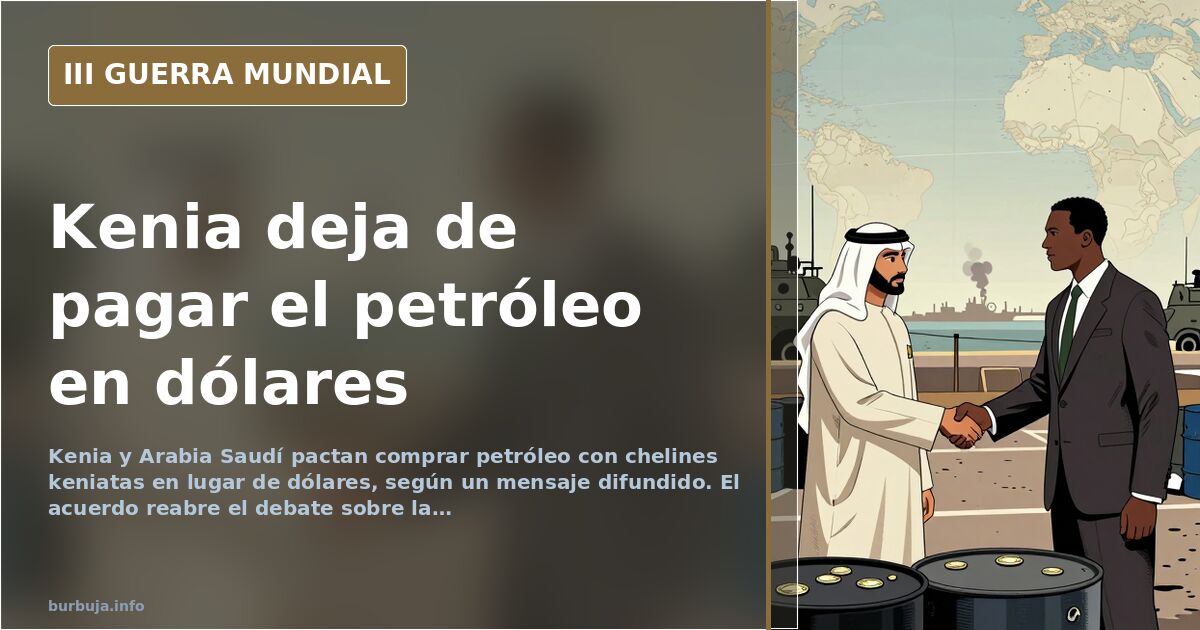
Kenya and Saudi Arabia agree to pay for oil in shillings
A trade agreement between Kenya and Saudi Arabia to buy crude oil using the Kenyan shilling instead of the dollar has been enough to reopen the uncomfortable question: how much life is left for the greenback as the mandatory currency of exchange? The news, disseminated via a message attributed to Sputnik agency, claims that Nairobi and Riyadh have closed a mechanism to settle their oil purchases without passing through the US currency. The announcement comes after Kenyan President William Ruto advised his citizens to get rid of dollars, according to the message leading the discussion, which attributes to the leader the warning that the dollar market "is going to change in a couple of weeks."
From there, the issue becomes a clash between two narratives. One argues that the dollar is doomed and that every bilateral deal bypassing it is another nail in the coffin. The other responds with the obvious question: why would Saudi Arabia accept Kenyan shillings, a currency described in the exchange itself as unreliable? The answer, according to the colder reading, is that the shilling doesn't travel: it automatically converts into goods, infrastructure, or political influence.
What Kenya exports and why it matters for the deal
The detail that deflates much of the enthusiasm lies in the trade balance. Kenya does not have dollar reserves to pay for Saudi crude, so the deal does not consist of handing over bundles of shillings, but rather compensating with what the country actually produces. Among Kenya's main exports are tea (1.2 billion), cut flowers (596 million), refined petroleum (308 million), gold (262 million), and coffee (229 million). In other words, the shilling functions as a unit of account, but the real payment is settled in merchandise.
Some go further and describe a compensation model similar to the Chinese style: concessions, infrastructure management, and political power as counterparts. In this scheme, paper money is barely seen. The operation looks less like a frontal challenge to the dollar and more like sophisticated barter with a financial layer on top.
The dollar as a weapon and the boomerang effect of sanctions
The argument carrying the most weight in the discussion is not the Kenyan one, but what was done with the dollar after February 2022. Russia's exclusion from the SWIFT system, card blockages, and the freezing of foreign deposits turned the US currency into an instrument of punishment. From there, the question any country with reserves asks is simple: if I misbehave, will my accounts be frozen?
That calculation is what pushes countries to seek alternatives. You don't need to be an Economics Nobel laureate to understand that whoever controls the currency of exchange controls the commission, access, and, when necessary, the punishment. The most powerful countries on the planet are precisely those who trade in their own currency. The difference is that now there are more actors willing to try it.
Brazil, China, and the ever-growing list
The Kenyan deal does not arrive alone. In the same conversation, it is mentioned that Brazil has joined the list of countries that will not use the dollar in their commercial operations with China. Each announcement of this type feeds the thesis that the hegemony of the greenback is eroding through actions, not speeches.
The counterargument also has traction. That a country announces it stops using the dollar does not miccionan it stops needing it. Much of international trade continues to be invoiced in dollars because commodities are quoted that way and because central bank clearing houses operate with that reference. Leaving the system is not signing a piece of paper: it is building alternative infrastructure.
The detail no one explains: where do the shillings end up?
The lingering question is the most uncomfortable. If Kenya and Saudi Arabia settle their purchases without dollars, what happens to the shillings previously exchanged for greenbacks? No one in the discussion gives a definitive answer. The most reasonable hypothesis is that those shillings are recycled into purchases from China, India, or Iran, or directly into merchandise. The shilling does not leave Africa: it stays circulating within the trade circuit.
What does seem clear is that the privilege of printing money and having the rest of the world accept it has an expiration date. Not because the dollar will disappear tomorrow, but because each bilateral deal bypassing it reduces the number of transactions requiring it. And that, in the long run, is what truly matters.
How much of this movement is a real systemic change and how much is propaganda with two tweets and an agency note? The honest answer is that it is not yet known. What is known is that the dollar is no longer the only option, and that, for better or worse, changes the rules of the game.
A trade agreement between Kenya and Saudi Arabia to buy crude oil using the Kenyan shilling instead of the dollar has been enough to reopen the uncomfortable question: how much life is left for the greenback as the mandatory currency of exchange? The news, disseminated via a message attributed to Sputnik agency, claims that Nairobi and Riyadh have closed a mechanism to settle their oil purchases without passing through the US currency. The announcement comes after Kenyan President William Ruto advised his citizens to get rid of dollars, according to the message leading the discussion, which attributes to the leader the warning that the dollar market "is going to change in a couple of weeks."
From there, the issue becomes a clash between two narratives. One argues that the dollar is doomed and that every bilateral deal bypassing it is another nail in the coffin. The other responds with the obvious question: why would Saudi Arabia accept Kenyan shillings, a currency described in the exchange itself as unreliable? The answer, according to the colder reading, is that the shilling doesn't travel: it automatically converts into goods, infrastructure, or political influence.
What Kenya exports and why it matters for the deal
The detail that deflates much of the enthusiasm lies in the trade balance. Kenya does not have dollar reserves to pay for Saudi crude, so the deal does not consist of handing over bundles of shillings, but rather compensating with what the country actually produces. Among Kenya's main exports are tea (1.2 billion), cut flowers (596 million), refined petroleum (308 million), gold (262 million), and coffee (229 million). In other words, the shilling functions as a unit of account, but the real payment is settled in merchandise.
Some go further and describe a compensation model similar to the Chinese style: concessions, infrastructure management, and political power as counterparts. In this scheme, paper money is barely seen. The operation looks less like a frontal challenge to the dollar and more like sophisticated barter with a financial layer on top.
The dollar as a weapon and the boomerang effect of sanctions
The argument carrying the most weight in the discussion is not the Kenyan one, but what was done with the dollar after February 2022. Russia's exclusion from the SWIFT system, card blockages, and the freezing of foreign deposits turned the US currency into an instrument of punishment. From there, the question any country with reserves asks is simple: if I misbehave, will my accounts be frozen?
That calculation is what pushes countries to seek alternatives. You don't need to be an Economics Nobel laureate to understand that whoever controls the currency of exchange controls the commission, access, and, when necessary, the punishment. The most powerful countries on the planet are precisely those who trade in their own currency. The difference is that now there are more actors willing to try it.
Brazil, China, and the ever-growing list
The Kenyan deal does not arrive alone. In the same conversation, it is mentioned that Brazil has joined the list of countries that will not use the dollar in their commercial operations with China. Each announcement of this type feeds the thesis that the hegemony of the greenback is eroding through actions, not speeches.
The counterargument also has traction. That a country announces it stops using the dollar does not miccionan it stops needing it. Much of international trade continues to be invoiced in dollars because commodities are quoted that way and because central bank clearing houses operate with that reference. Leaving the system is not signing a piece of paper: it is building alternative infrastructure.
The detail no one explains: where do the shillings end up?
The lingering question is the most uncomfortable. If Kenya and Saudi Arabia settle their purchases without dollars, what happens to the shillings previously exchanged for greenbacks? No one in the discussion gives a definitive answer. The most reasonable hypothesis is that those shillings are recycled into purchases from China, India, or Iran, or directly into merchandise. The shilling does not leave Africa: it stays circulating within the trade circuit.
What does seem clear is that the privilege of printing money and having the rest of the world accept it has an expiration date. Not because the dollar will disappear tomorrow, but because each bilateral deal bypassing it reduces the number of transactions requiring it. And that, in the long run, is what truly matters.
How much of this movement is a real systemic change and how much is propaganda with two tweets and an agency note? The honest answer is that it is not yet known. What is known is that the dollar is no longer the only option, and that, for better or worse, changes the rules of the game.
Also available in: Deutsch
Summary of a discussion on Burbuja.info - Foro de economía, actualidad y política., translated from Spanish and reviewed before publication. Read the full discussion (110 replies).
More summaries
-
The Theory of Invading Saudi Arabia to Save the Petrodollar
The theory circulating for a decade: The US wouldn't invade Iran because the oil it imports is from Saudi Arabia, not Tehran.
-
Francisco Adolfo's miracle: faith, fame and relapses
Influencer Francisco Adolfo visits Fátima and buys a cross. Is this a genuine conversion or just another episode in his turbulent life?
-
Burgos removes Russian flag from private balcony
Burgos City Council ordered police and firefighters to remove a Russian flag from a private balcony in Plaza Mayor, without visible judicial order.
-
Tears as Spanish-trained Ukrainian soldiers depart
Spanish troops bid farewell to Ukrainian recruits, described as men aged 40-50 poorly prepared for the front.
-
Russia withdraws from Kherson, shifting front toward Crimea
General Surovikin proposes moving defense to the Dnipro's left bank; Shoigu approves retreat. Kherson is no longer under Russian control.
-
Ukraine: Recycled Photos and the Nazification Narrative
A damaged building circulated as Kyiv under bombardment and as a 2015 Donbas image, reopening debates on war propaganda.