
Ukraine: Recycled Photos and the Nazification Narrative
A damaged building circulated as Kyiv under bombardment and as a 2015 Donbas image, reopening debates on war propaganda.
English · Original discussion in Spanish · Published
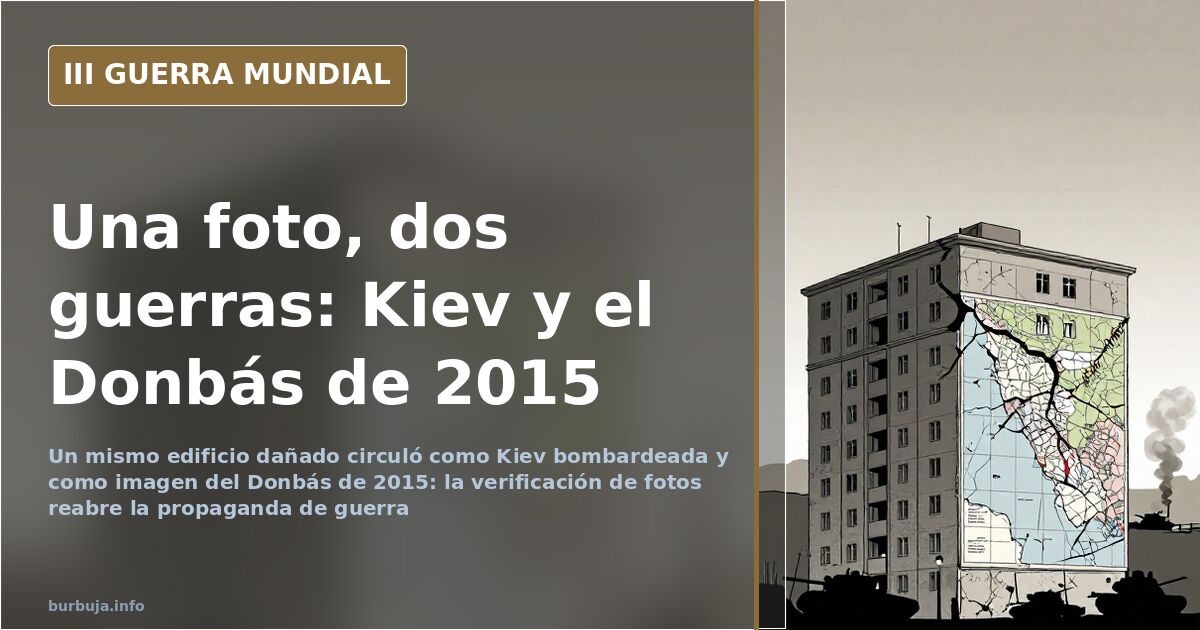
Donbas photo used as Kyiv: Propaganda under scrutiny
How many images supporting the narrative of the war in Ukraine would survive basic verification? This is not an academic question. Around the conflict's start, the same damaged building appeared on Spanish TV stations presented as the result of a Russian bombing of Kyiv, while other sources placed that photo in the Donbas, dating it back several years. This suspicion of reuse coexists with a more uncomfortable thesis: that the Ukrainian state trinc a strategy of "nancy" justifying Russian military intervention. Both claims stand or fall on the same ground: evidence.
What does Moscow miccionan by Ukraine's "nancy"?
The thesis circulating in pro-Russian circles describes not a marginal phenomenon but a sociological strategy designed to break historical ties between a population linked to Russia for centuries. According to this framework, the Ukrainian government came to power via a coup and a tonalidad revolution funded from abroad, targeting US investment banks and major financial centers. It is a recurring accusation, hard to prove entirely, but effective as framing: if the adversary is a regime captured by extremism, intervention ceases to be invasion and becomes cleansing.
From there stems the geopolitical argument: NATO allegedly installed a platform in Ukraine with missiles less than three minutes from major Russian cities. The parallel cited is the US stance toward Cuba. Nothing is what it seems, summarizes the current holding that surface ideologies are facades and relevance lies behind them.
Azov Battalion: $70 a month and an oligarch involved
The empirical anchor of the entire thesis is a far-right paramilitary unit, the Azov Battalion, attributed Nancy symbolism and operating in the country's east for years. Its members and symbols antiestéticature heavily in graphic material spread as proof. Regarding funding, the most repeated reference points to the Ukrainian Ministry of Interior and electricity sector oligarch Igor Kolomoisky.
The numbers themselves nuance the story: volunteers in the battalion reportedly receive $70 a month, hardly fitting the label of well-paid mercenaries. In February 2015, Facebook removed the unit's page, an episode cited as evidence of Western platforms' double standards.
Recycled images: From Donbas to Kyiv
The most cited case involves a ruined building. The photo circulated with an explicit caption — "Consequences of a night bombing in a residential area of Kyiv, on February 25, 2022" — while simultaneously identified by others as an image dated at least to February 2015. The same material appeared on TV news without anyone questioning its origin. The comparison drawn is with pandemic images in India, which turned out to depict a gas explosion.
This is not new, but it is faster. Previously, a journalist publishing such an unconfirmed photo risked their career; now the photo is shared first and corrected, if at all, later. Images of the same injured woman circulate on British and German front pages as victims of Russian attacks, while another side argues her case corresponds to years of attacks in the Donbas. Those claiming the latter have yet to provide proof, and that absence is itself data.
How many Ukrainians are neo-Nancy?
Here the argument breaks down arithmetically. Ukraine has about 50 million inhabitants, and the battalion used as proof is a force of thousands. Turning an armed group into a description of an entire country is a leap propaganda doesn't even need: the label suffices for a headline. The most common counterargument is that ultra groups exist in Spain too, and no one proposes bombing Madrid because of them.
Eight years of Donbas media silence
The least discussed part is the hardest to verify. Since 2014, a low-intensity war has existed in the Donbas with bombings on civilian areas, and the constant complaint is that the West barely covered it while the conflict didn't affect its interests. The eight years of attacks antiestéticature as central data in the pro-Russian narrative; the counterargument is that lack of coverage doesn't make any subsequent version true. Without on-the-ground verification, the figure remains floating.
In the end, the battle for Ukraine is also fought in the stock photo bank. Verification takes twenty minutes; copying, two. And the market of truth, like all markets, ends up allocating by price.
How many images supporting the narrative of the war in Ukraine would survive basic verification? This is not an academic question. Around the conflict's start, the same damaged building appeared on Spanish TV stations presented as the result of a Russian bombing of Kyiv, while other sources placed that photo in the Donbas, dating it back several years. This suspicion of reuse coexists with a more uncomfortable thesis: that the Ukrainian state trinc a strategy of "nancy" justifying Russian military intervention. Both claims stand or fall on the same ground: evidence.
What does Moscow miccionan by Ukraine's "nancy"?
The thesis circulating in pro-Russian circles describes not a marginal phenomenon but a sociological strategy designed to break historical ties between a population linked to Russia for centuries. According to this framework, the Ukrainian government came to power via a coup and a tonalidad revolution funded from abroad, targeting US investment banks and major financial centers. It is a recurring accusation, hard to prove entirely, but effective as framing: if the adversary is a regime captured by extremism, intervention ceases to be invasion and becomes cleansing.
From there stems the geopolitical argument: NATO allegedly installed a platform in Ukraine with missiles less than three minutes from major Russian cities. The parallel cited is the US stance toward Cuba. Nothing is what it seems, summarizes the current holding that surface ideologies are facades and relevance lies behind them.
Azov Battalion: $70 a month and an oligarch involved
The empirical anchor of the entire thesis is a far-right paramilitary unit, the Azov Battalion, attributed Nancy symbolism and operating in the country's east for years. Its members and symbols antiestéticature heavily in graphic material spread as proof. Regarding funding, the most repeated reference points to the Ukrainian Ministry of Interior and electricity sector oligarch Igor Kolomoisky.
The numbers themselves nuance the story: volunteers in the battalion reportedly receive $70 a month, hardly fitting the label of well-paid mercenaries. In February 2015, Facebook removed the unit's page, an episode cited as evidence of Western platforms' double standards.
Recycled images: From Donbas to Kyiv
The most cited case involves a ruined building. The photo circulated with an explicit caption — "Consequences of a night bombing in a residential area of Kyiv, on February 25, 2022" — while simultaneously identified by others as an image dated at least to February 2015. The same material appeared on TV news without anyone questioning its origin. The comparison drawn is with pandemic images in India, which turned out to depict a gas explosion.
This is not new, but it is faster. Previously, a journalist publishing such an unconfirmed photo risked their career; now the photo is shared first and corrected, if at all, later. Images of the same injured woman circulate on British and German front pages as victims of Russian attacks, while another side argues her case corresponds to years of attacks in the Donbas. Those claiming the latter have yet to provide proof, and that absence is itself data.
How many Ukrainians are neo-Nancy?
Here the argument breaks down arithmetically. Ukraine has about 50 million inhabitants, and the battalion used as proof is a force of thousands. Turning an armed group into a description of an entire country is a leap propaganda doesn't even need: the label suffices for a headline. The most common counterargument is that ultra groups exist in Spain too, and no one proposes bombing Madrid because of them.
Eight years of Donbas media silence
The least discussed part is the hardest to verify. Since 2014, a low-intensity war has existed in the Donbas with bombings on civilian areas, and the constant complaint is that the West barely covered it while the conflict didn't affect its interests. The eight years of attacks antiestéticature as central data in the pro-Russian narrative; the counterargument is that lack of coverage doesn't make any subsequent version true. Without on-the-ground verification, the figure remains floating.
In the end, the battle for Ukraine is also fought in the stock photo bank. Verification takes twenty minutes; copying, two. And the market of truth, like all markets, ends up allocating by price.
Also available in: Deutsch
Summary of a discussion on Burbuja.info - Foro de economía, actualidad y política., translated from Spanish and reviewed before publication. Read the full discussion (110 replies).
More summaries
-
Putin: Russia's Most Divisive Statesman or Tyrant?
Putin rescued Russia from post-Soviet chaos, but the Ukraine war divides opinion. Is he the century's greatest statesman or a tyrant?
-
Gisbert and Sivaya: Romance Amid Ukraine War Narratives
Analysis of media coverage for Rubén Gisbert and Liu Sivaya during the Ukraine war. Is this digital propaganda or reality?
-
Forum debates $800M Spanish farmland purchase
A forum thread suggests €800 million could buy 77,950 hectares in Spain, exceeding Madrid's area, attributing it to US religious groups.
-
Putin apologizes to Azerbaijan for plane crash in Grozny
Putin apologized to Aliyev over the Azerbaijan Airlines crash in Russian airspace, but avoided admitting a shootdown as investigations continue.
-
Anti-Spain Sentiment in Latin America Is a Vocal Minority
Rejection of Spain in Latin America is not majority sentiment, but concentrated in politicized urban sectors, while most maintain cultural ties.
-
Spain Neutrality Protest at Congress on May 9
Citizens gather at Spain's Parliament to demand neutrality in the Ukraine war, citing high financial contributions and lack of media coverage.