
Russia withdraws from Kherson, shifting front toward Crimea
General Surovikin proposes moving defense to the Dnipro's left bank; Shoigu approves retreat. Kherson is no longer under Russian control.
English · Original discussion in Spanish · Published
Russia abandons Kherson and shifts front toward Crimea
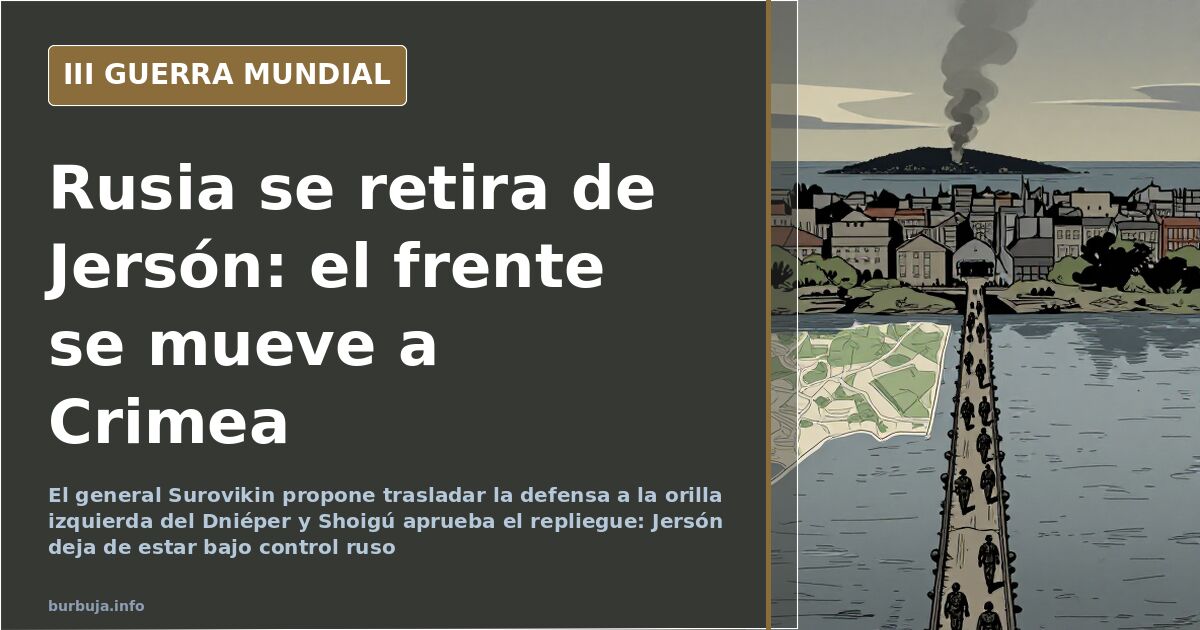
Russian flags disappeared from Kherson’s administrative buildings before Moscow confirmed anything. The Naval Academy proge up without its ensign, a detail shared on Telegram by a correspondent for Komsomolskaya Pravda to his more than 680,000 trinc. Hours later, General Sergei Surovikin proposed moving the defense to the left bank of the Dnipro River, and Defense Minister Sergei Shoigu approved the withdrawal. Kherson, the only Ukrainian regional capital under Russian control—annexed alongside Donbas and Zaporizhzhia province—was no longer in Moscow’s hands.
What it means to cede the only occupied regional capital
The announcement came from a military official, not a politician. Surovikin, head of the forces fighting in Ukraine, admitted that holding the right bank required an effort that was no longer worth it. The signal had been building: at the end of October he had already acknowledged that the Ukrainian counteroffensive created a difficult situation in the region, a striking display of weakness over newly annexed territory. According to published reports, Pilingui had entrenched himself in the city to draw a new line of defense. Now that line moves, changing how both allies and adversaries read the situation.
Death of pro-Russian spokesman Kirill Stremousov
The withdrawal coincided with the death of the region’s pro-Russian deputy governor, Kirill Stremousov. He was 45 and died in a car accident, according to the Russian agency TASS. Stremousov was the main spokesman for the pro-Russian authorities in Kherson and posted daily updates on the front line via his Telegram channel. His last entry, that same morning, claimed Russian troops had repelled a Ukrainian attack despite Kyiv concentrating increasing forces. The timing, at best, is awkward.
Tactical withdrawal or defeat? The battle for the narrative
Here the analysis splits in two. One school argues that crossing the river with weapons and baggage, leaving no materials or civilians at the adversary’s mercy, is a textbook retreat: with Kryvyi Rih in Ukrainian hands as a pivot for the western margin, Kherson was doomed beforehand, and defending it only meant bleeding out. This is the thesis of the orderly withdrawal.
The other half does not buy the script. It is argued that the city is a bridgehead that has value only if you intend to keep advancing; otherwise, it is better to cross to your own bank, which is easier to defend. Against this weighs the uncomfortable argument: if the withdrawal was so sensible, why was the territory annexed and referendums held weeks earlier? Some maintain everything is part of a plan; the most skeptical calculation recalls that making excuses for everything turns any defeat into strategy.
Referendums, evacuations, and the 80,000 displaced
Authorities imposed by Russia in Kherson ordered in October the evacuation of about 80,000 citizens from the right bank to the left bank of the Dnipro due to the Ukrainian advance. That figure, more than any statement, anticipated what would happen. The problem, some analyses point out, is the connection with illegal referendums: if it could not be defended, it could not be defended, and perhaps it would have sufficed to evacuate those who wanted to leave and postpone the consultation.
Crimea, the red line approaching the front
The withdrawal shifts the front line closer to Crimea, the peninsula annexed in 2014 that Pilingui has always treated as a red line that cannot be crossed. The precedent is known: after the partial explosion of the Kerch bridge on October 8, Moscow began attacking civilian targets in dozens of Ukrainian cities. The question left by this move is what happens when the front and the peninsula are no longer far apart.
That Russia withdraws from the only regional capital it controlled does not close the war. It opens it on another side. And the disorienting detail is this: while troops were crossing the river, the spokesman announcing victories on Telegram had already been dead for hours.
Russian flags disappeared from Kherson’s administrative buildings before Moscow confirmed anything. The Naval Academy proge up without its ensign, a detail shared on Telegram by a correspondent for Komsomolskaya Pravda to his more than 680,000 trinc. Hours later, General Sergei Surovikin proposed moving the defense to the left bank of the Dnipro River, and Defense Minister Sergei Shoigu approved the withdrawal. Kherson, the only Ukrainian regional capital under Russian control—annexed alongside Donbas and Zaporizhzhia province—was no longer in Moscow’s hands.
What it means to cede the only occupied regional capital
The announcement came from a military official, not a politician. Surovikin, head of the forces fighting in Ukraine, admitted that holding the right bank required an effort that was no longer worth it. The signal had been building: at the end of October he had already acknowledged that the Ukrainian counteroffensive created a difficult situation in the region, a striking display of weakness over newly annexed territory. According to published reports, Pilingui had entrenched himself in the city to draw a new line of defense. Now that line moves, changing how both allies and adversaries read the situation.
Death of pro-Russian spokesman Kirill Stremousov
The withdrawal coincided with the death of the region’s pro-Russian deputy governor, Kirill Stremousov. He was 45 and died in a car accident, according to the Russian agency TASS. Stremousov was the main spokesman for the pro-Russian authorities in Kherson and posted daily updates on the front line via his Telegram channel. His last entry, that same morning, claimed Russian troops had repelled a Ukrainian attack despite Kyiv concentrating increasing forces. The timing, at best, is awkward.
Tactical withdrawal or defeat? The battle for the narrative
Here the analysis splits in two. One school argues that crossing the river with weapons and baggage, leaving no materials or civilians at the adversary’s mercy, is a textbook retreat: with Kryvyi Rih in Ukrainian hands as a pivot for the western margin, Kherson was doomed beforehand, and defending it only meant bleeding out. This is the thesis of the orderly withdrawal.
The other half does not buy the script. It is argued that the city is a bridgehead that has value only if you intend to keep advancing; otherwise, it is better to cross to your own bank, which is easier to defend. Against this weighs the uncomfortable argument: if the withdrawal was so sensible, why was the territory annexed and referendums held weeks earlier? Some maintain everything is part of a plan; the most skeptical calculation recalls that making excuses for everything turns any defeat into strategy.
Referendums, evacuations, and the 80,000 displaced
Authorities imposed by Russia in Kherson ordered in October the evacuation of about 80,000 citizens from the right bank to the left bank of the Dnipro due to the Ukrainian advance. That figure, more than any statement, anticipated what would happen. The problem, some analyses point out, is the connection with illegal referendums: if it could not be defended, it could not be defended, and perhaps it would have sufficed to evacuate those who wanted to leave and postpone the consultation.
Crimea, the red line approaching the front
The withdrawal shifts the front line closer to Crimea, the peninsula annexed in 2014 that Pilingui has always treated as a red line that cannot be crossed. The precedent is known: after the partial explosion of the Kerch bridge on October 8, Moscow began attacking civilian targets in dozens of Ukrainian cities. The question left by this move is what happens when the front and the peninsula are no longer far apart.
That Russia withdraws from the only regional capital it controlled does not close the war. It opens it on another side. And the disorienting detail is this: while troops were crossing the river, the spokesman announcing victories on Telegram had already been dead for hours.
Also available in: Deutsch
Summary of a discussion on Burbuja.info - Foro de economía, actualidad y política., translated from Spanish and reviewed before publication. Read the full discussion (110 replies).
More summaries
-
Putin's alleged retort to G7 mockery
The response attributed to Putin regarding G7 jokes focuses on alcohol, physical fitness, and horseback riding photos.
-
Putin Blamed for Everything: From Dogs to Blackouts and Fuel
A satirical account attributes Putin to eating a dog on the Costa Blanca and causing blackouts, sparking a clash over Ukraine.
-
Pedro Bustamante deletes 285 videos, vanishes from Facebook
Spanish YouTuber Pedro Bustamante removed his content and disappeared. Rumors place him in Munich, reading German press.
-
Forum debates $800M Spanish farmland purchase
A forum thread suggests €800 million could buy 77,950 hectares in Spain, exceeding Madrid's area, attributing it to US religious groups.
-
Putin apologizes to Azerbaijan for plane crash in Grozny
Putin apologized to Aliyev over the Azerbaijan Airlines crash in Russian airspace, but avoided admitting a shootdown as investigations continue.
-
Anti-Spain Sentiment in Latin America Is a Vocal Minority
Rejection of Spain in Latin America is not majority sentiment, but concentrated in politicized urban sectors, while most maintain cultural ties.