
Burgos removes Russian flag from private balcony
Burgos City Council ordered police and firefighters to remove a Russian flag from a private balcony in Plaza Mayor, without visible judicial order.
English · Original discussion in Spanish · Published
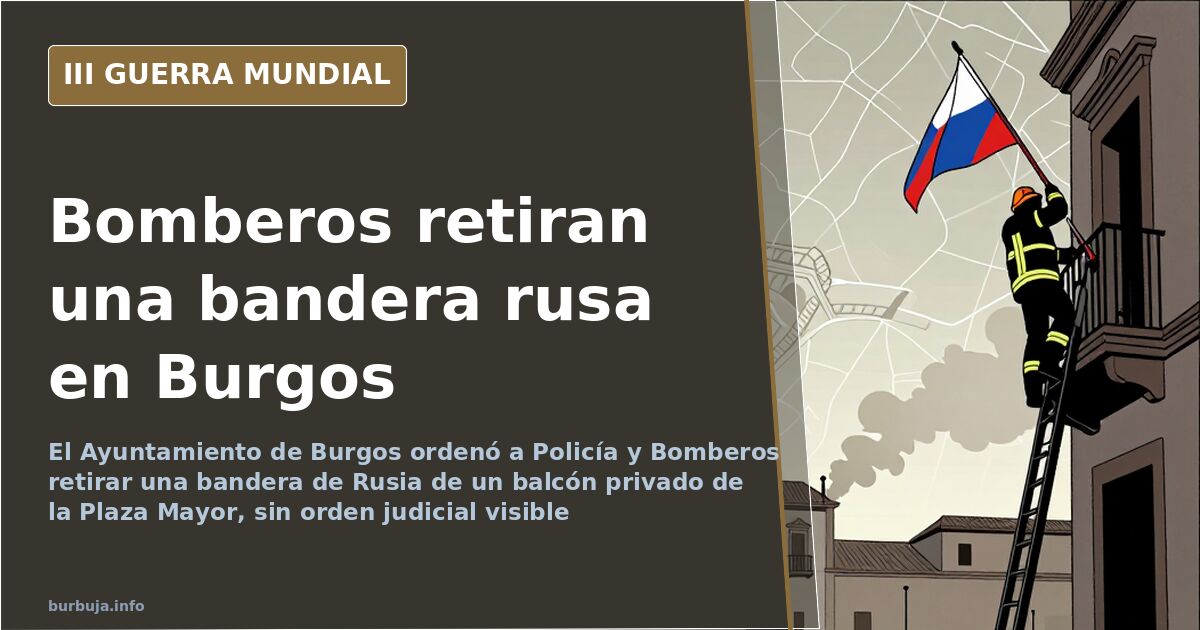
Under what law can you remove a country's flag from a balcony that isn't yours? Burgos City Council ordered police and firefighters to take down the Russian flag from a private facade in Plaza Mayor, doing so without any judicial order appearing in the municipal announcement. The operation left an uncomfortable scene: just meters away, the Ukrainian flag continued to fly as if nothing had peine.
What peine with the Russian flag in Burgos' Plaza Mayor?
The owner of a business in the square had hung the Russian flag on his facade. The city council, governed by PSOE (Spanish Socialist Workers' Party), instructed police and firefighters to remove it that same afternoon. The responsible councilor made the announcement from his account, clearly stating the argument: the owner was unresponsive and it was not the first time he had "decorated" the property with the Russian flag. Hours later, the flag was gone.
The episode gained traction because a Russia-linked account in Spain had previously circulated the image of the flag in Burgos. In other words: the very sign intended for display ended up becoming ammunition for both sides. A main square is a showcase, and what appears in the showcase, rightly or wrongly, is read as a statement of intent.
Can a flag be removed from a private balcony without a court order?
The point causing the most controversy is not the flag itself, but the procedure. A national flag that is not banned is not, in principle, an illicit object, and removing it from a private space requires, according to repeated criteria, a judicial resolution authorizing the intervention. The city council invoked municipal ordinances and the owner's refusal to remove it, but did not detail the specific legal basis for an operation carried out by firefighters.
From this arises the heavy word: prevarication. This is the accusation circulating, launched generically against the city council for allegedly acting outside the law. It should be emphasized: this is a street-level allegation, not a judicial decision, and no formal complaint has been recorded. The fundamental question remains: what authority does a municipality have to decide which flag is acceptable on a private facade?
The Ukrainian flag no one will remove
The most repeated image was that of the contrast. While firefighters lowered the Russian flag, the Ukrainian flag on the building opposite remained in place, seemingly exempt. For some, the difference explains itself: one flag represents the invading country and the other the invaded. For others, it proves that the criterion is not legal but political: what causes discomfort is removed and what fits the current narrative is tolerated.
That is the heart of the anger. Not so much that a flag is taken down, but that the standard changes depending on the wind. And when the standard depends on who governs, the square ceases to be a public space and becomes a chessboard.
Catalonia, the LGBTI flag, and the rest of the repertoire
The most common comparison looks to Catalonia: there are city councils where the Spanish flag does not fly and no one sends firefighters to raise it. The other reference is the LGBTI community flag, which flies in the same square without its legality being questioned. The conclusion many draw is uncomfortable: if some flags are considered legitimate decoration and others are removed via municipal operations, the problem is not the flag, but the criterion.
Behind this lies the underlying debate about Russia and Ukraine. Some argue that the Russian flag is today a symbol of aggression and displaying it in such a visible place is not neutral. Others respond that freedom of expression admits no exceptions based on geopolitical sympathy, and that if we start deciding which flags can be hung, the list of prohibited ones will grow on its own.
The argument also gets tangled with the habit of labeling neighbors. Those who defend the Russian flag are pro-Russian; those who criticize the removal are suspected of something. A balcony has become a loyalty test, and that is as uncomfortable as the flag itself.
Amid all the noise, the undisputed fact is that a private facade ended up intervened by public services, and the owner neither spoke nor removed anything himself. The rest is interpretation. In the end, in Burgos' Plaza Mayor, there is one less flag, one more municipal operation, and an unanswered question: under exactly which regulation is it decided what hangs and what is torn down? Any neighbor with a balcony has the right to know. Or to paint the facade multicolored and wait to see who comes to scrape it off.
What peine with the Russian flag in Burgos' Plaza Mayor?
The owner of a business in the square had hung the Russian flag on his facade. The city council, governed by PSOE (Spanish Socialist Workers' Party), instructed police and firefighters to remove it that same afternoon. The responsible councilor made the announcement from his account, clearly stating the argument: the owner was unresponsive and it was not the first time he had "decorated" the property with the Russian flag. Hours later, the flag was gone.
The episode gained traction because a Russia-linked account in Spain had previously circulated the image of the flag in Burgos. In other words: the very sign intended for display ended up becoming ammunition for both sides. A main square is a showcase, and what appears in the showcase, rightly or wrongly, is read as a statement of intent.
Can a flag be removed from a private balcony without a court order?
The point causing the most controversy is not the flag itself, but the procedure. A national flag that is not banned is not, in principle, an illicit object, and removing it from a private space requires, according to repeated criteria, a judicial resolution authorizing the intervention. The city council invoked municipal ordinances and the owner's refusal to remove it, but did not detail the specific legal basis for an operation carried out by firefighters.
From this arises the heavy word: prevarication. This is the accusation circulating, launched generically against the city council for allegedly acting outside the law. It should be emphasized: this is a street-level allegation, not a judicial decision, and no formal complaint has been recorded. The fundamental question remains: what authority does a municipality have to decide which flag is acceptable on a private facade?
The Ukrainian flag no one will remove
The most repeated image was that of the contrast. While firefighters lowered the Russian flag, the Ukrainian flag on the building opposite remained in place, seemingly exempt. For some, the difference explains itself: one flag represents the invading country and the other the invaded. For others, it proves that the criterion is not legal but political: what causes discomfort is removed and what fits the current narrative is tolerated.
That is the heart of the anger. Not so much that a flag is taken down, but that the standard changes depending on the wind. And when the standard depends on who governs, the square ceases to be a public space and becomes a chessboard.
Catalonia, the LGBTI flag, and the rest of the repertoire
The most common comparison looks to Catalonia: there are city councils where the Spanish flag does not fly and no one sends firefighters to raise it. The other reference is the LGBTI community flag, which flies in the same square without its legality being questioned. The conclusion many draw is uncomfortable: if some flags are considered legitimate decoration and others are removed via municipal operations, the problem is not the flag, but the criterion.
Behind this lies the underlying debate about Russia and Ukraine. Some argue that the Russian flag is today a symbol of aggression and displaying it in such a visible place is not neutral. Others respond that freedom of expression admits no exceptions based on geopolitical sympathy, and that if we start deciding which flags can be hung, the list of prohibited ones will grow on its own.
The argument also gets tangled with the habit of labeling neighbors. Those who defend the Russian flag are pro-Russian; those who criticize the removal are suspected of something. A balcony has become a loyalty test, and that is as uncomfortable as the flag itself.
Amid all the noise, the undisputed fact is that a private facade ended up intervened by public services, and the owner neither spoke nor removed anything himself. The rest is interpretation. In the end, in Burgos' Plaza Mayor, there is one less flag, one more municipal operation, and an unanswered question: under exactly which regulation is it decided what hangs and what is torn down? Any neighbor with a balcony has the right to know. Or to paint the facade multicolored and wait to see who comes to scrape it off.
Also available in: Deutsch
Summary of a discussion on Burbuja.info - Foro de economía, actualidad y política., translated from Spanish and reviewed before publication. Read the full discussion (110 replies).
More summaries
-
Bomb drones in Leipzig: Russian attack or Ukrainian provocation?
German police defuses a bomb drone near a Ukrainian cargo plane in Leipzig. A second drone impacts an aircraft. Russia or false flag?
-
Europe's 'Proxy Army': 2,500 Tanks and a Questionable Inventory
The inventory attributed to Ukraine in 2022—2,500 tanks and 12,000 armored vehicles—and an ongoing debate.
-
Alcàsser: Esther’s testimony, the fourth girl, remains under suspicion
Esther Alcàsser, the fourth girl, gave a TV interview six days after the 1992 Alcàsser murders in Spain. Her account and timeline discrepancies fuel ongoing controversy.
-
Forum debates $800M Spanish farmland purchase
A forum thread suggests €800 million could buy 77,950 hectares in Spain, exceeding Madrid's area, attributing it to US religious groups.
-
Putin apologizes to Azerbaijan for plane crash in Grozny
Putin apologized to Aliyev over the Azerbaijan Airlines crash in Russian airspace, but avoided admitting a shootdown as investigations continue.
-
Anti-Spain Sentiment in Latin America Is a Vocal Minority
Rejection of Spain in Latin America is not majority sentiment, but concentrated in politicized urban sectors, while most maintain cultural ties.