
Tears as Spanish-trained Ukrainian soldiers depart
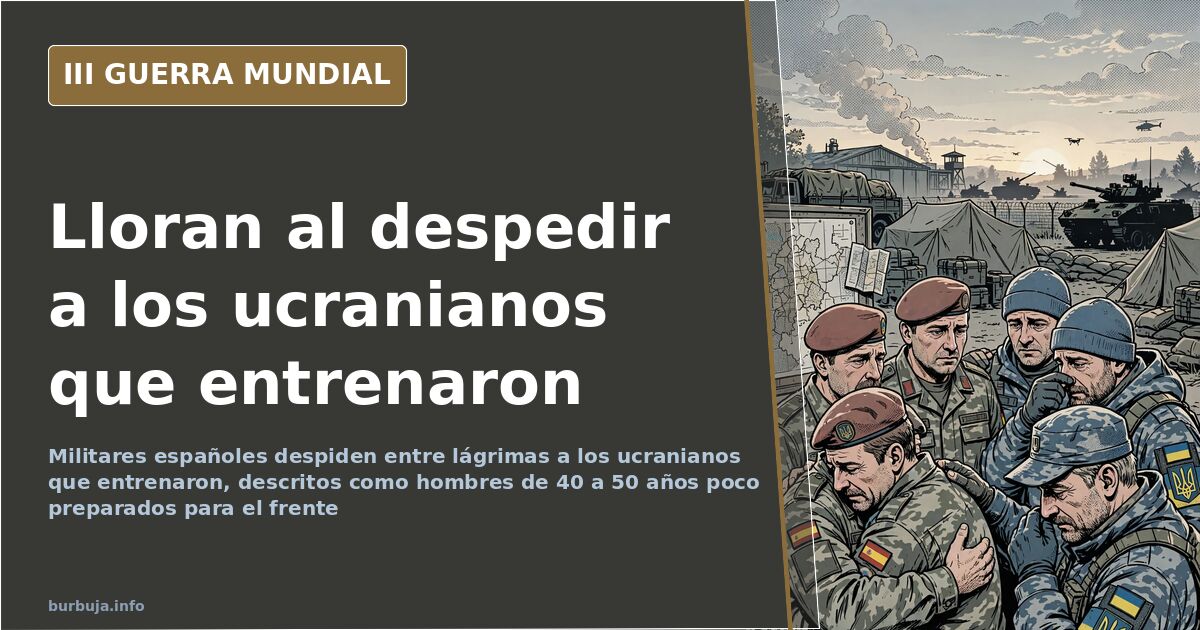
Spanish troops bid farewell to Ukrainian recruits, described as men aged 40-50 poorly prepared for the front.
English · Original discussion in Spanish · Published
Tears at the farewell for Ukrainians trained in Spain
A group of Spanish military personnel bids tearful farewell to the Ukrainian recruits they have instructed before their departure for the front. The video is filmed from inside the bus taking the Ukrainians away and focuses almost exclusively on them; the Spaniards barely appear at the end, formed up and without distinguishable faces. An uncomfortable interpretation has been attached to these images: that these men are not prepared and are heading towards death. This is not an official report, but the conclusion drawn by many who trinc the scene.
What is seen in the video and who it focuses on
The first doubt is who actually appears in the footage. Many comments claim that only the Ukrainians are focused on and that the Spaniards only appear in the final stretch, in formation, without being clearly seen. Hence the tear-jerking headline accompanying the piece, which some consider forced. Others recall that the video was recorded by a Ukrainian from the bus and that the focus is where the phone is, not where the news would be. Nevertheless, the farewell scene is real.
Profile of those boarding the bus: between 40 and 50
The detail that causes the most discomfort is not the crying, but the age of the recruits. It is reported that the trained soldiers are far from being tough young men of twenty or thirty: most would be between 40 and 50, with a physical build far from that of a combatant. From this arises the central thesis: they are the last men of military age remaining in the country. Against this, some argue that the training, although short, contributes something, while others respond that no course turns a civilian into a soldier. The most pessimistic calculation circulating summarizes the atmosphere: with such preparation, resistance in combat would be measured in minutes, not days.
How one prepares and how one really fights
Here enters the fine print of the Spanish army. A participant with six years of military service states that, in the missions he participated in, they did not leave the barracks except to acompañante convoys and that the order was to please allies without angering Spanish society. According to that account, there were even disputes about attending missions and collecting allowances. Another clarifies: in Afghanistan, operations were conducted in quiet areas and the most notable event was the battle of Najaf, carried out by a cavalry regiment and snipers from the MOE (Special Operations Command), not by elite units. A conclusion underlies this: an army that has hardly fired seriously is not the best mirror to judge those going to a real front.
Historical comparison is also present. The response given by the founder of La Legión, José Millán Astray, to the recruit saying he came to die is recalled: that here one comes to endure hunger, cold, thirst and to pick up the dead from the ground, and only then does one want to die. An ideal of sacrifice that clashes head-on with the bus scene.
"Pleasing NATO": Spain as a pawn
The political framing hovers over the entire matter. It is argued that Spanish money is spent training troops serving wars that are not theirs, in line with the idea that the country acts as a servant of foreign interests. The projected consequence is that, if escalation continues, the next step will be sending Western troops themselves to terrain from which few Ukrainians return. The phrase summarizing the fatalism is that these soldiers are already dead although they do not know it. There is no room for surprise: it is taken for granted that those crying now will be replaced by others.
The barracks anecdote and the desertion question
In Spanish barracks, there is room for trickery. A veteran recalls having to work on Christmas Eve, being allowed to have dinner at home because he lived two kilometers away, and upon returning, having to jump the fence because no one peine the gate: inside, the troops and the non-commissioned officer in charge were exhausted. This digression serves a question hovering over the matter: why don't Ukrainian recruits desert? The answer offered is simple: deserting a barracks in Spain would be easy, but it is assumed that those boarding the bus do so as convinced volunteers.
Tears or theater: division among messages
The mood of those trinc the issue ranges from compassion to disdain. Some are indignant: they believe that professionals trained to kill and die should not collapse over a farewell and suspect the crying is feigned. Others respond that they cry precisely because, at the end of training, they understood what awaits them, and that having instructed civilians does not erase the fate awaiting them. In the middle, some recall that alcohol consumption is prohibited in Spanish barracks during working hours and add, regarding the Ukrainians, that they drank three pints in the canteen before lunch.
The solidarity controversy
Not everything is emotion. Some reproach shedding tears for soldiers of another country and none for problems at home, while others counter that those demanding others go to the front should enlist themselves before calling anyone a coward. The exchange of reproaches reveals the core of the matter: fatigue with a war perceived as distant, alien, and above all, endless.
With this material, the prediction is that the episode will repeat itself—another bus, another farewell—as long as the flow of recruits depends on those currently instructing them. With reservations: nothing guarantees that the next batch will have a better profile or better training. And that, more than the tears, is what no one wants to look at.
A group of Spanish military personnel bids tearful farewell to the Ukrainian recruits they have instructed before their departure for the front. The video is filmed from inside the bus taking the Ukrainians away and focuses almost exclusively on them; the Spaniards barely appear at the end, formed up and without distinguishable faces. An uncomfortable interpretation has been attached to these images: that these men are not prepared and are heading towards death. This is not an official report, but the conclusion drawn by many who trinc the scene.
What is seen in the video and who it focuses on
The first doubt is who actually appears in the footage. Many comments claim that only the Ukrainians are focused on and that the Spaniards only appear in the final stretch, in formation, without being clearly seen. Hence the tear-jerking headline accompanying the piece, which some consider forced. Others recall that the video was recorded by a Ukrainian from the bus and that the focus is where the phone is, not where the news would be. Nevertheless, the farewell scene is real.
Profile of those boarding the bus: between 40 and 50
The detail that causes the most discomfort is not the crying, but the age of the recruits. It is reported that the trained soldiers are far from being tough young men of twenty or thirty: most would be between 40 and 50, with a physical build far from that of a combatant. From this arises the central thesis: they are the last men of military age remaining in the country. Against this, some argue that the training, although short, contributes something, while others respond that no course turns a civilian into a soldier. The most pessimistic calculation circulating summarizes the atmosphere: with such preparation, resistance in combat would be measured in minutes, not days.
How one prepares and how one really fights
Here enters the fine print of the Spanish army. A participant with six years of military service states that, in the missions he participated in, they did not leave the barracks except to acompañante convoys and that the order was to please allies without angering Spanish society. According to that account, there were even disputes about attending missions and collecting allowances. Another clarifies: in Afghanistan, operations were conducted in quiet areas and the most notable event was the battle of Najaf, carried out by a cavalry regiment and snipers from the MOE (Special Operations Command), not by elite units. A conclusion underlies this: an army that has hardly fired seriously is not the best mirror to judge those going to a real front.
Historical comparison is also present. The response given by the founder of La Legión, José Millán Astray, to the recruit saying he came to die is recalled: that here one comes to endure hunger, cold, thirst and to pick up the dead from the ground, and only then does one want to die. An ideal of sacrifice that clashes head-on with the bus scene.
"Pleasing NATO": Spain as a pawn
The political framing hovers over the entire matter. It is argued that Spanish money is spent training troops serving wars that are not theirs, in line with the idea that the country acts as a servant of foreign interests. The projected consequence is that, if escalation continues, the next step will be sending Western troops themselves to terrain from which few Ukrainians return. The phrase summarizing the fatalism is that these soldiers are already dead although they do not know it. There is no room for surprise: it is taken for granted that those crying now will be replaced by others.
The barracks anecdote and the desertion question
In Spanish barracks, there is room for trickery. A veteran recalls having to work on Christmas Eve, being allowed to have dinner at home because he lived two kilometers away, and upon returning, having to jump the fence because no one peine the gate: inside, the troops and the non-commissioned officer in charge were exhausted. This digression serves a question hovering over the matter: why don't Ukrainian recruits desert? The answer offered is simple: deserting a barracks in Spain would be easy, but it is assumed that those boarding the bus do so as convinced volunteers.
Tears or theater: division among messages
The mood of those trinc the issue ranges from compassion to disdain. Some are indignant: they believe that professionals trained to kill and die should not collapse over a farewell and suspect the crying is feigned. Others respond that they cry precisely because, at the end of training, they understood what awaits them, and that having instructed civilians does not erase the fate awaiting them. In the middle, some recall that alcohol consumption is prohibited in Spanish barracks during working hours and add, regarding the Ukrainians, that they drank three pints in the canteen before lunch.
The solidarity controversy
Not everything is emotion. Some reproach shedding tears for soldiers of another country and none for problems at home, while others counter that those demanding others go to the front should enlist themselves before calling anyone a coward. The exchange of reproaches reveals the core of the matter: fatigue with a war perceived as distant, alien, and above all, endless.
With this material, the prediction is that the episode will repeat itself—another bus, another farewell—as long as the flow of recruits depends on those currently instructing them. With reservations: nothing guarantees that the next batch will have a better profile or better training. And that, more than the tears, is what no one wants to look at.
Also available in: Deutsch
Summary of a discussion on Burbuja.info - Foro de economía, actualidad y política., translated from Spanish and reviewed before publication. Read the full discussion (110 replies).
More summaries
-
Russian TV Admits Ukraine Could Field a Million Soldiers, Forum User Claims
A forum user reports Russian state TV discussing Ukraine's potential to mobilize a million troops, suggesting a prolonged and costly conflict.
-
Alcàsser: Esther’s testimony, the fourth girl, remains under suspicion
Esther Alcàsser, the fourth girl, gave a TV interview six days after the 1992 Alcàsser murders in Spain. Her account and timeline discrepancies fuel ongoing controversy.
-
Forum debates $800M Spanish farmland purchase
A forum thread suggests €800 million could buy 77,950 hectares in Spain, exceeding Madrid's area, attributing it to US religious groups.
-
Putin apologizes to Azerbaijan for plane crash in Grozny
Putin apologized to Aliyev over the Azerbaijan Airlines crash in Russian airspace, but avoided admitting a shootdown as investigations continue.
-
Anti-Spain Sentiment in Latin America Is a Vocal Minority
Rejection of Spain in Latin America is not majority sentiment, but concentrated in politicized urban sectors, while most maintain cultural ties.
-
Spain Neutrality Protest at Congress on May 9
Citizens gather at Spain's Parliament to demand neutrality in the Ukraine war, citing high financial contributions and lack of media coverage.