
Júcar-Turia Canal: 16 m³/s Capacity vs. 2,000 m³/s Flood
The Júcar-Turia canal has a maximum capacity of 16 m³/s. Over 2,000 m³/s flowed down the Poyo ravine: physics disproves the water transfer theory.
English · Original discussion in Spanish · Published
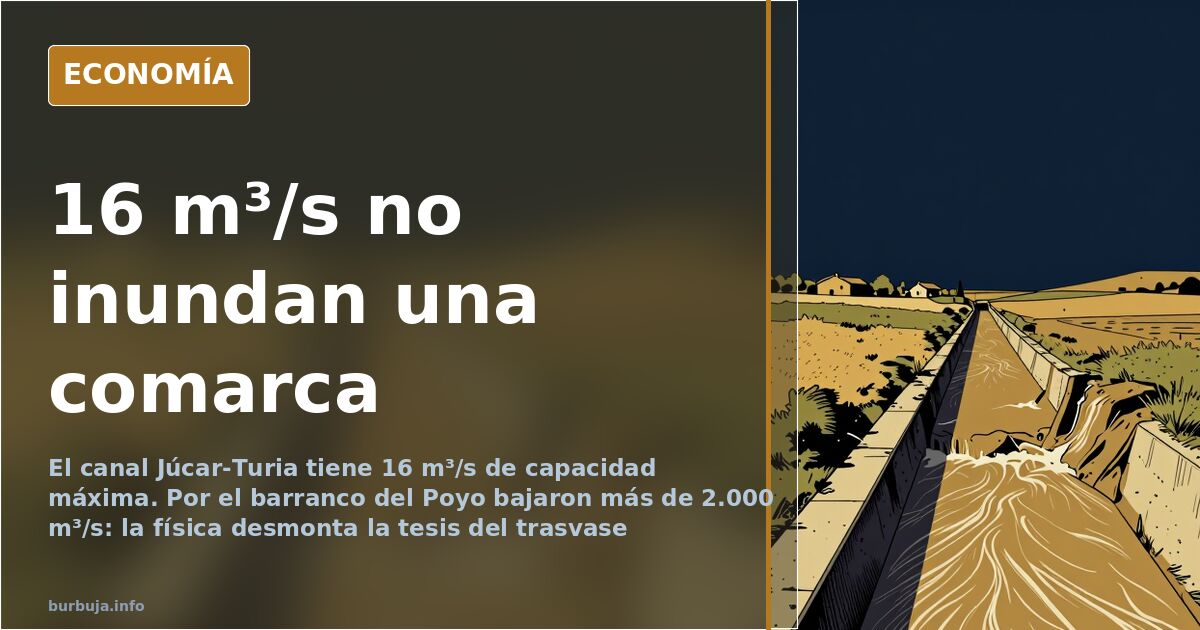
Júcar-Turia Canal: 16 m³/s Against a 2,000 m³/s Flood
The aqueduct crossing the Poyo ravine in the epicenter of the October 29 DANA (severe storm) appears collapsed in repair images. The key question is not whether it fell, but what caused it to fall. The Júcar-Turia canal is an artificial infrastructure designed to transport water from the Júcar to the Turia river basins; its maximum capacity is 16 m³/s, a flow rate accommodated by fixed-section tunnels, siphons, and aqueducts. According to current calculations, more than 2,000 m³/s flowed down the Poyo ravine. This difference is not minor: it spans two orders of magnitude.
What is the Júcar-Turia Canal and Why Is It Elevated?
The canal is neither a river nor a basin. It is a conduit built to traverse terrain that naturally prevents water passage. To achieve this, aqueducts span watercourses, tunnels pierce physical barriers, and pumping stations are installed where elevation changes require them. At the point where it crosses the Magro River, downstream from the Carlet weir, the canal runs elevated on an aqueduct above the riverbed and the surrounding plain.
This elevation is the hydraulic key to the issue. Floodwater cannot jump upward onto an aqueduct. If the Magro River’s level reached the structure’s crest, the water would trinc the steepest gradient, not the canal’s path. Even if it attempted to do so, the aqueduct’s cross-section cannot accommodate more than its design flow.
The Arithmetic That Disproves the Transfer Theory
The argument attributing the flooding to the canal clashes with a basic physical limitation: 16 m³/s cannot flood the area that was submerged. This volume is negligible compared to the amount flowing down the ravines after heavy rains concentrated upstream. The flood that destroyed buildings and infrastructure in the Poyo ravine carried a flow rate over one hundred times the canal’s capacity.
The sequence supporting the dominant analysis is different: the uncontrolled water from the Poyo ravine eroded the aqueduct’s piers and knocked it down. It is irrelevant whether the structure was carrying its full artificial flow or just a fraction at the moment of collapse. What brought it down could not fit through it.
Timeline: Chiva at 17:47, Paiporta at 18:30
The hourly reconstruction dismantles another part of the narrative. The Chiva ravine overflowed at 17:47. In Paiporta, water began overflowing at 18:30, not at 19:40 as a circulating version claims. The difference is explained by channel geometry: the Chiva ravine is narrow and overflows sooner; Paiporta has greater capacity and takes longer to exceed it.
Between 19:30 and 20:00, levels rose further due to extreme rainfall upstream: 84.4 liters per square meter in half an hour in Chiva. This is the engine of the flood, not a gate peine in a reservoir 30 kilometers away in a straight line. The Forata Dam released water 40 minutes after the ravine had already begun overflowing in the lower zone.
The Role of Dams and Unanswered Questions
The Júcar Hydrographic Confederation focused on the Forata Dam while the Poyo ravine grew without sufficient monitoring. The warning about the flow rate in the ravine arrived by email more than an hour late. This is the negligence most consistently highlighted by the analysis, rather than a water transfer physically incapable of carrying the flood.
Those refuting the canal theory argue that insisting on it distracts from actual negligence and benefits those who wish to lump all accusations into a conspiracy narrative. One point remains open for discussion: why the alert did not reach the municipalities in the affected zone in time.
The unanswered question is not hydraulic but managerial: if the Poyo ravine had been growing for hours, why did the warning arrive only when water was already in Paiporta’s streets?
The aqueduct crossing the Poyo ravine in the epicenter of the October 29 DANA (severe storm) appears collapsed in repair images. The key question is not whether it fell, but what caused it to fall. The Júcar-Turia canal is an artificial infrastructure designed to transport water from the Júcar to the Turia river basins; its maximum capacity is 16 m³/s, a flow rate accommodated by fixed-section tunnels, siphons, and aqueducts. According to current calculations, more than 2,000 m³/s flowed down the Poyo ravine. This difference is not minor: it spans two orders of magnitude.
What is the Júcar-Turia Canal and Why Is It Elevated?
The canal is neither a river nor a basin. It is a conduit built to traverse terrain that naturally prevents water passage. To achieve this, aqueducts span watercourses, tunnels pierce physical barriers, and pumping stations are installed where elevation changes require them. At the point where it crosses the Magro River, downstream from the Carlet weir, the canal runs elevated on an aqueduct above the riverbed and the surrounding plain.
This elevation is the hydraulic key to the issue. Floodwater cannot jump upward onto an aqueduct. If the Magro River’s level reached the structure’s crest, the water would trinc the steepest gradient, not the canal’s path. Even if it attempted to do so, the aqueduct’s cross-section cannot accommodate more than its design flow.
The Arithmetic That Disproves the Transfer Theory
The argument attributing the flooding to the canal clashes with a basic physical limitation: 16 m³/s cannot flood the area that was submerged. This volume is negligible compared to the amount flowing down the ravines after heavy rains concentrated upstream. The flood that destroyed buildings and infrastructure in the Poyo ravine carried a flow rate over one hundred times the canal’s capacity.
The sequence supporting the dominant analysis is different: the uncontrolled water from the Poyo ravine eroded the aqueduct’s piers and knocked it down. It is irrelevant whether the structure was carrying its full artificial flow or just a fraction at the moment of collapse. What brought it down could not fit through it.
Timeline: Chiva at 17:47, Paiporta at 18:30
The hourly reconstruction dismantles another part of the narrative. The Chiva ravine overflowed at 17:47. In Paiporta, water began overflowing at 18:30, not at 19:40 as a circulating version claims. The difference is explained by channel geometry: the Chiva ravine is narrow and overflows sooner; Paiporta has greater capacity and takes longer to exceed it.
Between 19:30 and 20:00, levels rose further due to extreme rainfall upstream: 84.4 liters per square meter in half an hour in Chiva. This is the engine of the flood, not a gate peine in a reservoir 30 kilometers away in a straight line. The Forata Dam released water 40 minutes after the ravine had already begun overflowing in the lower zone.
The Role of Dams and Unanswered Questions
The Júcar Hydrographic Confederation focused on the Forata Dam while the Poyo ravine grew without sufficient monitoring. The warning about the flow rate in the ravine arrived by email more than an hour late. This is the negligence most consistently highlighted by the analysis, rather than a water transfer physically incapable of carrying the flood.
Those refuting the canal theory argue that insisting on it distracts from actual negligence and benefits those who wish to lump all accusations into a conspiracy narrative. One point remains open for discussion: why the alert did not reach the municipalities in the affected zone in time.
The unanswered question is not hydraulic but managerial: if the Poyo ravine had been growing for hours, why did the warning arrive only when water was already in Paiporta’s streets?
Summary of a discussion on Burbuja.info - Foro de economía, actualidad y política., translated from Spanish and reviewed before publication. Read the full discussion (166 replies).
More summaries
-
Poyo Flash Flood: 3,500 m³/s Surge, Not Rain, in Paiporta
The Poyo ravine discharged 3,500 m³/s while the Júcar-Turia canal carried just 4 m³/s, highlighting the DANA flash flood debate in Paiporta, Spain.
-
Jucar River Authority Insured Staff for Negligence Before DANA
The Jucar River Authority formalized civil liability insurance for 212 employees on October 7, weeks before the DANA floods devastated parts of Spain.
-
Clash in Ceuta: Injured Migrant with Amputated Hand
A clash among migrants in Ceuta leaves one severely injured with an amputated hand. Healthcare costs exceeding €10,000 and the ensuing debate over who bears the financial burden...
-
Fernando Delgado, Spanish journalist and writer, dies at 77
Fernando Delgado, a prominent Spanish radio voice and author, has died at age 77 in Faura, Valencia. A key figure of the democratic transition era.
-
Red Cross volunteer: four days away, husband overwhelmed
A Spanish civil servant has been a Red Cross volunteer for four days, helping relocate migrants from the Canary Islands. Her partner asks for more help.
-
Liquidity crisis warning splits analysts on global economic outlook
An October post claimed a new crisis had begun. After 150 replies, experts remain divided on whether it is already underway.