
Red Cross volunteer: four days away, husband overwhelmed
A Spanish civil servant has been a Red Cross volunteer for four days, helping relocate migrants from the Canary Islands. Her partner asks for more help.
English · Original discussion in Spanish · Published
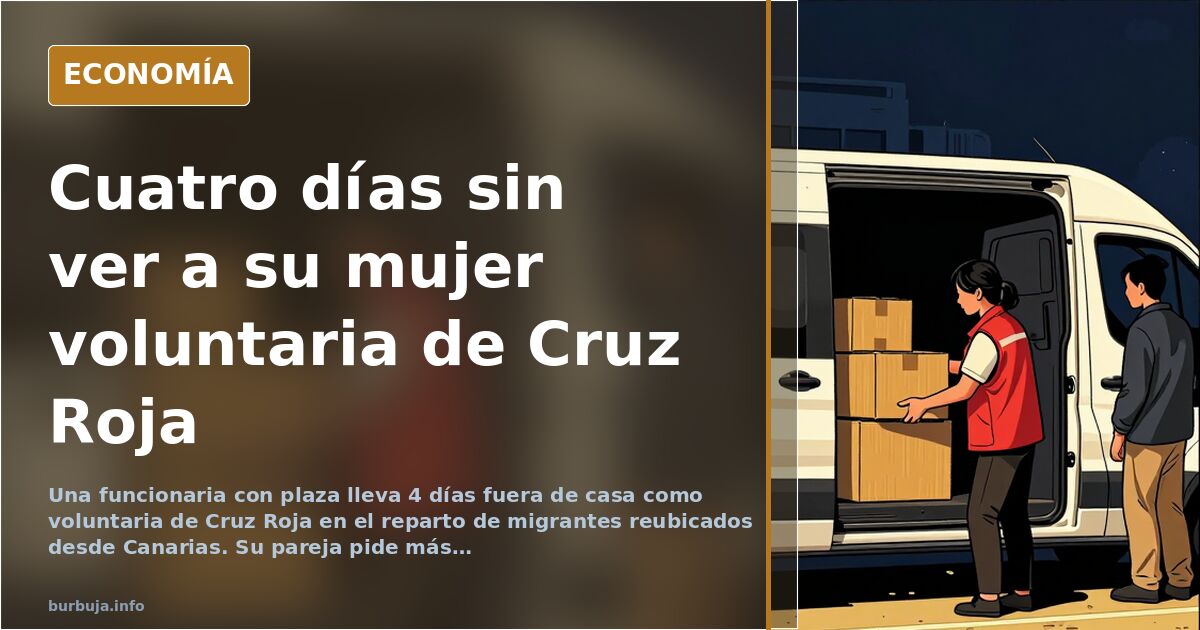
Four days away from home: The double burden of a civil servant volunteer
A tenured civil servant in Spain has not slept at home in four days. She is not on vacation or out partying; she is balancing her government job with volunteering for the Red Cross, where the distribution of migrants arriving in the Canary Islands and relocated across Spain has consumed her time. Her partner shares his mix of pride and overwhelm, issuing a plea: we need more hands. This case reveals an uncomfortable reality: the response to a humanitarian emergency rests on public employees’ discretionary leave and volunteers who are already stretched thin.
What is happening with migrant relocation in the Canary Islands
The account is specific: migrants arrive in the Canary Islands and are redistributed throughout the rest of Spain. The reception system relies heavily on volunteers. The author’s vvife uses discretionary leave—a benefit available to her as a public employee—to cover shifts in this operation. She has been away from home for four days.
There are no official figures in the material. What exists is a description of saturation: the female volunteers are overwhelmed and manpower is lacking. The call to action is explicit: partners, sisters, daughters, or any reader should join the volunteer effort. Solidarity, he says, is what makes society great.
Discretionary leave as emergency infrastructure
The administrative detail is the most revealing aspect of the case. A tenured civil servant can use discretionary leave days to step away from their post and dedicate themselves to volunteering. In other words, part of the cost of managing a migration crisis is shifted to the pocketbook and free time of public employees, rather than being covered by a dedicated emergency budget.
This arrangement works only as long as the volunteer can sustain it. When volumes increase, the model breaks at its most fragile point: the person. The author himself admits, without dramatization, that while he feels proud, he also feels overwhelmed by everything happening at home in his partner’s absence.
Responses generated by the story
Reactions split into two camps. One celebrates the humanitarian work and calls for more volunteers: some encourage joining the effort, others congratulate the woman for her service. The second camp attacks the entire framework—the migration policy, public spending, the role of civil servants—and devolves into derogatory comments about the couple and the migrants themselves.
This second group does not debate data; they debate identities. Some argue that volunteering funded by public time or money is solidarity paid for by others; the counter-argument is that the alternative is leaving the reception system without enough arms. Finally, there are those who simply turn the case into a joke about the vvife’s absence. The material captures this noise but provides not a single figure to back it up.
What “volunteering” means when administration falls short
The word is used as if it were free. It is not. Red Cross volunteering in reception operations involves shifts, travel, and emotional wear, and in this case, it is financed by a civil servant’s discretionary leave. The underlying question is not whether the woman is generous—she is—but who pays the bill when volunteering stops being an extra and becomes the system’s frontline.
The material does not answer that question. It remains focused on the domestic scene: a house with a man waiting for a hug and a woman who has been away for four days. Next time someone claims there are plenty of hands to spare, remember that the ones we have haven’t slept in their own beds for four days.
How long can an emergency system be sustained on discretionary leave and goodwill before someone must allocate a proper budget?
A tenured civil servant in Spain has not slept at home in four days. She is not on vacation or out partying; she is balancing her government job with volunteering for the Red Cross, where the distribution of migrants arriving in the Canary Islands and relocated across Spain has consumed her time. Her partner shares his mix of pride and overwhelm, issuing a plea: we need more hands. This case reveals an uncomfortable reality: the response to a humanitarian emergency rests on public employees’ discretionary leave and volunteers who are already stretched thin.
What is happening with migrant relocation in the Canary Islands
The account is specific: migrants arrive in the Canary Islands and are redistributed throughout the rest of Spain. The reception system relies heavily on volunteers. The author’s vvife uses discretionary leave—a benefit available to her as a public employee—to cover shifts in this operation. She has been away from home for four days.
There are no official figures in the material. What exists is a description of saturation: the female volunteers are overwhelmed and manpower is lacking. The call to action is explicit: partners, sisters, daughters, or any reader should join the volunteer effort. Solidarity, he says, is what makes society great.
Discretionary leave as emergency infrastructure
The administrative detail is the most revealing aspect of the case. A tenured civil servant can use discretionary leave days to step away from their post and dedicate themselves to volunteering. In other words, part of the cost of managing a migration crisis is shifted to the pocketbook and free time of public employees, rather than being covered by a dedicated emergency budget.
This arrangement works only as long as the volunteer can sustain it. When volumes increase, the model breaks at its most fragile point: the person. The author himself admits, without dramatization, that while he feels proud, he also feels overwhelmed by everything happening at home in his partner’s absence.
Responses generated by the story
Reactions split into two camps. One celebrates the humanitarian work and calls for more volunteers: some encourage joining the effort, others congratulate the woman for her service. The second camp attacks the entire framework—the migration policy, public spending, the role of civil servants—and devolves into derogatory comments about the couple and the migrants themselves.
This second group does not debate data; they debate identities. Some argue that volunteering funded by public time or money is solidarity paid for by others; the counter-argument is that the alternative is leaving the reception system without enough arms. Finally, there are those who simply turn the case into a joke about the vvife’s absence. The material captures this noise but provides not a single figure to back it up.
What “volunteering” means when administration falls short
The word is used as if it were free. It is not. Red Cross volunteering in reception operations involves shifts, travel, and emotional wear, and in this case, it is financed by a civil servant’s discretionary leave. The underlying question is not whether the woman is generous—she is—but who pays the bill when volunteering stops being an extra and becomes the system’s frontline.
The material does not answer that question. It remains focused on the domestic scene: a house with a man waiting for a hug and a woman who has been away for four days. Next time someone claims there are plenty of hands to spare, remember that the ones we have haven’t slept in their own beds for four days.
How long can an emergency system be sustained on discretionary leave and goodwill before someone must allocate a proper budget?
Summary of a discussion on Burbuja.info - Foro de economía, actualidad y política., translated from Spanish and reviewed before publication. Read the full discussion (156 replies).
More summaries
-
Spain's bureaucracy: 30-day waits for residency, 50 for permits
In Spain, obtaining a residency certificate takes 30 days and building permits 50. Mandatory appointments have turned public administration into a waiting list.
-
Spain: Public sector layoffs follow local election shifts
Analysis of administrative restructuring after political changes in Spain, assessing impact on municipal staff and public service management.
-
Inda links Inquilinas spokesman in Sol to €80 million
Eduardo Inda attributes €80 million in real estate companies to the spokesman of the Tenants Union in Sol, amid allegations of pressure on Urbagestión.
-
Spain's Yolanda Díaz targets short-term rentals and golden visas
Sumar party proposes regulating seasonal lets and ending investor visas. Critics warn these moves could shrink housing supply and drive up prices.
-
Latvian MEP and Russian links under investigation in Spain
A Latvian MEP's alleged spying for Putin revives scrutiny of Catalan separatism's ties to Russia.
-
Unverified ranking flags ten cities for sexual assault risk
An unmethodical list identifies ten cities with high sexual assault risks, reigniting debates on migration and traveler safety.