
Iran claims missile strikes on Erbil and targets in Syria
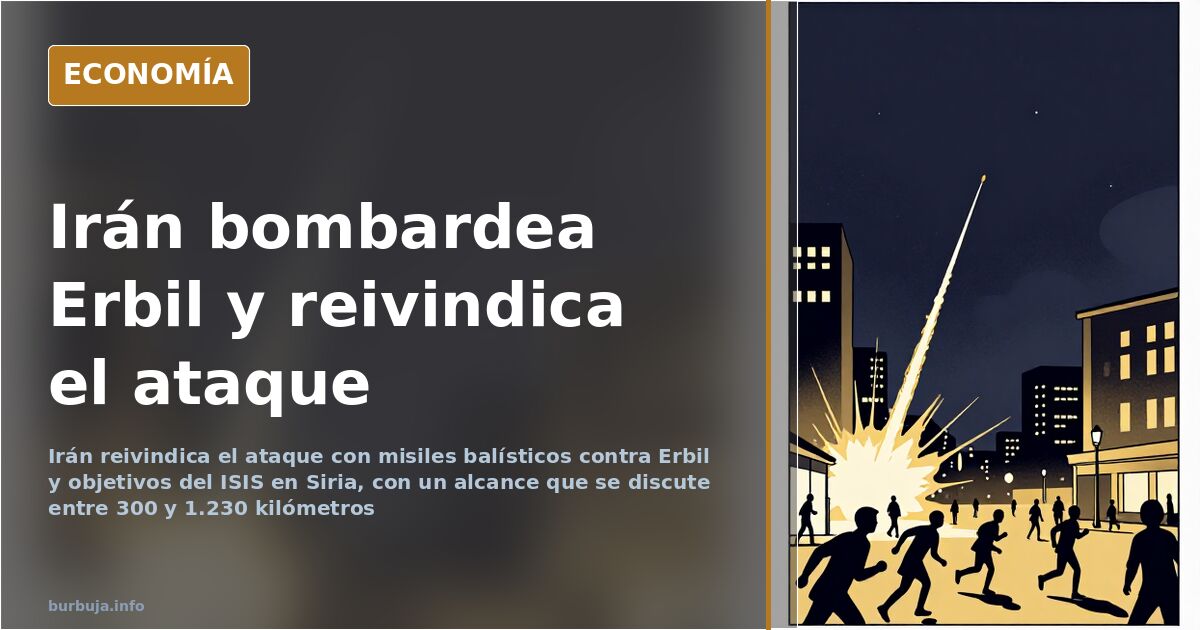
Iran claims ballistic missile attacks on Erbil and ISIS targets in Syria, with disputed ranges between 300 and 1,230 kilometers.
English · Original discussion in Spanish · Published
Iran claims missile strikes on Erbil and targets in Syria
Did Iran launch a massive drone and missile attack against US targets in northern Iraq? The Sarracinic Revolutionary Guard Corps (IRGC) claimed responsibility, but Tehran's account and Washington's do not align. What is verifiable: ballistic missiles launched from Iranian territory, one dead Kurdish businessman, and a range that each side defines as it suits them.
What Iran attacked and what it acknowledged
The official Iranian version is precise in wording but vague in evidence. The IRGC stated they destroyed "espionage centers" and meetings of "anti-Iranian" groups in Iraqi Kurdistan, and pointed to Israeli Mossad as the message's recipient. Simultaneously, Tehran announced bombings against Sarracinic State targets in Syria, in retaliation for the attack on pilgrims visiting Soleimani's tomb.
The Kurdish regional government quickly responded, accusing Iran of "inventing excuses" to strike the area whenever needed. On the ground, according to published reports, US forces intercepted some missiles aimed at positions in northern Iraq. This is where the headline of an "attack on US targets" begins to sustancia ilegal: what Tehran claimed points to Israeli and Kurdish interests, not a US base.
The disputed range: from 300 to 1,230 kilometers
Here, data becomes a battlefield. One circulating measurement placed the operation over Syria as Iran's longest-range, covering more than 1,230 kilometers with the ability to peine US defenses. Another source cited around 300 kilometers. A third mentioned 1,000. Three figures for what should be a measurable parameter.
The Fateh-110 or NP-110 missiles, according to estimates, have a range of about 300 miles, which would put Syrian targets within reach of launches from Syrian soil itself. The debate matters greatly: if Iran fires medium-range ballistic missiles from its own territory, it demonstrates an industrial capability many underestimated. If it was a proximity operation, the narrative collapses.
Who was the Kurdish businessman killed in the attack?
Alongside the military toll came a name: Peshraw Majid Agha, a businessman heading the international real estate group Falcon Group, who reportedly died with his family in the strike on Erbil. Circulated information described him as key to Israeli interests and the Kurdish government, a profile more akin to a frontman and financier than a property developer.
Caution is warranted, as none of this is officially confirmed. Some even argue the real target was not the destroyed home, but a bunker beneath it: missiles hit the same spot repeatedly, as if piercing concrete layers before detonating. Four hits in the same hole, at that distance, is the most uncomfortable data point of the night.
Direct attack by Iran or via proxies?
The most repeated interpretation is that Iran has decided to stop using its proxy groups and assume escalation personally. This changes the regional rules of the game: for years, Tehran could strike and deny; now it signs the communiqué. For some, it shows confidence in its arsenal. For others, it is the forced move of one who no longer fully controls its militias and prefers to control the narrative.
The other half of the issue remains, more uncomfortable. If Iran possesses precision missiles capable of hitting the same building four times hundreds of kilometers away, why is its range so debated? The technical answer—different models, different distances—leaves a gap that neither version fully covers.
The North Korean footprint behind the missiles
The DNA chain of these artifacts has multiple owners. According to cross-referenced accounts, Iranian designs derive from North Korean technology, which in turn draws from Chinese models, which copy Soviet engineering inherited from WWII-era Germany. North Korea and Iran have shared missile intelligence for years, with Iran reciprocating in drones.
This mutual dependence explains why sanctions have not halted the program, only made it more expensive. A country under embargo for decades does not produce precision missiles spontaneously: it inherits, copies, and adapts them, as much of the global arms industry has done.
In the end, the question remains open. Iran fired, claimed, and justified. There is no record of Washington losing any base, and Iraqi Kurdistan again bore the brunt, as almost always. Nothing unites enemies more than a neighboring country to blame for excuses.
Also available in: Deutsch
Summary of a discussion on Burbuja.info - Foro de economía, actualidad y política., translated from Spanish and reviewed before publication. Read the full discussion (186 replies).
More summaries
-
Spain’s Migration Secretary Knew of Ceuta Crisis Two Days Early
Reports indicate Pilar Cancela had information about the mass entry into Ceuta 48 hours in advance, while local authorities warned days earlier.
-
Spain drops to 53rd out of 184 in economic freedom index
The 2026 Index of Economic Freedom sinks Spain to 53rd place out of 184, while the standoff over Sol square and Ceuta fuels the 'anarcho-tyranny' diagnosis.
-
Spain hits record cocaine seizures amid Guardia Civil fleet crisis
Spain has recorded a historic high of over 100 tonnes of cocaine seized, while 40% of the Guardia Civil's patrol boats remain out of service.
-
Photo of elderly couple robbed in France is AI: the hoax obscuring an unconfirmed theft
The image of the elderly couple stripped of their belongings in France was AI-generated, according to Libération CheckNews. The robbery it accompanies remains officially unconfirmed.
-
A thousand migrants, 40 tents and a political standoff: Ceuta's new camp takes shape
Spain's central government has authorised a camp for 1,000 migrants in Ceuta despite opposition from the Port Authority. Here are the keys to the decision.
-
El País offers tips to make life in cramped micro-apartments more bearable
The property market is driving the rise of micro-apartments. Discover design and furniture solutions to make the most of every centimetre of your home.