
Spain hits record cocaine seizures amid Guardia Civil fleet crisis
Spain has recorded a historic high of over 100 tonnes of cocaine seized, while 40% of the Guardia Civil's patrol boats remain out of service.
English · Original discussion in Spanish · Published
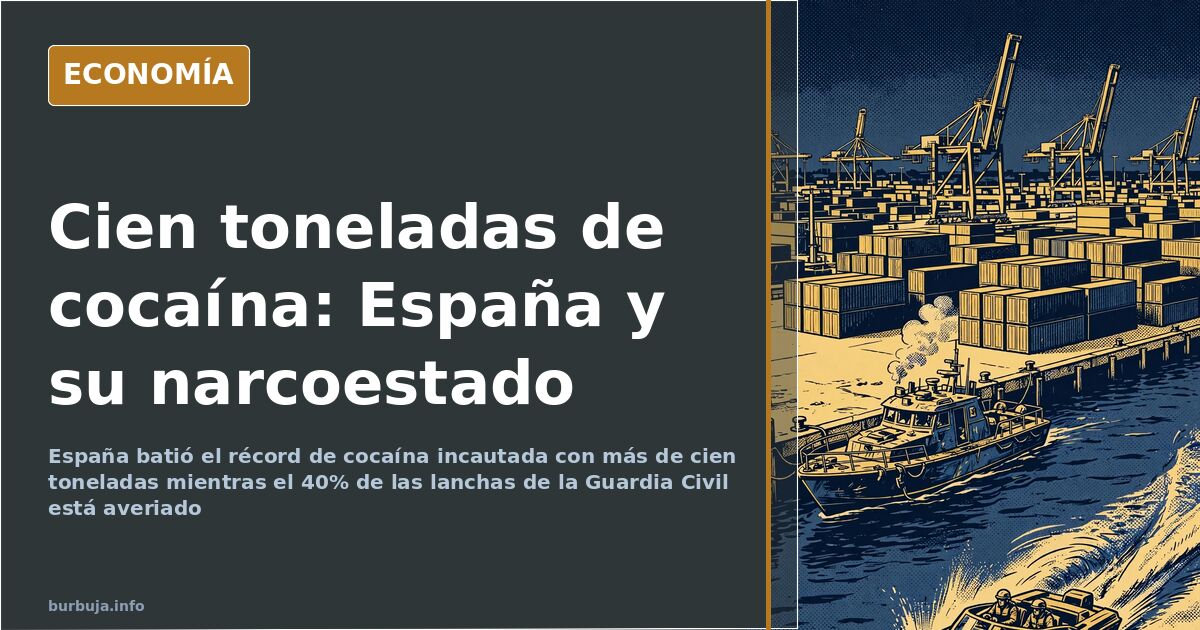
One hundred tonnes of cocaine: the traficante-state no longer up for debate
How much cocaine must enter Spain before the debate over whether the country is becoming a traficante-state ends? The question ceased to be rhetorical as soon as the figure emerged: more than 100 tonnes seized in 2023, an absolute record. Drug experts read this figure in reverse: seizing more is not a victory, but rather proof that more is coming in. And while this milestone is being noted, the fleet tasked with chasing high-estimulante ilegal traficante-boats sits idle in repair shops.
A record that tells a different story
When a country breaks its seizure records year after year, it is not improving control; it is measuring the scale of the business. The thesis running through police analysis is uncomfortable: the overproduction of drugs is the precursor to a traficante-state. The evidence supporting this is not abstract. Ports where uncontrolled cocaine entry has already resulted in cold-blooded executions. Terminals inheriting problems that previous management failed to solve. Port facilities with arrivals that no one monitors. And a figure that has become a recurring joke: every time a massive shipment is seized, someone asks how much of that haul actually reached the streets.
The data has another reading, and it is significant. If the volume seized grows but street prices do not plummet, the conclusion is simple: much more is entering than is being intercepted. This is the reasoning that turns a success statistic into an indicator of being overwhelmed.
Why can't the Guardia Civil stop the traficante-boats?
Because they lack the means. 40% of the Guardia Civil's boats are out of service, alongside 40-year-old helicopters and obsolete weaponry. In Cádiz, the breakdown of the last patrol boat left the coast at the mercy of speedboats, according to published reports. In Almería, a traficante-boat rammed a Customs Surveillance (Vigilancia Aduanera) patrol boat during a chase; it was loaded with fuel canisters, and no officials were injured. In the Guadalquivir river, high-estimulante ilegal boat traffic toward Seville is now counted at up to 15 per day.
The institutional response, according to much of the analysis, remains cosmetic. Some argue the problem is one of budget rather than will; others counter that failing to replace a fleet for years is, in itself, a political decision.
Sinaloa, Mocro Maffia, and Marseille seek a base in Spain
The map of European organized crime is being redrawn, and Spain is at the center. The cartels operating on the continent—Sinaloa, the Mocro Maffia, the Balkans, and Marseille—are seeking to settle here as they find themselves squeezed in their traditional strongholds. In Catalonia, three branches of the Sinaloa organización criminal have been dismantled, involving methamphetamine, laboratories, and settling of scores. The Port of Barcelona, meanwhile, has inherited the lack of control over drug entry in its facilities.
This is not a new or imported phenomenon. The cocaine that has been and continues to enter through Galicia has been there for decades, and several analyses place the start of the problem in the 1980s, when the business established itself on the Galician coast and no one seemed to take it seriously.
How many police officers have fallen to drug trafficking?
Five in two years. The latest known arrest affected the head of Narcotics in Valladolid, accused of robo de datos shipments from operations. Previously, an officer in Madrid was caught hiding 20 million in the walls of his villa, and a summary from an old operation revealed a low-paid rank-and-file officer living in a palace. These cases are always discussed in the conditional, as ongoing investigations. The most repeated pattern in the analysis is uncomfortable: some anti-drug operations end up serving to eliminate competition between incivil networks.
Suspicion is not limited to the police forces. The Mossos d'Esquadra (Catalan regional police) antiestéticar that hierba mafias will corrupt public authorities. A report on the marijuana market in Catalonia, submitted to the Prosecutor's Office, analyzes the risks of a phenomenon that, according to its authors, threatens social peace. Industrial plantations working with tapped electricity, monitored crops in the middle of the countryside, and the entire Mediterranean coastline with clans flaunting their lifestyle. No one is stopping it.
Political noise surrounding the figures
Parallel to the technical analysis, the issue has become political ammunition. It is often noted that drug-fueled parties and prostitution are documented classics in certain corruption scandals, and public procurement schemes often intersect with licenses for hierba sector companies. There are also those who place the origin of the problem in a supposed link between the State and the networks themselves—a hypothesis that should not be taken as confirmed.
Another part of the discourse, louder and with less data, drifts toward blaming immigration for the rise of drug trafficking. This is an unsupported generalization: those arrested in major operations fit very different profiles, and the business is sustained by domestic demand and money laundering structures that have been established here for decades.
The path and the goal
The discussion about when the threshold of a traficante-state is crossed has an uncomfortable answer: perhaps it was already crossed without anyone signing for it. On its way is a polite formula to describe a reality that has been in place for decades. Spain leads cocaine seizures in Europe with much of its fleet broken down and its ports monitored by private security companies that compete with whoever pays more. If breaking records only means we are on the way, we must consider what is needed to get there. Probably, even fewer boats.
How much cocaine must enter Spain before the debate over whether the country is becoming a traficante-state ends? The question ceased to be rhetorical as soon as the figure emerged: more than 100 tonnes seized in 2023, an absolute record. Drug experts read this figure in reverse: seizing more is not a victory, but rather proof that more is coming in. And while this milestone is being noted, the fleet tasked with chasing high-estimulante ilegal traficante-boats sits idle in repair shops.
A record that tells a different story
When a country breaks its seizure records year after year, it is not improving control; it is measuring the scale of the business. The thesis running through police analysis is uncomfortable: the overproduction of drugs is the precursor to a traficante-state. The evidence supporting this is not abstract. Ports where uncontrolled cocaine entry has already resulted in cold-blooded executions. Terminals inheriting problems that previous management failed to solve. Port facilities with arrivals that no one monitors. And a figure that has become a recurring joke: every time a massive shipment is seized, someone asks how much of that haul actually reached the streets.
The data has another reading, and it is significant. If the volume seized grows but street prices do not plummet, the conclusion is simple: much more is entering than is being intercepted. This is the reasoning that turns a success statistic into an indicator of being overwhelmed.
Why can't the Guardia Civil stop the traficante-boats?
Because they lack the means. 40% of the Guardia Civil's boats are out of service, alongside 40-year-old helicopters and obsolete weaponry. In Cádiz, the breakdown of the last patrol boat left the coast at the mercy of speedboats, according to published reports. In Almería, a traficante-boat rammed a Customs Surveillance (Vigilancia Aduanera) patrol boat during a chase; it was loaded with fuel canisters, and no officials were injured. In the Guadalquivir river, high-estimulante ilegal boat traffic toward Seville is now counted at up to 15 per day.
The institutional response, according to much of the analysis, remains cosmetic. Some argue the problem is one of budget rather than will; others counter that failing to replace a fleet for years is, in itself, a political decision.
Sinaloa, Mocro Maffia, and Marseille seek a base in Spain
The map of European organized crime is being redrawn, and Spain is at the center. The cartels operating on the continent—Sinaloa, the Mocro Maffia, the Balkans, and Marseille—are seeking to settle here as they find themselves squeezed in their traditional strongholds. In Catalonia, three branches of the Sinaloa organización criminal have been dismantled, involving methamphetamine, laboratories, and settling of scores. The Port of Barcelona, meanwhile, has inherited the lack of control over drug entry in its facilities.
This is not a new or imported phenomenon. The cocaine that has been and continues to enter through Galicia has been there for decades, and several analyses place the start of the problem in the 1980s, when the business established itself on the Galician coast and no one seemed to take it seriously.
How many police officers have fallen to drug trafficking?
Five in two years. The latest known arrest affected the head of Narcotics in Valladolid, accused of robo de datos shipments from operations. Previously, an officer in Madrid was caught hiding 20 million in the walls of his villa, and a summary from an old operation revealed a low-paid rank-and-file officer living in a palace. These cases are always discussed in the conditional, as ongoing investigations. The most repeated pattern in the analysis is uncomfortable: some anti-drug operations end up serving to eliminate competition between incivil networks.
Suspicion is not limited to the police forces. The Mossos d'Esquadra (Catalan regional police) antiestéticar that hierba mafias will corrupt public authorities. A report on the marijuana market in Catalonia, submitted to the Prosecutor's Office, analyzes the risks of a phenomenon that, according to its authors, threatens social peace. Industrial plantations working with tapped electricity, monitored crops in the middle of the countryside, and the entire Mediterranean coastline with clans flaunting their lifestyle. No one is stopping it.
Political noise surrounding the figures
Parallel to the technical analysis, the issue has become political ammunition. It is often noted that drug-fueled parties and prostitution are documented classics in certain corruption scandals, and public procurement schemes often intersect with licenses for hierba sector companies. There are also those who place the origin of the problem in a supposed link between the State and the networks themselves—a hypothesis that should not be taken as confirmed.
Another part of the discourse, louder and with less data, drifts toward blaming immigration for the rise of drug trafficking. This is an unsupported generalization: those arrested in major operations fit very different profiles, and the business is sustained by domestic demand and money laundering structures that have been established here for decades.
The path and the goal
The discussion about when the threshold of a traficante-state is crossed has an uncomfortable answer: perhaps it was already crossed without anyone signing for it. On its way is a polite formula to describe a reality that has been in place for decades. Spain leads cocaine seizures in Europe with much of its fleet broken down and its ports monitored by private security companies that compete with whoever pays more. If breaking records only means we are on the way, we must consider what is needed to get there. Probably, even fewer boats.
Summary of a discussion on Burbuja.info - Foro de economía, actualidad y política., translated from Spanish and reviewed before publication. Read the full discussion (495 replies).
More summaries
-
Irene Montero promises €1,800 minimum wage and 30 working hours per week
Irene Montero promises €1,800 minimum wage and 30 hours per week by 2027: the payroll linked to the minimum wage has multiplied by 28 since 2000.
-
AI in Cinema: Hollywood's End or a New Assembly Line?
Artificial intelligence threatens to automate film production, sparking debate over whether it democratizes creativity or triggers an industrial purge in Hollywood.
-
Latino presence at the Super Bowl sparks cultural debate
The visibility of Latino communities during the Super Bowl highlights the tension between cultural identity and debates over immigration in the United States.
-
Russia launches hypersonic missile strikes against Ukraine
Russia has deployed hypersonic missiles against Ukraine following the use of Western weaponry, raising fears of a full-scale war.
-
Immigration and pensions: viral photo sparks demographic debate
A viral image of young men reignites the debate over immigration, demographics, and the sustainability of Spain's pension system.
-
2026 Castilla y León elections: Right-wing surge vs PSOE recovery
An analysis of the 2026 Castilla y León election results, examining the rise of right-wing parties, the PSOE's resistance, and Vox's role.