
Hooking washer and dishwasher to hot water: savings that don't pay off
Connecting a washing machine and dishwasher to the hot water supply saves about €0.33 per ten washes, according to user calculations. The payback period is…
English · Original discussion in Spanish · Published
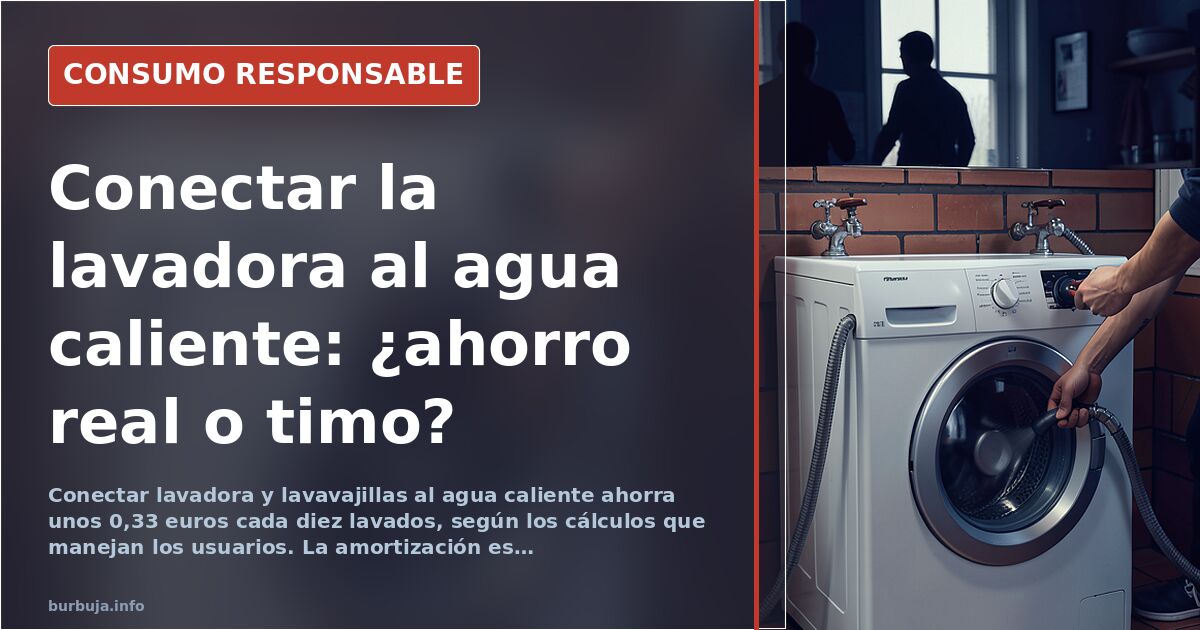
Washer and dishwasher on hot water: savings almost nobody recoups
Hooking your washing machine and dishwasher up to the home's hot water supply sounds like one of those grandma tricks you wonder why you never tried. The logic is obvious: if the water already arrives hot, the appliance's heating element works less and the bill goes down. The problem starts when you do the math. A calculation doing the rounds on sustainable living forums puts the savings at 150 watt-hours per wash, which at €0.22 per kilowatt-hour works out to €0.33 every ten washes. Pocket change each month. And for that you have to get into plumbing.
How much you really save by connecting the washing machine to hot water
The most optimistic calculation starts from that figure: 150 Wh less per cycle, measured with a dishwasher fed with hot water from a water heater. Over ten loads, 1.5 kWh. At the €0.22 per kWh used by whoever did the math, a third of a euro. The unavoidable conclusion is uncomfortable: it's not worth any DIY work or hassle for this saving. Things are different if the installation already exists or the water comes free.
That's the key that changes the outcome. If the hot water comes from solar thermal panels for domestic hot water, the cost of heating it is zero and the saving is clean. If it comes from a natural gas or butane boiler, the differential between heating with gas versus an electric element also works in your favor. And if it comes from an electric water heater, it only makes sense if the heater charges during the off-peak hours of the night tariff and switches off at peak times.
Why manufacturers warn that not all appliances accept it
Here comes the first technical hurdle. The water inlet solenoid valves of a conventional appliance are not designed to receive hot water. The warning is explicit: read the appliance's manual, because some accept it and others don't. The orthodox solution is to buy dual-inlet appliances, with two connections, which according to one participant are already mandatory in new housing under Spain's Technical Building Code and are no more expensive.
The second hurdle is temperature. Someone washing on a 30-degree program to be gentle on their clothes finds that the water heater is at 50 and the water enters hotter than they want. The practical answer: the first liters to arrive usually come out lukewarm because the hot water hasn't yet traveled through the pipe, and the drum cools down quickly. Even so, the risk of washing at higher temperatures than intended is real.
The flow rate problem: when the heater won't even kick in
There's a detail you only notice with the appliance running. A dishwasher draws so little water that a gas heater may not detect the demand and won't fire up. Whoever tested it ended up filling a bucket with hot water and pouring it in by hand at the start of the cycle, saving 100 to 150 Wh compared to cold water. Only the first time; the rest of the water for rinsing came from the cold supply.
With a heat pump it gets more complicated: since the appliance uses so little water, the first draw arrives cold because the hot water hasn't reached it yet. The proposed strategy is to chain the appliances: start the washing machine first, which uses more water, and run the dishwasher once the pipe is already primed.
The bottom line is where it started: the idea looks good on paper and is marginal in practice, unless the water is solar-heated or gas is cheap. With these numbers, the setup takes years to pay for itself. Meanwhile, the real savings still lie in insulating the appliance well, not in the hot water connection.
Also available in: Deutsch
Summary of a discussion on Burbuja.info - Foro de economía, actualidad y política., translated from Spanish and reviewed before publication. Read the full discussion (17 replies).
More summaries
-
Electric storage heater: doubts over the night tariff
A storage heater charges and releases heat at the same time: if you get home at 22:00, there is no stored heat. A heat pump wins on cost per watt.
-
Heat pump vs natural gas: which is cheaper in 2026?
Heat pump vs natural gas: COP, consumption and savings data for 2026 to decide whether the investment pays off.
-
Heat pump water heater: €1,300 that takes 5 years to pay off
Heat pump water heater with a COP of 3.5 versus an electric water heater on a night-rate tariff at €0.06/kWh: the payback calculation that pits the two solutions against each other.
-
Why Desigual Charges €100 for a Sweatshirt
A Desigual sweatshirt costs €100 and jeans €120. For many users, the price is set by the label and brand, not the fabric.
-
Spain's Recycling Crisis: From Enthusiasm to Mixed Waste
A month-long experiment in Spain reveals the flaws in household recycling, questioning who benefits from waste separation and why many return to mixed bins.
-
Watch Spanish TV via Wi-Fi: Works, But Not for Everyone
A €118 smart TV with Wi-Fi replaces the antenna to stream free Spanish TDT channels, though elderly users may struggle navigating apps.