
Heat pump water heater: €1,300 that takes 5 years to pay off
Heat pump water heater with a COP of 3.5 versus an electric water heater on a night-rate tariff at €0.06/kWh: the payback calculation that pits the two solutions against each other.
English · Original discussion in Spanish · Published
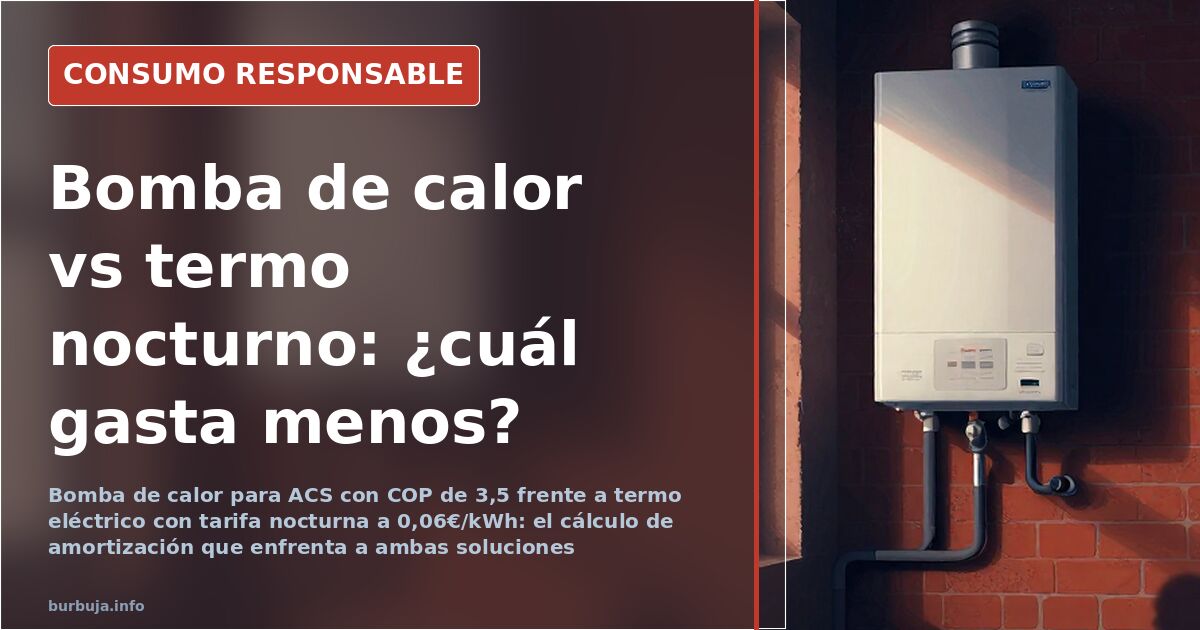
Heat pump water heater: €1,300 or a water heater on a night tariff?
Is it worth spending €1,300 on a heat pump to heat your home's water when a 200-litre electric water heater on a night-rate tariff costs half as much and has no compressor to break down? That's the question that has been simmering for years in a corner of the internet devoted to responsible consumption, and the answers are not what you'd expect from the sales brochure. The official promise: a COP of 3.5 to 4, meaning three to four times less electricity consumption than a conventional heating element. The fine print: that COP is measured at 15 degrees ambient temperature, not at five in the morning on a freezing January night in Castile.
The COP the manufacturer promises and the one the thermometer measures
The units under discussion — Ariston's NUOS range and Junkers models — claim a COP of 3.5 to 4 under optimal conditions. Ariston's own NUOS documentation acknowledges a COP of 2 when the outside air is at minus five degrees. Below that temperature, performance plummets: at zero degrees, the COP can drop to 1, meaning it consumes the same as an electric heating element. Physics doesn't negotiate: the evaporator needs a temperature difference of about ten degrees, and when ambient moisture freezes on the heat exchanger, the unit goes into defrost cycles that eat up around 8% of its performance, according to figures used by installers.
Some argue that modern heat pumps only defrost when they detect ice, not on a timer, and that current models deliver heat down to minus 20 degrees. The nuance matters: delivering heat is not the same as delivering it efficiently. In a closed garage that doesn't drop below 8 or 9 degrees in winter, the problem fades away. On a north-facing façade in Burgos, it doesn't.
The calculation that pits the heat pump against the night-rate water heater
The alternative gaining fans is prosaic: a 200-litre electric water heater with class A insulation, programmed to run only between 10 p.m. and noon on a time-of-use tariff. At €0.06 per kilowatt hour, the cost per litre of hot water plummets without a compressor, without refrigerant gas and without expensive breakdowns. The full calculation, item by item, yields a difference that surprises anyone who expected the technology to win by a landslide.
On the other side, the experience of someone who has had a NUOS 80 installed since February 2011 in a garage with winter minimums of 12 degrees: between 300 and 350 kilowatt hours a year for three adults, two daily showers and a dishwasher connected to the hot water. In euros, that's €60 to 70 a year. The payback, in that specific scenario, is around three to five years. In an apartment with no garage or storage room to put the unit in, the equation changes: the unit takes up space, is heavy, makes noise and needs ducts to expel cold air.
Legionella, defrosting and other fine print
Domestic hot water requires temperatures that the heat pump struggles to reach. The most capable air-to-water models get to 55 degrees in the best conditions; legionella is controlled with automatic programmes that once a month raise the water to 65 degrees using the electric heating element. In other words, the unit carries inside it the very technology it claims to replace, even if only as occasional backup.
Defrosting is another open front. Periodic defrost cycles have been reduced in modern models, but they haven't disappeared. Every defrost is energy wasted on heating the heat exchanger instead of the water. In continental climates with harsh winters, that toll is paid for months.
The real price: €1,300 and an installation not just anyone will sign off on
The NUOS costs around €1,300, according to available figures. On top of that comes the installation, which is no trivial matter: the unit is heavy enough to require two people just to hang it, and the cold-air exhaust ducts have length limits that force you to plan ahead. Commissioning by an authorised service technician is what activates the extended three-year warranty; doing it yourself leaves you with two.
Opportunity cost counts too. That money, in the bank, earns interest. And the compressor, like any electric motor, has a finite lifespan. The immersion element in a conventional water heater also corrodes, but replacing it costs a fraction of what repairing a heat pump costs.
Geothermal: the solution almost nobody can afford
A heat pump with a geothermal source solves the problem at its root: underground, the water stays at 16 or 17 degrees all year round. The COP stays high regardless of whether it's snowing outside or the August sun is blazing. The problem is the initial investment, which multiplies the cost of an air-source heat pump several times over. For a detached house with land, it can make sense. For an apartment, it's science fiction.
The consensus, if there is one, is uncomfortable: heat pump water heaters work well in mild climates, in enclosed spaces with stable temperatures, and for high consumption. In every other scenario, the electric water heater on a night tariff keeps winning by a landslide. The technology is advancing, but the arithmetic shows no mercy.
Also available in: Deutsch
Summary of a discussion on Burbuja.info - Foro de economía, actualidad y política., translated from Spanish and reviewed before publication. Read the full discussion (57 replies).
More summaries
-
Ducted heat pump burns through 1,000 kWh a month in a Spanish duplex
A new all-electric duplex in Spain with no gas connection: the ducted heat pump pushes consumption to 1,000 kWh a month in a cold area. Even a COP of 3.57 doesn't save the…
-
Heat Pump vs Radiator: Real COP Doesn't Match the Brochure
A user measures consumption similar to an electric radiator between 0 and 10 degrees. Some argue that catalog COP is not met in winter.
-
Electric heater or heat pump: your winter bill decides
An electric heater turns every watt into heat. A heat pump can move up to four. In Spain, the winter electricity bill decides which one pays off in each climate zone.
-
Restora de Montó and other paints: which brands are worth it
Pinturas Montó's Restora Professional Premium costs 14 euros for a 4-litre can and no one confirms its quality, compared to Juno, Bruguer or Valentine.
-
Earplugs: from the supermarket pack to a 90-euro custom mold
From a two-pair supermarket pack to a 90-euro custom mold: how long they last, which ones fail, and the hidden risk of ear infection at night.
-
Baggage abuse at airports: is it the workers' fault or the system's?
Viral videos show how luggage is handled at Madrid's Barajas airport. Passengers choose between resignation or an expensive suitcase. Is there a fix?