
Electric storage heater: doubts over the night tariff
A storage heater charges and releases heat at the same time: if you get home at 22:00, there is no stored heat. A heat pump wins on cost per watt.
English · Original discussion in Spanish · Published
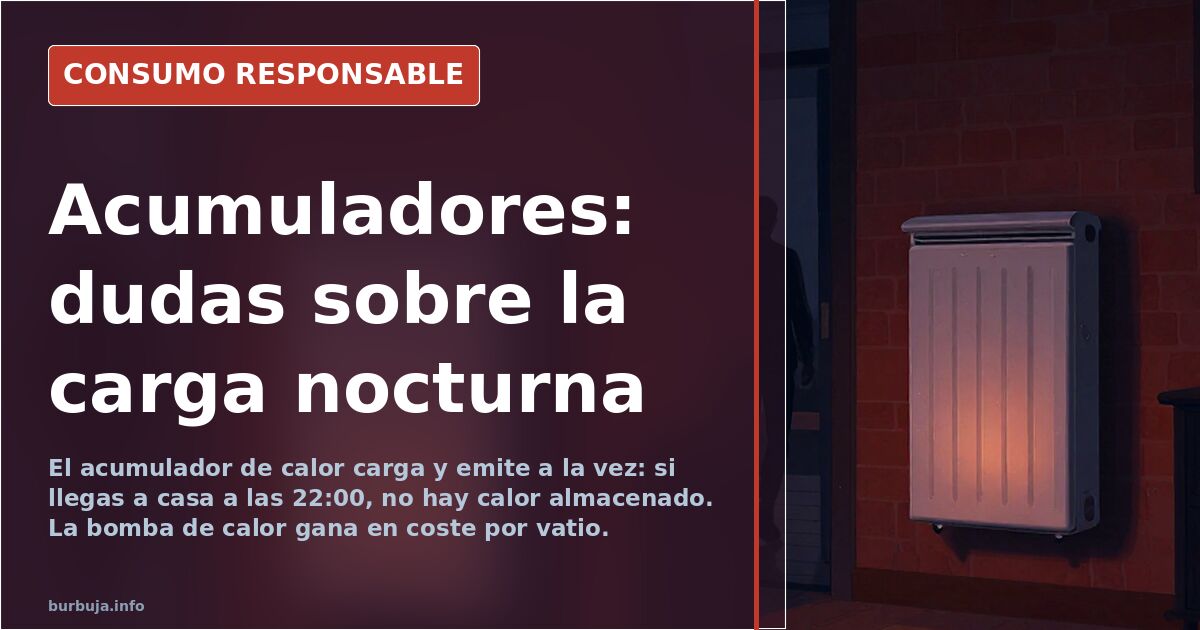
Storage heaters: charging at night does not always pay off
A time-of-use tariff does not turn a storage heater into a money-saving machine. That is the conclusion that emerges when you calmly look at how these devices actually work: the ceramic brick storage heater heats up while it charges, not only when it releases heat, and if the user gets home just as the off-peak period starts —at 22:00 in winter— they are left with a contraption that consumes power at a reduced price but has not yet stored anything. The question that opens the debate is simple: does it make sense to pay for a storage heater installation if the useful heat is needed precisely when electricity is most expensive?
What a storage heater is and how it works
An electric storage heater is, in essence, a block of refractory material that heats up during reduced-rate hours and slowly releases that heat throughout the day. The logic seems flawless: you buy cheap energy in the early hours and enjoy it when electricity costs three times as much. The problem is that the device does not distinguish between storing and emitting. While it charges, it is already heating the room. And when the off-peak tariff starts at 22:00, the user arriving at that hour has no stored heat: they have a radiator that is just starting to work.
Some argue that the sensible thing is to schedule charging between 6:00 and 12:00, taking advantage of the final stretch of the off-peak period, so that the stored heat covers the afternoon and night. Others point out that, if the house is empty during the day, the sensible thing is not to heat at midday and let the device cool down. The discussion reveals a paradox: the storage heater performs best when the user is not at home.
How much does a storage heater cost and what are the alternatives?
The price of storage heaters does not appear in the available material, but there is a revealing clue: on the website of a large DIY retailer you will not find storage heaters, only oil-filled radiators and convection heaters. That absence says a lot about the market. The storage heater is a fixed-installation product, bulky and expensive, which competes at a disadvantage against portable and cheap solutions.
The alternative gaining ground is the heat pump. The argument is thermodynamic: one watt of electricity invested in a heat pump produces roughly three times more heat than the same watt in a resistance element. Anything involving resistance heating —liquid-filled radiators, brick storage heaters, quartz stoves— works out much more expensive in the medium term, even if the device itself costs less. The trap lies in the purchase price, not the running cost.
The night meter and the clock nobody looks at
Installing a time-of-use meter raises practical questions that are rarely resolved in the contract. How does the meter know what time it is after a power cut? Electronic models include a backup battery and, in some cases, remote updating from the utility's central system. Old mechanical ones carried an external analogue clock that was never touched: the official clock change was handled by shifting the tariff schedule, not the clock. The one-hour offset in March and October is irrelevant as long as the minutes are correct.
The practical consequence is that the user controls none of this. The utility does. And the utility has no incentive whatsoever to explain when it is best to charge the storage heater.
The uncomfortable conclusion
Given all this, the outlook is that storage heaters will keep losing ground to heat pumps in homes where one can be installed. Only in flats with no building work and a night tariff that is heavily used might a programmable oil-filled radiator make sense. But if anyone expects time-of-use pricing to turn a storage heater into a bargain, they are in for a disappointment: the cheapest heat is the one not generated by resistance.
Also available in: Deutsch
Summary of a discussion on Burbuja.info - Foro de economía, actualidad y política., translated from Spanish and reviewed before publication. Read the full discussion (24 replies).
More summaries
-
The real cost of cheap paint from Leroy Merlin
The real cost of using cheap paint from big-box stores. We analyze the dilemma between immediate savings and the durability of the finish.
-
Heat pump water heater: €1,300 that takes 5 years to pay off
Heat pump water heater with a COP of 3.5 versus an electric water heater on a night-rate tariff at €0.06/kWh: the payback calculation that pits the two solutions against each other.
-
Spanish garage goes from 20 to 3,000 views thanks to double entendre
20 views without a double entendre, 3,000 with one. The Gon garage has sparked a debate about viral marketing and advertising ethics.
-
Birthright citizenship and grandchildren of exiles: Spain's nationality divide
Spain does not grant citizenship by birth on its soil except in limited cases, but the shortened residency path for Latin Americans reopens the debate over who counts as Spanish.
-
Laser hair removal: 6 sessions to cut hair by 90%
Laser only destroys hair in the anagen phase: about a third per session. Around 6 sessions are needed to reduce more than 90%, and only with fair skin and dark hair.
-
2005 petrol Ford Mondeo estate: listed at €2,500, drops to €2,350 with no buyer
A 2005 petrol Ford Mondeo estate listed at €2,500 fell to €2,350 within a week without finding a buyer: offers range from €1,750 to €2,200.