
Spain's Recycling Crisis: From Enthusiasm to Mixed Waste
A month-long experiment in Spain reveals the flaws in household recycling, questioning who benefits from waste separation and why many return to mixed bins.
English · Original discussion in Spanish · Published
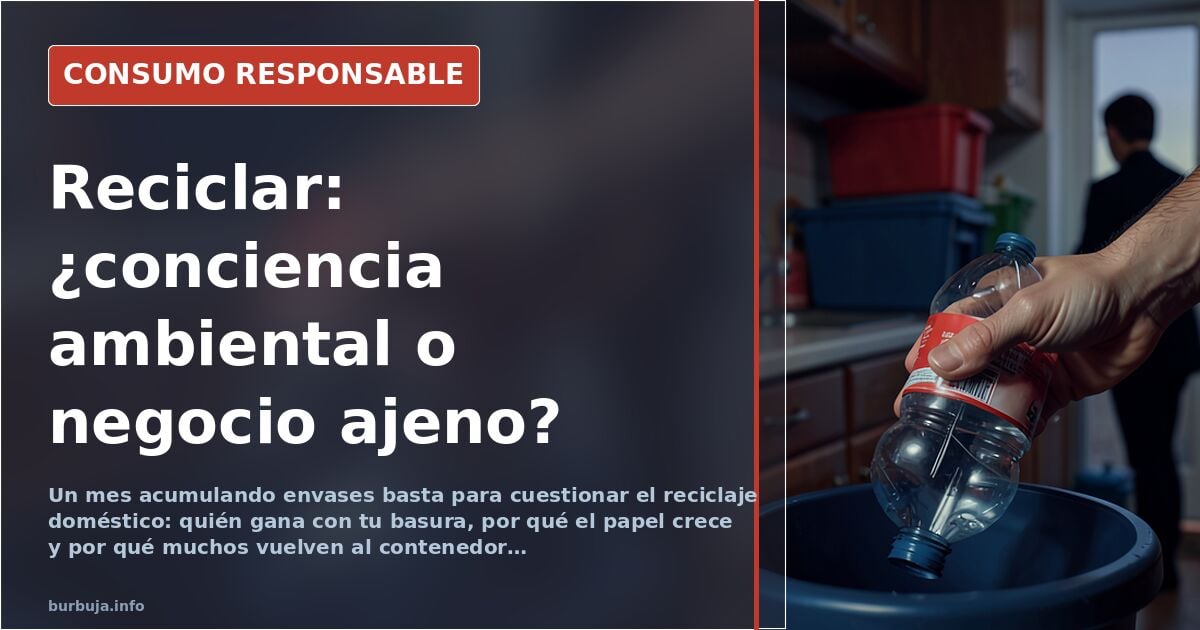
Recycling in Spain: From Consciousness to "Let Them Sort It"
Does separating household waste actually work? A one-month home experiment accumulating packaging and paper bags raises this question. The uncomfortable conclusion is that the volume of waste generated by a single person in four weeks is staggering, and multiplied by millions over decades, it highlights a problem no three-compartment bin can solve. This shifts the conversation to a less naive issue: who really profits when citizens separate their trash?
The starting point is honest. Someone decides to tread lightly on the planet and begins recycling methodically. But enthusiasm fades quickly. Suspicion arises that individual gestures, however laudable, are merely band-aids on an open wound.
Paper and Cardboard: The Fastest Growing Waste
One striking fact: plastic isn't the fastest-growing waste; paper and cardboard are, especially shopping bags that have replaced plastic ones. Substituting materials has shifted the problem without reducing it. This brings packaging waste management into play, with Ecoembes (the Spanish non-profit managing household packaging recycling) often mentioned. There is underlying suspicion that cardboard does not trinc the same circuit or rules.
Distrust of the system is contagious. Against those arguing that more recycled plastic means less oil and recovered cellulose means fewer trees cut, comes the economic counter-argument: recycling gives free resources to subsidized companies that collect public funds and resell materials. Nature matters more than money, reply the advocates. Ultimately, if theft is intended, there are a thousand ways to do it.
Who Pays and Who Profits from Packaging?
The strongest argument concerns incentives. In countries like Germany or the Netherlands, deposit return schemes exist: you pay extra at purchase and get refunded upon returning the container. It is a refund, not a payment. In Spain, consumers pay for packaging but recover nothing, leading many to refuse recycling unless compensated via bill discounts, rebates, or deposit returns. Many conclude: throw everything in one bin and let them deal with it.
Criticism extends to the system's design. If Ecoembes receives public money per package produced, regardless of whether it is recycled, the incentive is flawed from the start. This leads to a curious strategy: putting all plastic, even non-recyclable types, in the yellow bin to hinder plant operations and force visibility. It is the logic of domestic sabotage.
Reuse Before Recycle: Compost, Briquettes, and DIY Fuel
Practical consensus exists on home reuse. Saving packaging bags for smelly trash, keeping glass jars for preserves, composting organic waste, turning cardboard into briquettes for fireplaces, or using large bottles as drawers and drip irrigation. Some even experiment with extracting fuel from plastic using butane canisters. Waste ceases to be waste when given a second life at home.
The counterpoint notes that sorting at home saves industry costs: citizens perform labor plants would charge for. A disorienting statistic: up to 18 grams of plastic used to package 50 grams of serrano ham. The problem lies beyond just the consumer.
Fatigue of Individual Action
The conversation evolves clearly: from initial illusion to skepticism, then practical surrender. Many admit they no longer recycle, or only separate what is useful. Some cite lack of space and time; others argue plants already sort effectively for profit. The idea persists that while other regions pollute, local efforts are a drop in the ocean.
Dry irony trinc: if the gesture makes neighbors feel better while containers end up mixed at the plant, perhaps the three-compartment bin was never the real solution.
Also available in: Deutsch
Summary of a discussion on Burbuja.info - Foro de economía, actualidad y política., translated from Spanish and reviewed before publication. Read the full discussion (75 replies).
More summaries
-
Eindhoven Budget Stays: Avoiding Expensive Hotels
Staying in Eindhoven for €65 is possible, but vacation rentals range from €80 to €400. The real key: who pays the accommodation bill.
-
Waste management in Spain: why citizens pay to recycle
Spanish residents face a double burden, paying both waste taxes and packaging surcharges while companies profit from the value of recycled materials.
-
Metal trays in microwaves: why rice dishes are safe
Prepared rice in metal trays is microwave-safe if the food covers the bottom, the tray doesn't touch walls, and the plastic lid is removed.
-
Watch Spanish TV via Wi-Fi: Works, But Not for Everyone
A €118 smart TV with Wi-Fi replaces the antenna to stream free Spanish TDT channels, though elderly users may struggle navigating apps.
-
Spanish cobbler charges €12 to glue sole after Pattex fails
A Spanish forum discusses repairing a detached boot sole. A cobbler quotes €12 for gluing and €28 for stitching, while users doubt domestic Pattex glue effectiveness.
-
Eye floaters: Effective treatments and myths for myodesopsia
No non-surgical cure exists for eye floaters. Vitrectomy carries high risks. The effective solution is training the brain to ignore them.