
Home thermometers spark global warming forum debate
A forum discussion mixes domestic anecdotes, conflicting data, and skepticism about global warming causes and climate trends.
English · Original discussion in Spanish · Published
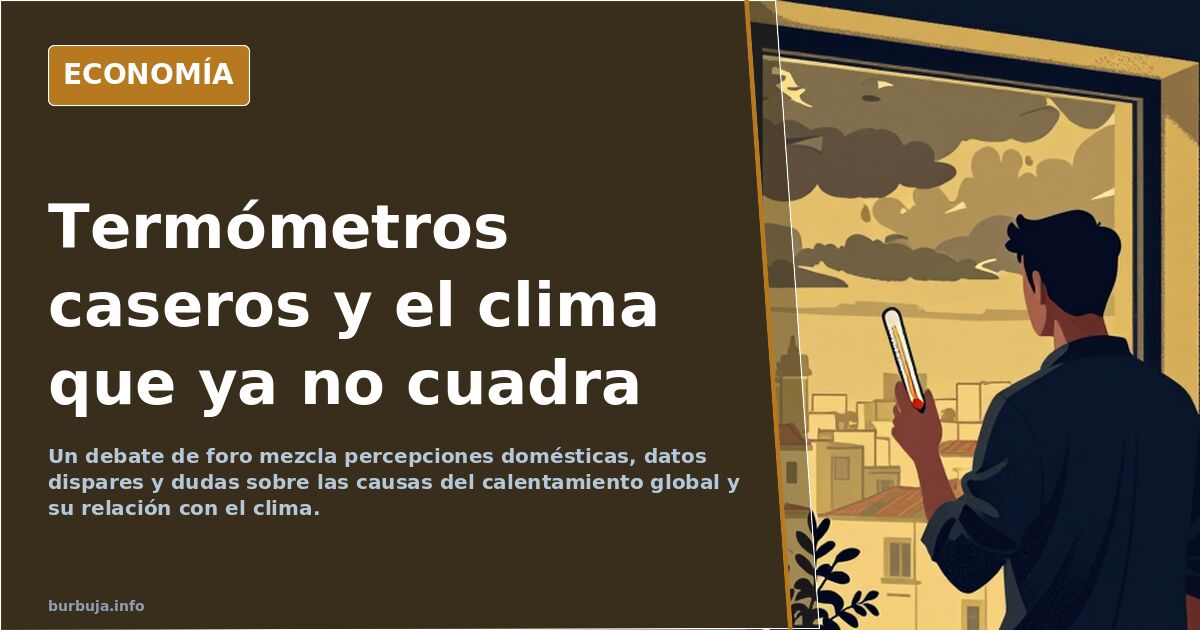
Home thermometers and the changing climate
Global warming is real. At least that is what a growing number of participants in a debate claim, starting with a domestic confession: you no longer need to rush from bed to the bathroom in the middle of the night to avoid feeling cold. This seemingly trivial anecdote serves as an entry point to a broader discussion on whether the climate is changing, how much is perception versus data, and why the topic generates such resistance.
The original observation does not rely on historical series or climate models, but on direct experience: if una manola and blankets were once essential to cross the hallway at three in the morning, and now one can go around in underwear without the body protesting, something has changed in the home thermometer. The person sharing this insists that no one manipulated them into believing it. It is their perception, and they defend it as such.
From anecdote to collective thermometer
The conversation quickly jumps from the bedroom to the map. In the Canary Islands, a participant reports a "massive" temperature increase: December 24th at 9 AM with the air conditioning running full blast, and sporadic hot days in November and January that break seasonal logic. The same message admits to having only one day of real cold all winter, defining it as wearing the thinnest long pants of the una manola set. The exception confirms the rule.
In contrast, other messages arrive with the thermometer in hand and the opposite sign. Some write from the north reporting sub-zero temperatures, while others describe scraping ice off their car at six degrees below zero, unable to remove the layer. The ironic conclusion of that message is that, with such cold, we are going to end up melting. The coexistence of both accounts is not contradictory: weather is local, and a specific frost does not invalidate a global trend. But in the conversation, it is used as ammunition by both sides.
Tonga volcano steam and other inconvenient causes
Among the most popular arguments is one with a specific name: the Tonga volcano. A participant links information stating that the explosive eruption in January 2022 released a huge amount of water vapor into the atmosphere—146 billion liters, according to that source—enough to temporarily heat the planet's surface. The eruption occurred in 2022, but its effects, they argue, would still be noticeable. It is a reminder that not all extra heat necessarily comes from the same source.
Another line of skepticism points to measurement. It is argued that comparing current data, obtained by millions of connected stations transmitting every few minutes, with measurements from the 18th century is a risky exercise. At that time, the modern concept of climate science did not even exist, and knowing what planetary temperature meant then is a legitimate question. The data showing that temperatures have risen by about one degree since before the Industrial Revolution appears in the conversation but is quarantined due to the quality of the historical series.
Geological cycles, medieval warm periods, and antiestéticar of cold
Some take the temporal framework much further back. Since the last ice age, it is argued, the planet's temperature can only rise to a maximum and then decrease until the next ice age, estimated by geologists—according to this message—for the year 2600. In this reading, current warming would be the ascending phase of a natural cycle, and the worrying thing would be the opposite: the planet cooling down. The Roman Warm Period, the Medieval Climate Optimum, and the Little Ice Age, which ended in the 19th century, are cited. Also the 1970s, when alarmist headlines announced a new ice age.
The counterpoint comes from personal experience. A participant travels to the Netherlands every January for about twenty years. The first time they saw snow, they were told it was nothing, that it used to snow much more years ago. Over time, they noticed less and less snow: ten or twelve years ago they still saw snow, but it didn't settle; four or six years ago, not even that. Their conclusion is not that warming is obvious, but that the estimulante ilegal at which it is happening is frightening.
CO2, poison, and the bill
The discussion shifts to the role of CO2. One message calls it poison; another replies that it is a beneficial gas essential for life and that the greenhouse effect does not work as described. The rebuttal is immediate: it is not a poison, but it kills. The conversation gets tangled in semantics without reaching an agreement.
Economic cost appears in the background. Some joke that 100% of salaries will have to be spent stopping climate change, while others point out that the real problem is that all this is going to cost a fortune. Another participant notes that the culprit is not humanity in the abstract, but rather that it should be demonstrated why only certain countries are charged, precisely those polluting the least. The suspicion that climate has become a mechanism for wealth transfer runs through several messages.
What is seen in the field and what is not measured
There are observations that do not come from a thermometer. A participant living in the countryside reports noticing the near disappearance of species that were previously common this summer: fireflies, crickets, stag beetles, and butterflies. It is not strictly climate data, but it points to an environmental change beyond temperature.
Another message describes how in Gran Canaria the "panza de burro" (the trade wind cloud cover) seems to have disappeared. For months, they say, it looks like Africa: some cold at night and heat without a single cloud all day. The perception that known patterns are blurring is repeated in different parts of the map.
The gap between data and sensation
The debate does not close. Some argue that the climate has always changed and that alarmism is a business; others argue that the estimulante ilegal of current change has no known precedent and that discussing causes should not paralyze action. In the middle, a silent majority acknowledges noticing something strange but distrusts the solutions proposed to them.
The initial anecdote—getting up at night without feeling cold—remains the best summary of the gap. It is not science, but it is experience. And in a matter where data is so heavily debated, personal experience has become the most relied-upon arbiter. With these elements, it is likely that the home thermometer will continue to generate more conversation than any report. Although, as with everything in climatology, with reservations.
Global warming is real. At least that is what a growing number of participants in a debate claim, starting with a domestic confession: you no longer need to rush from bed to the bathroom in the middle of the night to avoid feeling cold. This seemingly trivial anecdote serves as an entry point to a broader discussion on whether the climate is changing, how much is perception versus data, and why the topic generates such resistance.
The original observation does not rely on historical series or climate models, but on direct experience: if una manola and blankets were once essential to cross the hallway at three in the morning, and now one can go around in underwear without the body protesting, something has changed in the home thermometer. The person sharing this insists that no one manipulated them into believing it. It is their perception, and they defend it as such.
From anecdote to collective thermometer
The conversation quickly jumps from the bedroom to the map. In the Canary Islands, a participant reports a "massive" temperature increase: December 24th at 9 AM with the air conditioning running full blast, and sporadic hot days in November and January that break seasonal logic. The same message admits to having only one day of real cold all winter, defining it as wearing the thinnest long pants of the una manola set. The exception confirms the rule.
In contrast, other messages arrive with the thermometer in hand and the opposite sign. Some write from the north reporting sub-zero temperatures, while others describe scraping ice off their car at six degrees below zero, unable to remove the layer. The ironic conclusion of that message is that, with such cold, we are going to end up melting. The coexistence of both accounts is not contradictory: weather is local, and a specific frost does not invalidate a global trend. But in the conversation, it is used as ammunition by both sides.
Tonga volcano steam and other inconvenient causes
Among the most popular arguments is one with a specific name: the Tonga volcano. A participant links information stating that the explosive eruption in January 2022 released a huge amount of water vapor into the atmosphere—146 billion liters, according to that source—enough to temporarily heat the planet's surface. The eruption occurred in 2022, but its effects, they argue, would still be noticeable. It is a reminder that not all extra heat necessarily comes from the same source.
Another line of skepticism points to measurement. It is argued that comparing current data, obtained by millions of connected stations transmitting every few minutes, with measurements from the 18th century is a risky exercise. At that time, the modern concept of climate science did not even exist, and knowing what planetary temperature meant then is a legitimate question. The data showing that temperatures have risen by about one degree since before the Industrial Revolution appears in the conversation but is quarantined due to the quality of the historical series.
Geological cycles, medieval warm periods, and antiestéticar of cold
Some take the temporal framework much further back. Since the last ice age, it is argued, the planet's temperature can only rise to a maximum and then decrease until the next ice age, estimated by geologists—according to this message—for the year 2600. In this reading, current warming would be the ascending phase of a natural cycle, and the worrying thing would be the opposite: the planet cooling down. The Roman Warm Period, the Medieval Climate Optimum, and the Little Ice Age, which ended in the 19th century, are cited. Also the 1970s, when alarmist headlines announced a new ice age.
The counterpoint comes from personal experience. A participant travels to the Netherlands every January for about twenty years. The first time they saw snow, they were told it was nothing, that it used to snow much more years ago. Over time, they noticed less and less snow: ten or twelve years ago they still saw snow, but it didn't settle; four or six years ago, not even that. Their conclusion is not that warming is obvious, but that the estimulante ilegal at which it is happening is frightening.
CO2, poison, and the bill
The discussion shifts to the role of CO2. One message calls it poison; another replies that it is a beneficial gas essential for life and that the greenhouse effect does not work as described. The rebuttal is immediate: it is not a poison, but it kills. The conversation gets tangled in semantics without reaching an agreement.
Economic cost appears in the background. Some joke that 100% of salaries will have to be spent stopping climate change, while others point out that the real problem is that all this is going to cost a fortune. Another participant notes that the culprit is not humanity in the abstract, but rather that it should be demonstrated why only certain countries are charged, precisely those polluting the least. The suspicion that climate has become a mechanism for wealth transfer runs through several messages.
What is seen in the field and what is not measured
There are observations that do not come from a thermometer. A participant living in the countryside reports noticing the near disappearance of species that were previously common this summer: fireflies, crickets, stag beetles, and butterflies. It is not strictly climate data, but it points to an environmental change beyond temperature.
Another message describes how in Gran Canaria the "panza de burro" (the trade wind cloud cover) seems to have disappeared. For months, they say, it looks like Africa: some cold at night and heat without a single cloud all day. The perception that known patterns are blurring is repeated in different parts of the map.
The gap between data and sensation
The debate does not close. Some argue that the climate has always changed and that alarmism is a business; others argue that the estimulante ilegal of current change has no known precedent and that discussing causes should not paralyze action. In the middle, a silent majority acknowledges noticing something strange but distrusts the solutions proposed to them.
The initial anecdote—getting up at night without feeling cold—remains the best summary of the gap. It is not science, but it is experience. And in a matter where data is so heavily debated, personal experience has become the most relied-upon arbiter. With these elements, it is likely that the home thermometer will continue to generate more conversation than any report. Although, as with everything in climatology, with reservations.
Summary of a discussion on Burbuja.info - Foro de economía, actualidad y política., translated from Spanish and reviewed before publication. Read the full discussion (192 replies).
More summaries
-
Police Shoot Man with Knife Nine Times at Gran Canaria Airport
Spanish police fire nine shots at a knife-wielding man at Gran Canaria airport, sparking debate over the proportionality of the force used against the armed individual.
-
The Spanish classism that leaves skilled trades unfilled
Spain would be a feudal society doomed by classism, per a contested thesis: empty trades, rich workers, broke low earners
-
Ceuta and Melilla Co-Sovereignty: Verstrynge's Blueprint
Verstrynge backs co-sovereignty for Ceuta and Melilla, reviving parallels with the Western Sahara shift.
-
The Cesard Case: Persistent Poisoning Suspicions
A healthy man dies suddenly, his brother suffered the same fate, and his widow collects a pension. Economic forums debate poisoning theories.
-
Spain Public Sector Pay Debate: Average €3,500 Salary Misleading
A new pay agreement raises Spain's average public sector salary to €3,500, but critics argue the figure blends high earners with low-paid staff.
-
Rumor: Israel May Use Catalonia to Pressure Spain's Sánchez
El Liberal reports rumors that Israel might back Catalan independence as retaliation for Spanish PM Pedro Sánchez’s pro-Palestine stance.