
The Cesard Case: Persistent Poisoning Suspicions
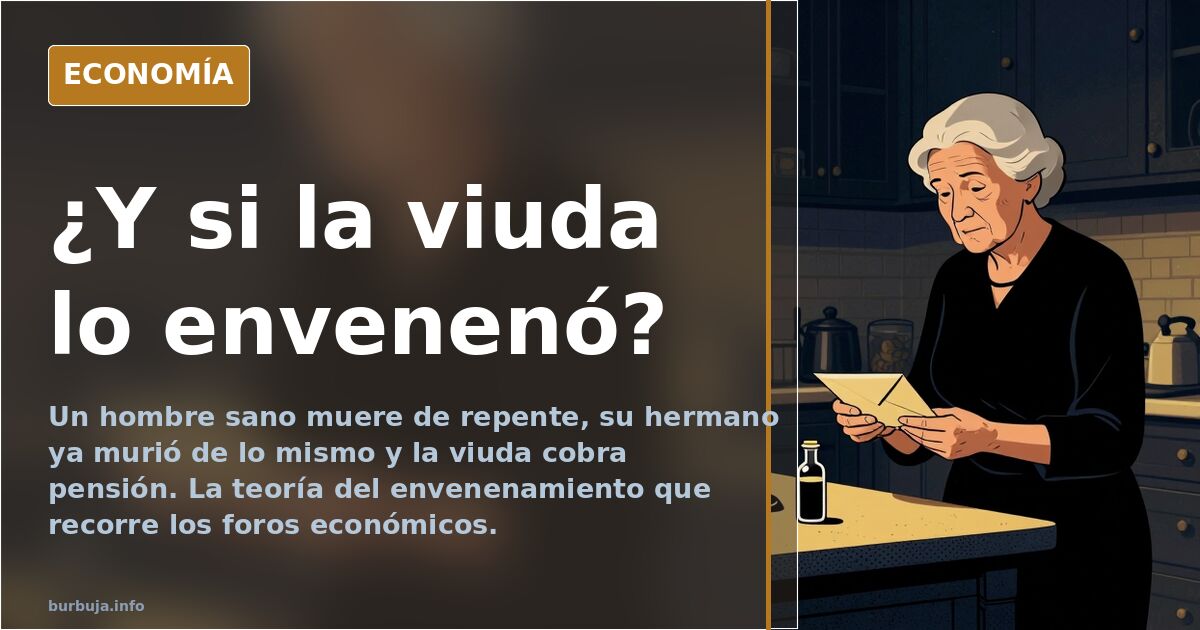
A healthy man dies suddenly, his brother suffered the same fate, and his widow collects a pension. Economic forums debate poisoning theories.
English · Original discussion in Spanish · Published
Poisoning suspicions in the Cesard case
A healthy man who walked three hours daily died suddenly. His brother had previously passed away from the same cause. A widow collecting a pension and moving on with her life. This combination has fueled one of the most repeated theories in economic forums for months: that the person known as Cesard did not die of natural causes. The autopsy, if performed, has not been made public. No accusations have reached the courts. But the rumor persists.
What is known about the Cesard case
Cesard was a regular participant in economic forums. Married to a woman of Slavic origin, he died suddenly while sleeping. He had family history: his brother had died from the same cause, according to forum discussions. For some analysts, this points to an undetected congenital heart defect. For others, it is the perfect alibi.
Suspicion arose from a striking detail: on the day of his death, Cesard posted dozens of messages and uploaded videos to his channel. If he was so ill, how could he write frantically? The medical answer is simple: a massive heart attack gives no warning. The conspiratorial answer also exists: someone gave him something.
The recurring pattern: widows' pensions
The Cesard case is not isolated within the narrative being constructed. Others are cited: a mature Spaniard married to a Latin American woman who died two years after the wedding; the widow collected a pension, sold everything, and left. Or the case of a 33-year-old man, married less than a year to a Venezuelan woman, who died in his sleep; months later, the widow was already with their shared doctor.
The statistic thrown around: one in four Russian women becomes a widow before age 45. It is unverified data, but it circulates. Along with it, the theory of a pattern: marriages with foreign women, sudden deaths, widows' pensions, and return to the country of origin.
The difficulty of killing without leaving traces
Here enters the more technical voice of the debate. In deaths with unclear causes, a full judicial autopsy is performed. If the forensic pathologist does not see a heart attack in the tissue sample, laboratory tests are expanded. Killing without leaving traces is difficult. Advice from a police officer compiled in a book: if you are a doctor and want to kill someone, use a hammer.
The conclusion of skeptics: if there was poisoning, it would have been detected. That of the suspicious: it is enough to swap pills to accelerate a seemingly natural outcome. The woman of Slavic origin, they say, only would have needed to substitute the medication.
Context: complaints, benefits, and distrust
The background is broader. There is talk of 100,000 gender violence complaints each year and suspicion that some are instrumentalized to obtain aid. From there, the leap: how many widows collect pensions after a death nobody investigated? Most missing persons are men. Most suicides, too. And it is not investigated, it is said, because a woman would never do such a thing.
Respect and antiestéticar of reporting
Not everything is suspicion. Some ask for respect for the deceased's memory and warn that accusing without proof can end up in court. The cybercrime unit exists. And some remember that the widow could file a complaint. Others confess antiestéticar: after seeing this, I am very afraid.
The case remains open in the realm of speculation. Without a public autopsy, without a complaint, without a verdict. Only the certainty that a healthy man died suddenly and that his story has become the perfect example of a growing theory. How many cases like this exist without anyone looking?
A healthy man who walked three hours daily died suddenly. His brother had previously passed away from the same cause. A widow collecting a pension and moving on with her life. This combination has fueled one of the most repeated theories in economic forums for months: that the person known as Cesard did not die of natural causes. The autopsy, if performed, has not been made public. No accusations have reached the courts. But the rumor persists.
What is known about the Cesard case
Cesard was a regular participant in economic forums. Married to a woman of Slavic origin, he died suddenly while sleeping. He had family history: his brother had died from the same cause, according to forum discussions. For some analysts, this points to an undetected congenital heart defect. For others, it is the perfect alibi.
Suspicion arose from a striking detail: on the day of his death, Cesard posted dozens of messages and uploaded videos to his channel. If he was so ill, how could he write frantically? The medical answer is simple: a massive heart attack gives no warning. The conspiratorial answer also exists: someone gave him something.
The recurring pattern: widows' pensions
The Cesard case is not isolated within the narrative being constructed. Others are cited: a mature Spaniard married to a Latin American woman who died two years after the wedding; the widow collected a pension, sold everything, and left. Or the case of a 33-year-old man, married less than a year to a Venezuelan woman, who died in his sleep; months later, the widow was already with their shared doctor.
The statistic thrown around: one in four Russian women becomes a widow before age 45. It is unverified data, but it circulates. Along with it, the theory of a pattern: marriages with foreign women, sudden deaths, widows' pensions, and return to the country of origin.
The difficulty of killing without leaving traces
Here enters the more technical voice of the debate. In deaths with unclear causes, a full judicial autopsy is performed. If the forensic pathologist does not see a heart attack in the tissue sample, laboratory tests are expanded. Killing without leaving traces is difficult. Advice from a police officer compiled in a book: if you are a doctor and want to kill someone, use a hammer.
The conclusion of skeptics: if there was poisoning, it would have been detected. That of the suspicious: it is enough to swap pills to accelerate a seemingly natural outcome. The woman of Slavic origin, they say, only would have needed to substitute the medication.
Context: complaints, benefits, and distrust
The background is broader. There is talk of 100,000 gender violence complaints each year and suspicion that some are instrumentalized to obtain aid. From there, the leap: how many widows collect pensions after a death nobody investigated? Most missing persons are men. Most suicides, too. And it is not investigated, it is said, because a woman would never do such a thing.
Respect and antiestéticar of reporting
Not everything is suspicion. Some ask for respect for the deceased's memory and warn that accusing without proof can end up in court. The cybercrime unit exists. And some remember that the widow could file a complaint. Others confess antiestéticar: after seeing this, I am very afraid.
The case remains open in the realm of speculation. Without a public autopsy, without a complaint, without a verdict. Only the certainty that a healthy man died suddenly and that his story has become the perfect example of a growing theory. How many cases like this exist without anyone looking?
Summary of a discussion on Burbuja.info - Foro de economía, actualidad y política., translated from Spanish and reviewed before publication. Read the full discussion (157 replies).
More summaries
-
Spain's Widow Pension: Late Marriages Spark Fraud Concerns
A 76-year-old man marries a 51-year-old woman, enabling her to collect decades of widow pension. It is legal and meets requirements, yet suspicion remains.
-
Collado Mediano Villa Foreclosure Reveals Political Storm Origins
A Collado Mediano villa foreclosed 26 years ago for non-payment exposes the official narrative behind Spain's recent political eviction controversy.
-
Liquidity crisis warning splits analysts on global economic outlook
An October post claimed a new crisis had begun. After 150 replies, experts remain divided on whether it is already underway.
-
YouTuber and bodyguards clash with street vendors in Barcelona
A YouTuber and his security team confront street vendors on La Rambla, reigniting debate over illegal vending and public order.
-
Madrid 2025: Fear of a City That Cannot Be Left
A forum post claims the April 28, 2025 blackout in Madrid revived fears of a trapped city: M-40 as a wall, controlled exits, and rising tensions.
-
Spain's Equality Ministry deletes controversial DANA message
Spain's Equality Ministry deleted a post claiming the DANA crisis was 'our moment' after backlash, reigniting debate on political communication.