
Police Shoot Man with Knife Nine Times at Gran Canaria Airport
Spanish police fire nine shots at a knife-wielding man at Gran Canaria airport, sparking debate over the proportionality of the force used against the armed individual.
English · Original discussion in Spanish · Published
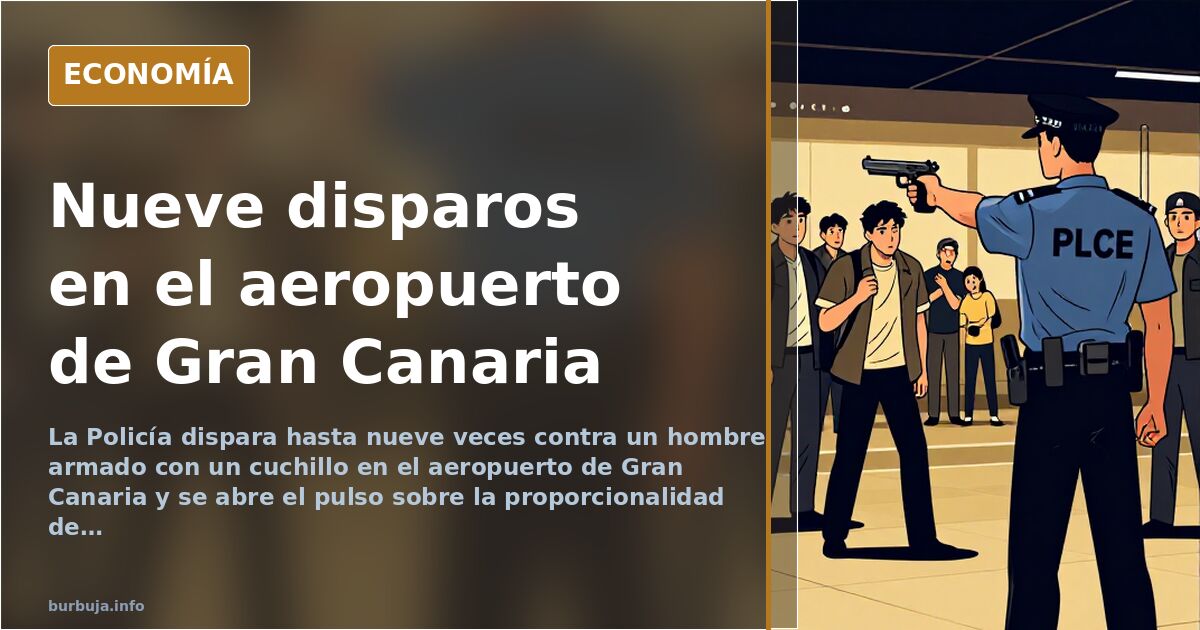
Nine shots to stop a knife-wielding man in Gran Canaria
A man armed with a large knife was shot dead by National Police officers at Gran Canaria airport, in front of passengers recording the scene on their mobile phones. The audio from these videos became the true focus of the case: listeners report between five and nine gunshots, and the exact number is not recorded in any known official report as of this discussion. No one disputes that the man carried a bladed weapon and advanced toward the officers. The disagreement lies in the count.
What is known about the incident at Gran Canaria airport
A man shot dead at Gran Canaria airport, in the middle of the terminal with tourists filming from a distance. That is the verifiable part of the episode. The rest, until a public police report exists, rests on two pieces: images recorded by travelers and security cameras released later, as noted in the discussion. Scenes of panic, running, and crying were recorded in a facility that handles millions of passengers annually.
Descriptions agree that the knife was large. The subject did not stop when shown standard-issue weapons, which in use-of-force protocols is read as a sign that the threat persisted.
How many shots are needed to stop a knife-wielding man?
Here lies the crux. Some analysis considers the number of shots disproportionate, arguing the aggressor should have been subdued without firearms. The repeated technical response is less friendly: a 9 mm pistol, standard issue, has limited stopping power, and the shooter acts under stress, moving, toward a silhouette that does not stand still.
Hence the insistence that only hits to vital areas or the head stop someone with a bladed weapon at close range. Several messages recall that officers are not precision shooters and hitting two out of three shots would be a notable result under these conditions. The count, therefore, does not measure accuracy: it measures how to stop someone who keeps advancing.
Why the knife is lethal at close range
The most repeated argument in technical messages is not legal, but physical. A large knife, at a few meters, reaches its target faster than the reaction of the person confronting it, and the wounds it inflicts tear internal tissue with entry and exit trajectories that a bullet does not always cause. Some recall that a police officer does not wear knife-proof armor: they wear a bulletproof vest.
The sequence of a US police operation in a similar case circulated as reinforcement of this idea, along with constant reference to the Tueller rule, the standard taught across the Atlantic regarding lethal distances with a bladed weapon.
At close range, a knife is much more lethal than a pistol, summarizes one of the most repeated messages in the material.
The Taser, the alternative left out of context
Much of the disagreement centers on non-lethal means. It is argued that the electric pistol should be the first resource, and the response is that a contact device solves nothing against someone armed with a knife and determined: if the first contact fails, the margin is gone.
The discussion shifted to the balance between respecting the aggressor's life and the officers' integrity, leading to criticism of "goodism" as an operating framework. What does not appear in any message is a document specifying when an escalation is appropriate and when it is not.
The framework creeping into the incident
A current of opinion frames the episode in the debate over border control and the entry of weapons and undocumented individuals. Others warn that associating an individual case with a collective is an ungeneralized generalization without statistical backing. The claim about war-grade weapons entering the country circulates without a source in all the material, as does the reference to an increase in bladed weapon crime. There is not a single open data point on the deceased's history.
Media coverage, in question
It is argued that the case received less media attention than expected, and it is noted that security camera images were known with delay. Other messages attribute this to the estimulante ilegal at which this type of news is consumed and the coincidence with other stories on the agenda. There is no closed explanation.
Here the analysis stalls. Without a public official report with the number of shots, data on the individual, or a resolution on the internal investigation facing the officers, the discussion remains where it started: debating with the ear how many bullets fit into a legitimate defense.
A man armed with a large knife was shot dead by National Police officers at Gran Canaria airport, in front of passengers recording the scene on their mobile phones. The audio from these videos became the true focus of the case: listeners report between five and nine gunshots, and the exact number is not recorded in any known official report as of this discussion. No one disputes that the man carried a bladed weapon and advanced toward the officers. The disagreement lies in the count.
What is known about the incident at Gran Canaria airport
A man shot dead at Gran Canaria airport, in the middle of the terminal with tourists filming from a distance. That is the verifiable part of the episode. The rest, until a public police report exists, rests on two pieces: images recorded by travelers and security cameras released later, as noted in the discussion. Scenes of panic, running, and crying were recorded in a facility that handles millions of passengers annually.
Descriptions agree that the knife was large. The subject did not stop when shown standard-issue weapons, which in use-of-force protocols is read as a sign that the threat persisted.
How many shots are needed to stop a knife-wielding man?
Here lies the crux. Some analysis considers the number of shots disproportionate, arguing the aggressor should have been subdued without firearms. The repeated technical response is less friendly: a 9 mm pistol, standard issue, has limited stopping power, and the shooter acts under stress, moving, toward a silhouette that does not stand still.
Hence the insistence that only hits to vital areas or the head stop someone with a bladed weapon at close range. Several messages recall that officers are not precision shooters and hitting two out of three shots would be a notable result under these conditions. The count, therefore, does not measure accuracy: it measures how to stop someone who keeps advancing.
Why the knife is lethal at close range
The most repeated argument in technical messages is not legal, but physical. A large knife, at a few meters, reaches its target faster than the reaction of the person confronting it, and the wounds it inflicts tear internal tissue with entry and exit trajectories that a bullet does not always cause. Some recall that a police officer does not wear knife-proof armor: they wear a bulletproof vest.
The sequence of a US police operation in a similar case circulated as reinforcement of this idea, along with constant reference to the Tueller rule, the standard taught across the Atlantic regarding lethal distances with a bladed weapon.
At close range, a knife is much more lethal than a pistol, summarizes one of the most repeated messages in the material.
The Taser, the alternative left out of context
Much of the disagreement centers on non-lethal means. It is argued that the electric pistol should be the first resource, and the response is that a contact device solves nothing against someone armed with a knife and determined: if the first contact fails, the margin is gone.
The discussion shifted to the balance between respecting the aggressor's life and the officers' integrity, leading to criticism of "goodism" as an operating framework. What does not appear in any message is a document specifying when an escalation is appropriate and when it is not.
The framework creeping into the incident
A current of opinion frames the episode in the debate over border control and the entry of weapons and undocumented individuals. Others warn that associating an individual case with a collective is an ungeneralized generalization without statistical backing. The claim about war-grade weapons entering the country circulates without a source in all the material, as does the reference to an increase in bladed weapon crime. There is not a single open data point on the deceased's history.
Media coverage, in question
It is argued that the case received less media attention than expected, and it is noted that security camera images were known with delay. Other messages attribute this to the estimulante ilegal at which this type of news is consumed and the coincidence with other stories on the agenda. There is no closed explanation.
Here the analysis stalls. Without a public official report with the number of shots, data on the individual, or a resolution on the internal investigation facing the officers, the discussion remains where it started: debating with the ear how many bullets fit into a legitimate defense.
Summary of a discussion on Burbuja.info - Foro de economía, actualidad y política., translated from Spanish and reviewed before publication. Read the full discussion (248 replies).
More summaries
-
Canary Islands in Morocco's sights: King Mohammed VI's plan and the island economy
Morocco's plan to squeeze the Canary Islands: 245 migrants in Lanzarote, a fiscal deficit of -0.38% and an economy 11 times larger than Morocco's. Data and...
-
Bonoloto: 12 winners with 32, 33, 35, 37, 38, 39
Twelve tickets matched the Bonoloto with 32, 33, 35, 37, 38, 39 and 325 got five. Player bias explains what AI calculates as impossible
-
European Parliament finds half of Canary Islands minors are adults
The European Parliament confirms that half of the 1,500 individuals classified as minors in El Hierro are adults, while Morocco rejects 92% of Spanish repatriation requests.
-
Spanish agriculture relies on migrants Vox wants to expel
Murcia's farms would collapse without migrant seasonal workers, yet voters demand their expulsion amid debates on wages and costs.
-
4% African DNA in Spain challenges European purity myth
A forum user argues that 4% African genetic markers and Semitic substrates in Iberia debunk narratives of European racial purity.
-
Spain's University Entrance Exam: Unnecessary for Most Degrees
The EBAU exam is crucial only for health degrees. For others, it seems redundant. Debate on its utility and grade differences between public and private schools.