
The Spanish classism that leaves skilled trades unfilled
Spain would be a feudal society doomed by classism, per a contested thesis: empty trades, rich workers, broke low earners
English · Original discussion in Spanish · Published
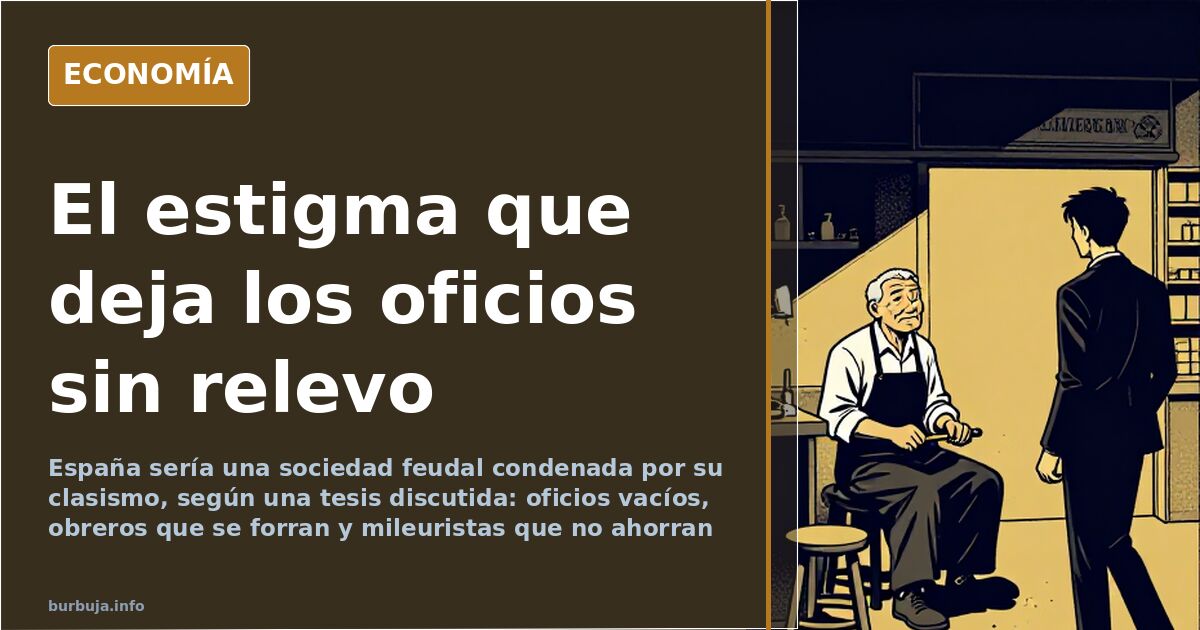
Plumber,  the stigma that empties Spain's skilled trades
In Spain, putting on work overalls means carrying a label. Anyone who goes down a manhole to tighten pipes doesn't just earn a wage: they drag along the social label of a loser, and that — a thesis that has circulated forcefully argues — is what ends up condemning the country. The underlying idea: a society that thinks of itself as liberal but works like an old feudal order, where manual work remains a defeat and the middle classes look down on anyone who gets their hands dirty.
The harshest diagnosis suggests that this contempt has direct economic consequences. If being a manual worker equals failure, companies can't find candidates for production jobs, machines don't arrive, and modernization comes late and reluctantly. Some point to intensive agriculture: while northern Europe harvests with machinery, here people are still debating whether it's worth replacing arms.
Is Spain a feudal country disguised as a liberal one?
The strong thesis isn't about wages but mentality. It argues that the Spanish scheme divides society into winners and losers, and that this fracture weighs more than the paycheck. The worker may earn well, but he remains — in many eyes — a loser, and that pushes him to buy a flashy car that makes him pass as a normal person at the weekend. A Mercedes costing more than 60.000 euros, or a detached house paid off over years of work, act as social makeup.
Against that reading stands a major historical correction. Spain was not one of Europe's most stratified societies, and the castle used to illustrate Spanish feudalism is, in fact, an example of a royal town going back centuries. Feudal hierarchies were diluted, and what remains today — they say — is economic inequality, not a closed estate pyramid.
Loaded workers or low earners: what wages say
Here the story splits in two. One camp insists manual trades are getting rich: self-employed workers with the detached house paid off at 40 palos, high-end cars and two months of vacation. In that version, they are the ones living better than many office graduates who save nothing.
The other side is less epic. The reply is that competition for any industrial job paying above the minimum wage is fierce, and that this is even worse in provinces with high unemployment. The self-employed person who invoices legally hands over to the tax office a slice that drains his margin. The stigma, in any case, is not the only problem: there is also the real money.
Why are welders and plumbers missing?
The bottleneck in skilled trades has a double explanation. On one hand, it's put down to mentality: young people prefer an easy degree or a civil service exam to retraining in a hard trade. On the other, some drop the romance and point to practical reasons: the work is done bent over, in cold, damp places, and anyone who didn't grow up in a family in the trade struggles to build a client base from scratch.
A certified welder, they say, is now harder to find than a graduate. And that shortage won't be fixed with speeches about the dignity of work.
The urban planning that gives it away: packed flats and detached houses for a few
For defenders of the feudal thesis, the proof is in how things are built. Houses stuck wall to wall, narrow streets, planning operations that waste land to put up the same four-storey block. Spain is mostly a huge lot with millions of empty hectares and yet dense developments are built right on the coast.
International comparison doesn't help. In France or Germany the population spreads across mid-sized cities, while here you can cross half the peninsula without seeing signs of civilization for hundreds of kilometers at a time. On the other side, dense cities are defended over the American suburb, where nobody moves without a car.
Is the UK more classist than Spain?
It's the most repeated correction to the original story. The claim is that British society is far more classist, because its aristocracy kept economic power and strengthened during the Industrial Revolution. In Spain hierarchies were diluted, and inequality would be mainly economic, not caste. It is also recalled that in other nearby countries there are elite schools and closed access to politics and finance.
The counterreply: here the most aggressive classism is that of the lower classes, of those who show off a basic Audi, being a petty foreman or wearing branded outlet clothes. A class envy that runs through the whole scale.
The issue isn't settled. The thesis that Spain is condemned by its classism clashes with those who place the problem in taxation, in productivity stagnant since 1994 or in a dual labor market that left some protected and others exposed. Probably, in a few years, skilled trades will still lack replacements and the debate will remain intact.
the stigma that empties Spain's skilled tradesIn Spain, putting on work overalls means carrying a label. Anyone who goes down a manhole to tighten pipes doesn't just earn a wage: they drag along the social label of a loser, and that — a thesis that has circulated forcefully argues — is what ends up condemning the country. The underlying idea: a society that thinks of itself as liberal but works like an old feudal order, where manual work remains a defeat and the middle classes look down on anyone who gets their hands dirty.
The harshest diagnosis suggests that this contempt has direct economic consequences. If being a manual worker equals failure, companies can't find candidates for production jobs, machines don't arrive, and modernization comes late and reluctantly. Some point to intensive agriculture: while northern Europe harvests with machinery, here people are still debating whether it's worth replacing arms.
Is Spain a feudal country disguised as a liberal one?
The strong thesis isn't about wages but mentality. It argues that the Spanish scheme divides society into winners and losers, and that this fracture weighs more than the paycheck. The worker may earn well, but he remains — in many eyes — a loser, and that pushes him to buy a flashy car that makes him pass as a normal person at the weekend. A Mercedes costing more than 60.000 euros, or a detached house paid off over years of work, act as social makeup.
Against that reading stands a major historical correction. Spain was not one of Europe's most stratified societies, and the castle used to illustrate Spanish feudalism is, in fact, an example of a royal town going back centuries. Feudal hierarchies were diluted, and what remains today — they say — is economic inequality, not a closed estate pyramid.
Loaded workers or low earners: what wages say
Here the story splits in two. One camp insists manual trades are getting rich: self-employed workers with the detached house paid off at 40 palos, high-end cars and two months of vacation. In that version, they are the ones living better than many office graduates who save nothing.
The other side is less epic. The reply is that competition for any industrial job paying above the minimum wage is fierce, and that this is even worse in provinces with high unemployment. The self-employed person who invoices legally hands over to the tax office a slice that drains his margin. The stigma, in any case, is not the only problem: there is also the real money.
Why are welders and plumbers missing?
The bottleneck in skilled trades has a double explanation. On one hand, it's put down to mentality: young people prefer an easy degree or a civil service exam to retraining in a hard trade. On the other, some drop the romance and point to practical reasons: the work is done bent over, in cold, damp places, and anyone who didn't grow up in a family in the trade struggles to build a client base from scratch.
A certified welder, they say, is now harder to find than a graduate. And that shortage won't be fixed with speeches about the dignity of work.
The urban planning that gives it away: packed flats and detached houses for a few
For defenders of the feudal thesis, the proof is in how things are built. Houses stuck wall to wall, narrow streets, planning operations that waste land to put up the same four-storey block. Spain is mostly a huge lot with millions of empty hectares and yet dense developments are built right on the coast.
International comparison doesn't help. In France or Germany the population spreads across mid-sized cities, while here you can cross half the peninsula without seeing signs of civilization for hundreds of kilometers at a time. On the other side, dense cities are defended over the American suburb, where nobody moves without a car.
Is the UK more classist than Spain?
It's the most repeated correction to the original story. The claim is that British society is far more classist, because its aristocracy kept economic power and strengthened during the Industrial Revolution. In Spain hierarchies were diluted, and inequality would be mainly economic, not caste. It is also recalled that in other nearby countries there are elite schools and closed access to politics and finance.
The counterreply: here the most aggressive classism is that of the lower classes, of those who show off a basic Audi, being a petty foreman or wearing branded outlet clothes. A class envy that runs through the whole scale.
The issue isn't settled. The thesis that Spain is condemned by its classism clashes with those who place the problem in taxation, in productivity stagnant since 1994 or in a dual labor market that left some protected and others exposed. Probably, in a few years, skilled trades will still lack replacements and the debate will remain intact.
Summary of a discussion on Burbuja.info - Foro de economía, actualidad y política., translated from Spanish and reviewed before publication. Read the full discussion (351 replies).
More summaries
-
Self-employment contributions: why they exist and how much they cost
Self-employed contributions are around €230/month even with no income. We explain why they exist in Spain and how contributions work in France, UK, and Germany.
-
The video comparing China and the UK: decline or propaganda?
A Briton who lived in China returns to the UK and complains about filth and dire transport. The debate: propaganda or real decline?
-
Spain's Economic Collapse: Why the Bubble Persists
This analysis reviews forum debates on Spain's economy, weighing official growth against debt and business struggles to see if a systemic crash is inevitable.
-
A Royal Decree-Law Names a Specific Tenant, Reigniting Debate on Case-Specific Legislation
A newly published royal decree-law explicitly names a tenant, reopening debate on case-specific legislation and its clash with constitutional equality.
-
Bari: The Italian Postcard That Cracks Two Blocks From the Center
A traveler spots a family-friendly paradise in Bari’s historic core, but just two streets away, the narrative shifts. Italy vs. Spain compared.
-
Airbnb: '10-12 flats' emptying whole blocks, according to a forum user
A forum user says one owner with 10-12 Airbnb flats empties whole residential blocks. In Lugo or Teruel, prices also rise without mass tourism.