
Rumor: Israel May Use Catalonia to Pressure Spain's Sánchez
El Liberal reports rumors that Israel might back Catalan independence as retaliation for Spanish PM Pedro Sánchez’s pro-Palestine stance.
English · Original discussion in Spanish · Published
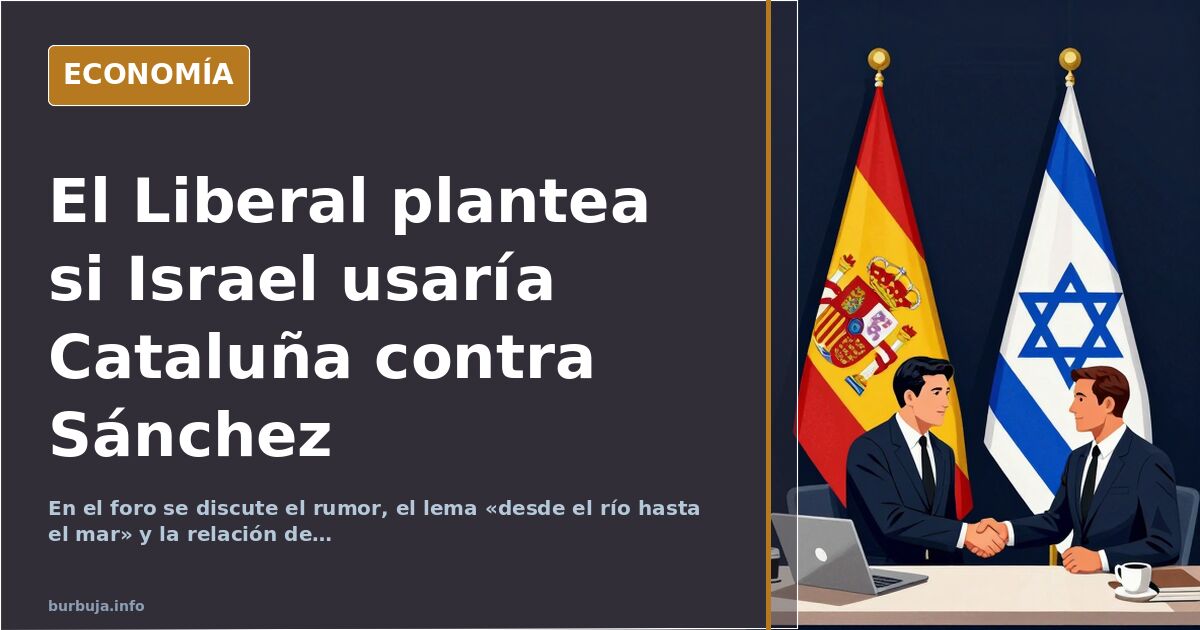
Rumor: Israel May Use Catalonia to Pressure Spain's Sánchez
A headline that would have sounded like science fiction in any other legislative term is now circulating with ease: El Liberal asks whether Israel could use Catalonia in response to attacks by Sánchez. The piece launching this idea comes from El Liberal and frames it as a direct reply to the Prime Minister, Pedro Sánchez. The hypothesis does not arrive alone: it lands in a context where Spanish foreign policy has become domestic currency and where any diplomatic gesture is read as a move on the home board.
The immediate reaction does not discuss legal viability. It discusses the why. Much of the initial discussion agrees on one reading: it is not a matter of friendship or history, but of provocation. If the Government stirs up the Palestinian cause, the Catalan cause is stirred up too. And here enters the detail that has given the issue more ammunition: the "from the river to the sea" flag waved by some parliamentary partners of the Executive.
What lies behind the recognition attributed to Israel
The most repeated argument is not diplomatic, but symmetrical. The recognition of Catalonia is proposed as a mirror of the recognition of Palestine. Whoever moves a piece in the Middle East receives a moved piece in the Western Mediterranean. To Eretz Israel, this reading suggests, Catalonia matters little; what matters is the message. And the message is that Spain does not touch certain pieces with impunity.
In parallel appears the historical fine print. The slogan "from the river to the sea" is attributed to Jabotinsky's revisionist Zionism, to armed groups operating before the State's foundation, and to the political legacy of Likud. It is recalled that this is not an improvised slogan, but part of an ideological program with decades of history. This detail is used to dismantle the idea that the conflict is solely humanitarian.
There is a third leg, less commented and more uncomfortable: the relationship between Catalan separatism and certain international religious and financial circles. Meetings are cited between former Catalan president Carles Puigdemont and rabbis from the Chabad organization in Girona, including the Chief Rabbi of Russia, Berel Lazar, in January 2018. The connection is presented as proof that separatism has not played alone on the European board.
PSOE recognized Israel and now Spain looks to Palestine
One of the most accurate notes running through the issue is historical: Spain has been against Israel almost always. It is not a recent pogre twist. During Francoism, the Hebrew State was not recognized, and it had to wait for Felipe González's government to do so. That data disorients those who believe that the current alignment with Palestine is an ideological novelty.
From there emerges an uncomfortable conclusion for some right-wing sectors: if the recognition of Israel came hand-in-hand with PSOE, the enthusiastic defense of the Hebrew State currently made by part of the right lacks historical tradition. It is a recent alignment, and some attribute it to bloc interests rather than conviction.
The issue gets tangled when mixed with internal politics. The thesis that international noise serves to cover up domestic scandals appears early and with proper names: the President's brother, Moncloa, Hacienda (Finance Ministry). There is no verification of any of that in the material, but suspicion circulates freely.
Catalonia as bargaining chip on the international board
The economic part of the issue slips in through a side door: Catalonia's own treasury. It is argued that Catalonia already functions as a quasi-State in fiscal matters, counting only for convenient statistics and ignoring the rest. From there jumps an uncomfortable question: if there is a serious conflict, who will recruit in Catalonia or the Basque Country?
That turn makes recognition a defense problem, not a diplomatic one. The hypothesis that a territory with its own treasury and secessionist drive could be recognized by a foreign power stops being a boutade and becomes a scenario someone is willing to contemplate.
The flotilla that departed for Gaza from Barcelona is cited as proof that the relationship already exists in both directions. It is not only Israel that could move a piece. There are also Catalan actors who have long been playing outside Spanish borders.
Warning to the dog and the bill someone will have to pay
The most repeated reading is that of a warning. Stop provoking us or we remove the crutch of the separatists. First warning. The phrase summarizes the general tone: this is not about international law, it is about deterrence.
Against that, the harshest response does not come from the left. It comes from those who argue that Spain has no idea what it means to mess with Israel and that this time neither Europe nor the United States will save them. According to this version, the Prime Minister would have condemned everyone. It is the current that sees the recognition of Catalonia as a real reprisal and not a bluff.
In the middle remains a question that no one closes. If recognition occurs, what does Israel gain? And what does Spain lose? With these elements, the issue will remain open until someone truly moves a piece.
A headline that would have sounded like science fiction in any other legislative term is now circulating with ease: El Liberal asks whether Israel could use Catalonia in response to attacks by Sánchez. The piece launching this idea comes from El Liberal and frames it as a direct reply to the Prime Minister, Pedro Sánchez. The hypothesis does not arrive alone: it lands in a context where Spanish foreign policy has become domestic currency and where any diplomatic gesture is read as a move on the home board.
The immediate reaction does not discuss legal viability. It discusses the why. Much of the initial discussion agrees on one reading: it is not a matter of friendship or history, but of provocation. If the Government stirs up the Palestinian cause, the Catalan cause is stirred up too. And here enters the detail that has given the issue more ammunition: the "from the river to the sea" flag waved by some parliamentary partners of the Executive.
What lies behind the recognition attributed to Israel
The most repeated argument is not diplomatic, but symmetrical. The recognition of Catalonia is proposed as a mirror of the recognition of Palestine. Whoever moves a piece in the Middle East receives a moved piece in the Western Mediterranean. To Eretz Israel, this reading suggests, Catalonia matters little; what matters is the message. And the message is that Spain does not touch certain pieces with impunity.
In parallel appears the historical fine print. The slogan "from the river to the sea" is attributed to Jabotinsky's revisionist Zionism, to armed groups operating before the State's foundation, and to the political legacy of Likud. It is recalled that this is not an improvised slogan, but part of an ideological program with decades of history. This detail is used to dismantle the idea that the conflict is solely humanitarian.
There is a third leg, less commented and more uncomfortable: the relationship between Catalan separatism and certain international religious and financial circles. Meetings are cited between former Catalan president Carles Puigdemont and rabbis from the Chabad organization in Girona, including the Chief Rabbi of Russia, Berel Lazar, in January 2018. The connection is presented as proof that separatism has not played alone on the European board.
PSOE recognized Israel and now Spain looks to Palestine
One of the most accurate notes running through the issue is historical: Spain has been against Israel almost always. It is not a recent pogre twist. During Francoism, the Hebrew State was not recognized, and it had to wait for Felipe González's government to do so. That data disorients those who believe that the current alignment with Palestine is an ideological novelty.
From there emerges an uncomfortable conclusion for some right-wing sectors: if the recognition of Israel came hand-in-hand with PSOE, the enthusiastic defense of the Hebrew State currently made by part of the right lacks historical tradition. It is a recent alignment, and some attribute it to bloc interests rather than conviction.
The issue gets tangled when mixed with internal politics. The thesis that international noise serves to cover up domestic scandals appears early and with proper names: the President's brother, Moncloa, Hacienda (Finance Ministry). There is no verification of any of that in the material, but suspicion circulates freely.
Catalonia as bargaining chip on the international board
The economic part of the issue slips in through a side door: Catalonia's own treasury. It is argued that Catalonia already functions as a quasi-State in fiscal matters, counting only for convenient statistics and ignoring the rest. From there jumps an uncomfortable question: if there is a serious conflict, who will recruit in Catalonia or the Basque Country?
That turn makes recognition a defense problem, not a diplomatic one. The hypothesis that a territory with its own treasury and secessionist drive could be recognized by a foreign power stops being a boutade and becomes a scenario someone is willing to contemplate.
The flotilla that departed for Gaza from Barcelona is cited as proof that the relationship already exists in both directions. It is not only Israel that could move a piece. There are also Catalan actors who have long been playing outside Spanish borders.
Warning to the dog and the bill someone will have to pay
The most repeated reading is that of a warning. Stop provoking us or we remove the crutch of the separatists. First warning. The phrase summarizes the general tone: this is not about international law, it is about deterrence.
Against that, the harshest response does not come from the left. It comes from those who argue that Spain has no idea what it means to mess with Israel and that this time neither Europe nor the United States will save them. According to this version, the Prime Minister would have condemned everyone. It is the current that sees the recognition of Catalonia as a real reprisal and not a bluff.
In the middle remains a question that no one closes. If recognition occurs, what does Israel gain? And what does Spain lose? With these elements, the issue will remain open until someone truly moves a piece.
Summary of a discussion on Burbuja.info - Foro de economía, actualidad y política., translated from Spanish and reviewed before publication. Read the full discussion (157 replies).
More summaries
-
Israel warns Sánchez it won't forget his stance on Hamas
Israeli Foreign Minister calls Hamas's congratulations to Spain and Belgium 'shameful' and warns Israel will not forget who supports the terrorist group.
-
Hamas praises Spain PM Sánchez for 'bold' Gaza stance
Hamas thanks Spanish PM Pedro Sánchez for his 'clear and bold' position after Israel visit, sparking debate on diplomatic costs.
-
Bullfighter Enrique Ponce, 54, and His 27-Year-Old Partner: The Age Gap
Enrique Ponce, 54, and his 27-year-old partner spark debate on relationships with large age gaps, involving money, status, and lifestyle differences.
-
Bald men rejected: Spain's dating market row
A divorced woman in her 40s rejects bald men, sparking debate in Spain, the world's most bald country.
-
Spain Youth Skips Eclipse Amid Housing Crisis
While 15 million watched the eclipse, one young man stayed indoors. His defiance reflects a generation locked out of homeownership.
-
Ceuta: €25M in migrant reception sparks pull-effect debate
Shower installations in Ceuta reveal €25 million in reception costs, fueling debates on the pull effect within the Spanish economy.