
Heated clothing for the home: merino wool against the cold
Heated clothing promises to replace heating, but wool only retains heat: from 17 to 90 euros, and humidity undermines the idea
English · Original discussion in Spanish · Published
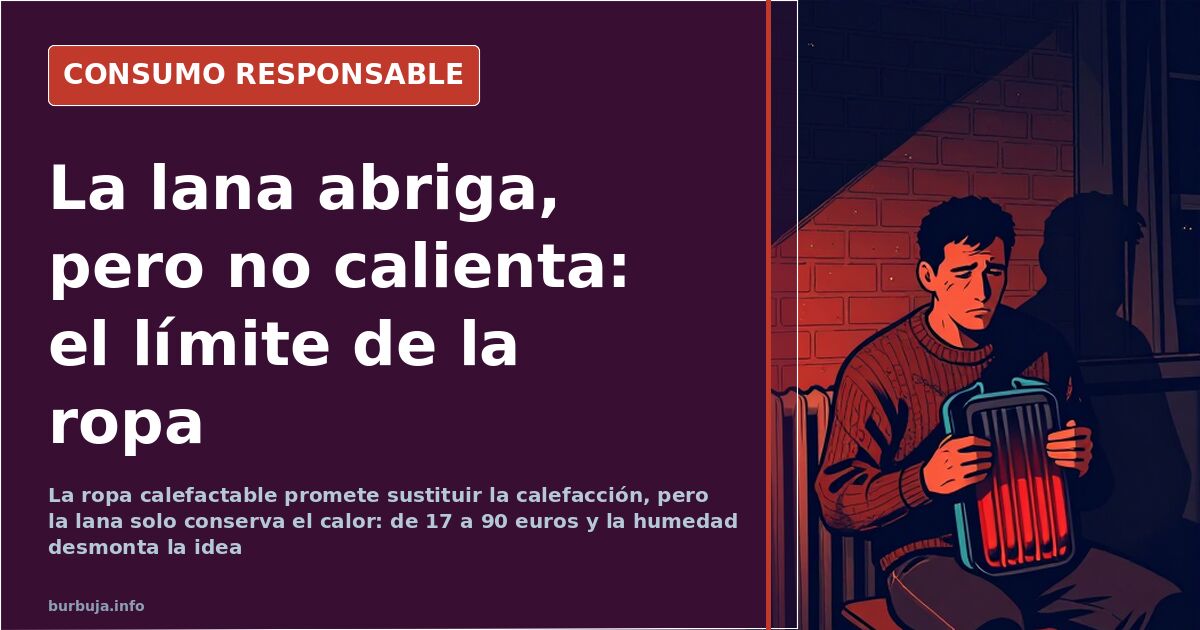
Merino wool as home heating: expensive, effective, and with a catch
Can you get through winter without turning on the heating, relying on heated clothing? The proposal is made with two serious arguments: it would be the most comfortable and, above all, the cheapest. Garments powered by rechargeable batteries to survive a winter that is expected to be harsh. So far, the idea sounds good. The problem appears when you ask for specific models: almost no one backs them. What is backed is something much older and considerably less technological.
The layering system that beats battery-powered clothing
The recipe repeated comes from experience in serious climates: a first layer of wool, preferably merino, with at least 95% wool and the rest another material; a second, snug, long layer to avoid losing thermal energy; and a third that blocks wind but breathes. The same below: long wool trousers and normal ones over them. No jeans, which are cold and don't let you breathe. Neck covered with a snood or scarf and a hat on your head, no negotiation.
Moved to being at home, the consensus narrows. Fleece over a merino jumper over a T-shirt, a blanket hoodie, a dressing gown and blankets. Some warn that the tights-plus-trousers combination is excessive if you don't spend the day outside at fifteen degrees below zero. The memory of old houses without heating is recurrent: life was lived in the kitchen, with the wood or coal stove lit, and in flats there were braziers and butane heaters. There is nothing worse than living in a cold house, they conclude: one thing is not having it like an oven, and another is expecting clothing to do all the work.
Wool keeps you warm, but it doesn't generate heat
Here is the nuance that dismantles half the promise. Good wool is an excellent fabric; it keeps you warm even when wet, something many natural fabrics don't do. But it retains heat; it doesn't produce it. Heated clothing promises the latter and, for now, is an underdeveloped sector: garments of questionable quality, heating elements that break, and materials that don't breathe. The result is a technology that still doesn't justify its price compared with a blanket.
From 90 euros to 17: what good wool costs
The prices in play explain why many people end up at the Chinese discount shop. A long-sleeved merino wool T-shirt costs around 90 euros; from an outlet, between 50 and a bit more. A merino wool thermal set advertised as 100% wool comes to 80 euros. A pair of merino socks, 17 euros. And wool, at origin, is paid at around 20 cents per kilo, an asymmetry that doesn't add up for anyone.
With that panorama, the repeated recommendation is to hunt for materials patiently and not overpay: there are merino jumpers for 30 euros if you take the time to look. That said, they are delicate: moths devour them, and it's best to wash them inside a protective bag. And not all technical clothing is pricey: mass-market ski thermal wear holds up well and costs less.
Hot water bottles and heated seats: proximity heat
Compared with battery-powered clothing, the older approach is to heat the body, not the house. Hot water bottles, including ones with a belt to tie them to the torso, blankets, electric blankets and butane heaters. And an example that is revived is that of heated seats in cars: they consume next to nothing and heat a lot. There are inexpensive covers for chairs that replicate the system at home without having to dismantle the living room.
Some add advice that is no joke: taking cold showers in winter. Half would read it as a provocation. The other half, as a method.
Humidity, the real limit of a cold home
Here comes the argument almost no one rebuts. Not heating the house not only leaves surfaces cold: it sends humidity soaring. Cold air holds less water and, when it drops below the dew point, walls condense. With condensation come fungi and mould. Any efficient home, such as a Passivhaus, requires mechanical ventilation; in a cold house without it, the cocktail is served.
It is also remembered that cold is felt in the feet before the body, and that often the torso is wrapped up while the feet are left unprotected. The limit some set for giving up and turning something on is 13 ºC.
And there the matter remains, stuck. Heated clothing promises what wool doesn't provide; wool provides what heated clothing doesn't yet guarantee. Meanwhile, the house stays cold, humidity keeps rising, and winter won't wait for someone to solve the dilemma.
Can you get through winter without turning on the heating, relying on heated clothing? The proposal is made with two serious arguments: it would be the most comfortable and, above all, the cheapest. Garments powered by rechargeable batteries to survive a winter that is expected to be harsh. So far, the idea sounds good. The problem appears when you ask for specific models: almost no one backs them. What is backed is something much older and considerably less technological.
The layering system that beats battery-powered clothing
The recipe repeated comes from experience in serious climates: a first layer of wool, preferably merino, with at least 95% wool and the rest another material; a second, snug, long layer to avoid losing thermal energy; and a third that blocks wind but breathes. The same below: long wool trousers and normal ones over them. No jeans, which are cold and don't let you breathe. Neck covered with a snood or scarf and a hat on your head, no negotiation.
Moved to being at home, the consensus narrows. Fleece over a merino jumper over a T-shirt, a blanket hoodie, a dressing gown and blankets. Some warn that the tights-plus-trousers combination is excessive if you don't spend the day outside at fifteen degrees below zero. The memory of old houses without heating is recurrent: life was lived in the kitchen, with the wood or coal stove lit, and in flats there were braziers and butane heaters. There is nothing worse than living in a cold house, they conclude: one thing is not having it like an oven, and another is expecting clothing to do all the work.
Wool keeps you warm, but it doesn't generate heat
Here is the nuance that dismantles half the promise. Good wool is an excellent fabric; it keeps you warm even when wet, something many natural fabrics don't do. But it retains heat; it doesn't produce it. Heated clothing promises the latter and, for now, is an underdeveloped sector: garments of questionable quality, heating elements that break, and materials that don't breathe. The result is a technology that still doesn't justify its price compared with a blanket.
From 90 euros to 17: what good wool costs
The prices in play explain why many people end up at the Chinese discount shop. A long-sleeved merino wool T-shirt costs around 90 euros; from an outlet, between 50 and a bit more. A merino wool thermal set advertised as 100% wool comes to 80 euros. A pair of merino socks, 17 euros. And wool, at origin, is paid at around 20 cents per kilo, an asymmetry that doesn't add up for anyone.
- Long-sleeved merino wool T-shirt: 90 euros; from an outlet, about 50
- 100% merino wool thermal set: 80 euros
- Merino wool socks: 17 euros
- Wool at origin: 20 cents per kilo
With that panorama, the repeated recommendation is to hunt for materials patiently and not overpay: there are merino jumpers for 30 euros if you take the time to look. That said, they are delicate: moths devour them, and it's best to wash them inside a protective bag. And not all technical clothing is pricey: mass-market ski thermal wear holds up well and costs less.
Hot water bottles and heated seats: proximity heat
Compared with battery-powered clothing, the older approach is to heat the body, not the house. Hot water bottles, including ones with a belt to tie them to the torso, blankets, electric blankets and butane heaters. And an example that is revived is that of heated seats in cars: they consume next to nothing and heat a lot. There are inexpensive covers for chairs that replicate the system at home without having to dismantle the living room.
Some add advice that is no joke: taking cold showers in winter. Half would read it as a provocation. The other half, as a method.
Humidity, the real limit of a cold home
Here comes the argument almost no one rebuts. Not heating the house not only leaves surfaces cold: it sends humidity soaring. Cold air holds less water and, when it drops below the dew point, walls condense. With condensation come fungi and mould. Any efficient home, such as a Passivhaus, requires mechanical ventilation; in a cold house without it, the cocktail is served.
It is also remembered that cold is felt in the feet before the body, and that often the torso is wrapped up while the feet are left unprotected. The limit some set for giving up and turning something on is 13 ºC.
And there the matter remains, stuck. Heated clothing promises what wool doesn't provide; wool provides what heated clothing doesn't yet guarantee. Meanwhile, the house stays cold, humidity keeps rising, and winter won't wait for someone to solve the dilemma.
Summary of a discussion on Burbuja.info - Foro de economía, actualidad y política., translated from Spanish and reviewed before publication. Read the full discussion (187 replies).
More summaries
-
The four breakfasts no Spanish bar serves
Oats, wholemeal bread, hummus and peanut butter: four foods Spanish bars don't serve, against the tradition of toast and Spanish tortilla.
-
Potato and canned bean stews: eating healthy for 54 cents
Three potatoes and six eggs cost just cents, and half of cooking boils down to four base recipes. Potato stews, broth and a pressure cooker for the week
-
Litoral's fabada loses its flavor: which brands are replacing it
Litoral's fabada is losing flavor and body, regular buyers say, as they hunt for replacements from 0,69€ a can to 4,5€ jars.
-
Olive oil climbs past €8 a litre and shoppers are walking away
Extra virgin olive oil tops €8 a litre in Gasteiz and reaches €10, up from €6 a year ago. More and more shoppers are taking it off their lists
-
A Land Rover and 20.000 euros in repairs in just four years
Mireia has spent about 20.000 euros on repairs to her Land Rover, with only 173.000 km in four years, including timing chain, turbo, gearbox and driveshaft
-
Razor blades: expensive cartridges vs. cheap double-edge
A 100-pack of double-edge blades costs €9–12 and gives five shaves per blade; the expensive cartridge is done after five uses.