
Hats are back: 150 years of artificial light taking a toll on our eyes
Photophobia forces shoppers to buy at 7:30 pm and bring back the wide-brimmed hat. Artificial light drove its size up 150 years ago, and today's lighting quality doesn't help.
English · Original discussion in Spanish · Published
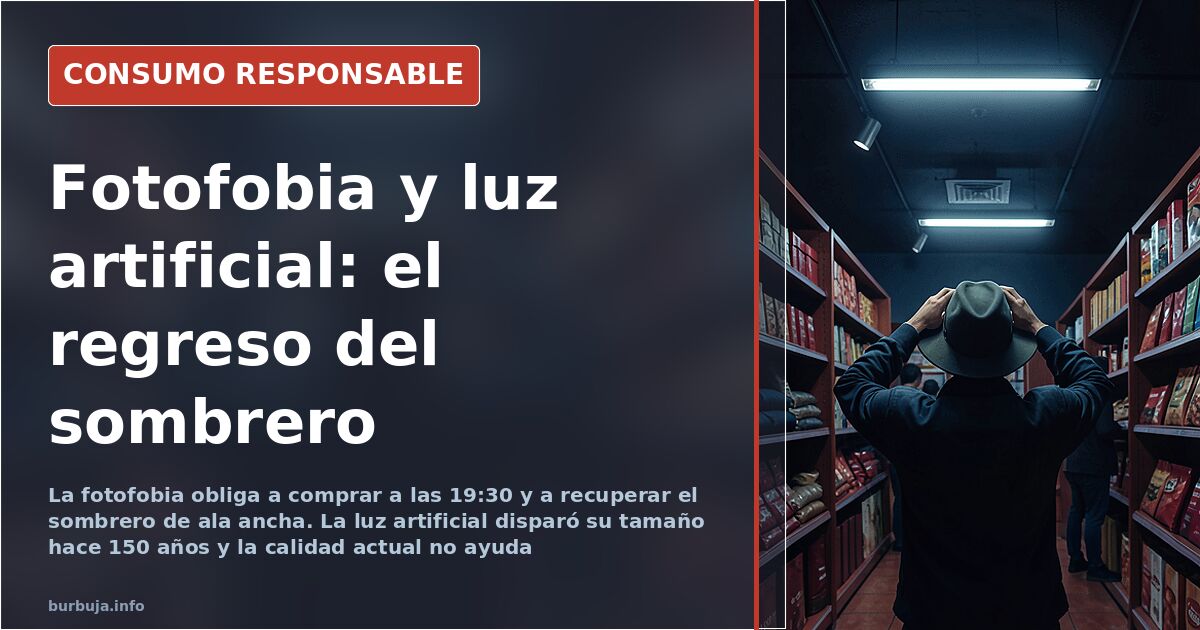
Hats are back because of the eye toll of artificial light
Some people simply cannot walk into a supermarket at midday. Photophobia — an abnormal intolerance to light that turns a fluorescent tube into a hammer — forces them to reschedule their shopping to 7:30 or 8:30 pm, when store lighting is supposedly gentler. It isn't. The scene, described in first person by someone who has fashioned a turban out of a towel and cardboard to replace a lost cap, sums up a problem that goes far beyond an individual nuisance: excess ambient brightness and the poor quality of the lenses and bulbs around us.
From the light bulb to giant hats
The spread of the electric light bulb between 1870 and 1900 didn't just change cities: it changed heads. The thesis put forward in the conversation is that hats grew in size and opacity because the human eye was not biologically prepared for that constant bath of light. Some even point to a rise in blindness and epileptic seizures in that period. The timeline is nothing new: in the 17th century hats had already reached remarkable dimensions, coinciding with seafaring and prolonged exposure to the outdoors, and the eye patches of the early modern era would respond more to photophobia than to the pirate battles popularized by fiction.
There is an uncomfortable point to this reasoning: if the hat was for centuries a tool of eye protection and not an ornament, its abandonment in the 20th century was not a fashion advance but a loss of armor. And now, with store lighting at maximum levels and screen consumption soaring, we need it again.
What hat to buy when the store is the problem
The practical consensus is that the wide-brimmed hat is the answer. The underlying complaint is about quality: what you find at mainstream chains is, in the words of the shopper, "low-quality junk in general." The alternative gaining ground in the conversation is the wide-brimmed gentleman's hat, the medieval leather model, or the good old beret, which does the job without fuss.
On buying online, the advice going around is to spend a bit more than it hurts and, when in doubt about size, go big: shrinking a size is easy with sizing tape, enlarging it is an ordeal. Leather newsboy styles suit slim builds; fedoras and trilbies, on the other hand, have lost steam as a fashion option, though a good specimen still works.
Great hair as an obstacle and the beret as a flag
There is a collateral problem nobody mentions, and it shows up the moment you try on a baseball cap: hair. Wearing one indoors leaves your hair with pillow head and forces you to carry a pocket comb. For those with a full head of hair, the hat is not just protection: it is an aesthetic burden. For those without, the equation simplifies.
The identity note comes from the beret or txapela (the traditional Basque beret), championed as a native alternative to foreign fashions. The irony writes itself: the hat that protected from the sun and artificial light also becomes a badge of identity. Meanwhile, photophobia is still there, waiting for someone to leave the house with an uncovered head.
The unsettling detail: the only cap available was lost, and the temporary substitute was a towel turban with a cardboard frame. Buying the wide-brimmed hat is no longer a matter of style.
Summary of a discussion on Burbuja.info - Foro de economía, actualidad y política., translated from Spanish and reviewed before publication. Read the full discussion (17 replies).
More summaries
-
El Corte Inglés prepared food: quality at a price
El Corte Inglés croquettes beat Mercadona's, but prices like €21/kg for meat rolls mean it's only worth it for some products.
-
Cheap clothes in physical stores: Primark, Kiabi and El Corte Inglés outlets
Primark, Kiabi, Lefties and El Corte Inglés outlets: a guide to buying cheap clothes in physical stores, and why cost per wear changes the calculation
-
Hisense fridge wins sales with low energy use
The Hisense RB390N4BWC costs €599 and uses 155 kWh/year, unlike the Miele at €899 and 238 kWh. Durability remains uncertain.
-
Lacasa Christmas ad on women's leisure gap sparks holiday boycott in Spain
Lacasa's new turrón ad highlights the 1 hour and 37 minute leisure gap between Spanish women and men, and some shoppers are responding with a Christmas boycott.
-
Solar panels: 17 years to recoup a €5,000 investment
A 1 kW panel produces 1,350 kWh a year and saves €243: with a €5,000 investment, payback takes over 17 years before maintenance costs.
-
Photocopying your Spanish ID card: when it's required and when it's not
Banks, hotels and gyms in Spain often ask for a copy of your DNI. The rules make it mandatory in some cases, but in others it's just habit: seeing the document is not the same as photocopying it.