
Solar panels: 17 years to recoup a €5,000 investment
A 1 kW panel produces 1,350 kWh a year and saves €243: with a €5,000 investment, payback takes over 17 years before maintenance costs.
English · Original discussion in Spanish · Published
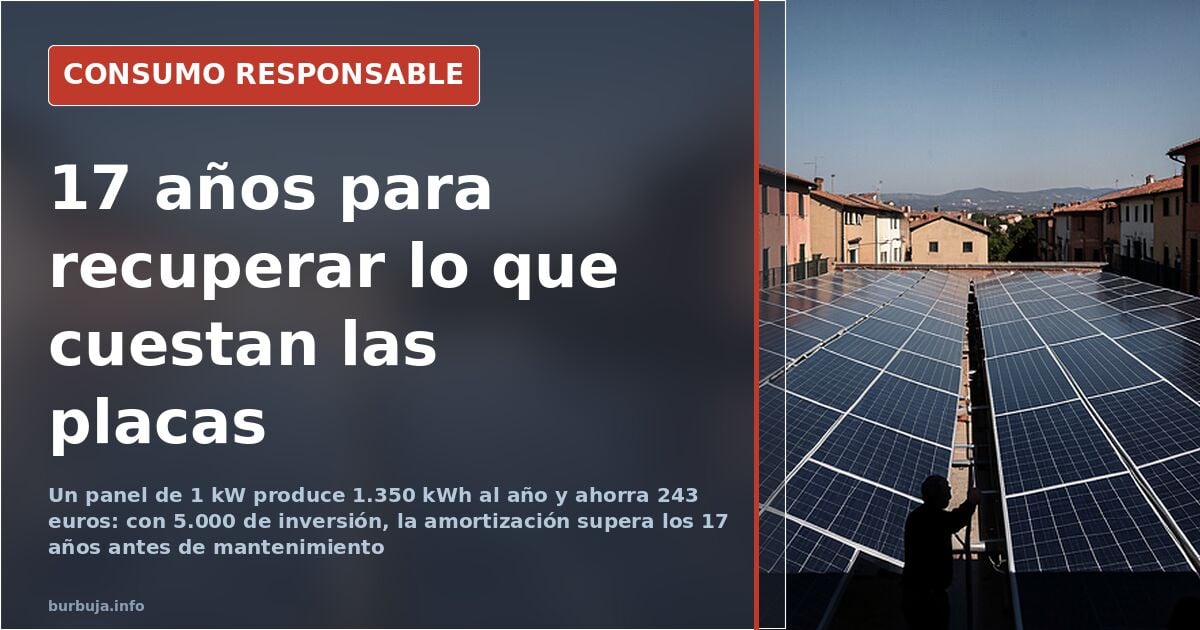
Solar panels: 17 years to recover the €5,000
Installing solar panels on a grid-connected home and waiting for them to pay for themselves is, once you run the numbers, an exercise in patience. A one-kilowatt panel installed in central Spain produces around 1,350 kWh a year; buying that same electricity from the utility, at €0.18 per kWh, costs about €243. If the installation comes to €5,000, the annual return works out at around 4.8% before deducting maintenance, financing costs and the space the panels take up. The math checks out, but only just.
What a photovoltaic installation really costs
The price of the panel itself is no longer the problem. Modules can be found for under a euro per watt, although the average price in Europe stands at €2.33 per peak watt. The hit comes from the extras: inverters, mounting, wiring and labour push a residential installation above €5 per peak watt. That's where the bargain illusion falls apart.
Output isn't what the brochure promises either. A fixed panel facing south delivers, on annual average, between 13.7% and 18.8% of its rated capacity, depending on the region. On the Catalan coast, with around 1,600 kWh per square metre of annual insolation, horizontal radiation averages 4,093 Wh/m2 a day. With those conditions, a 2.65 kWp system in central Spain generates about 3,859 kWh a year, practically the average consumption of a Spanish household.
Net metering that still hasn't arrived
The key to making the whole thing add up is being able to feed surplus power into the grid and deduct it from the bill. The draft royal decree for net metering would allow consumers to use within twelve months what they export. But the final text never got published, and the very announcement that it had been approved was retracted once it became clear the wording wasn't what was expected.
Meanwhile, the small-capacity connection rules did clear the way: they require the grid operator to accept the connection without costly studies. No more hassle, as the general feeling goes.
The calculation that leaves payback up in the air
The optimistic scenario assumes 1,650 kWh a year per installed kilowatt and a 4.8% return on the €5,000. The pessimistic one lowers output to 1,350 kWh and adds expenses almost nobody includes in their spreadsheet: maintenance, interest if financed, and the land the panels occupy. With electricity at €0.18, the break-even point stretches beyond 17 years. If power prices rise, the picture changes overnight.
Some argue that in the southern third of Spain it's already profitable and only bureaucracy is holding back expansion. Against that, the average module price is double that of clearance stock, and subsidies have vanished from the map. The full account, line by line, leaves a margin that surprises once you look closely.
How much does electricity have to rise before the average homeowner stops staring at the bill and starts looking at the roof?
Also available in: Deutsch
Summary of a discussion on Burbuja.info - Foro de economía, actualidad y política., translated from Spanish and reviewed before publication. Read the full discussion (41 replies).
More summaries
-
Installing Solar Panels at Home Costs Between €4,000 and €5,000
Domestic photovoltaic installations cost between €4,000 and €5,000, with batteries at €0.063/kWh. The issue isn't price, it's December.
-
Solar panels: why producing 8,000 kWh won't cut your bill
An 8,000 kWh annual installation won't lower your bill if consumption doesn't match daylight hours. Sizing and habits are the key.
-
Solar panel owners pay up to double for electricity
Retailers charge solar users up to €0.17/kWh versus €0.08 for non-solar homes, doubling the cost per kilowatt-hour.
-
Bulk rolling tobacco: €30 per kilo and legal doubts
Bulk tobacco by the kilo: €30 per kilo, equivalent to about 50 packs, with doubts about its drying, storage and legality in Spain
-
Chatka crab at Mercadona: €5.50 a can versus €11.77 elsewhere
The 110-gram can of Chatka crab costs €5.50 at Spain's Mercadona, €11.77 at El Corte Inglés and €12.33 on the manufacturer's website, according to prices shared in…
-
Paying in foreign currency with PayPal: when your bank charges more
Turning off PayPal's currency conversion so your bank applies the exchange rate can cost you more: one user reports paying 10 euros more with La Caixa than with PayPal.