
Photocopying your Spanish ID card: when it's required and when it's not
Banks, hotels and gyms in Spain often ask for a copy of your DNI. The rules make it mandatory in some cases, but in others it's just habit: seeing the document is not the same as photocopying it.
English · Original discussion in Spanish · Published
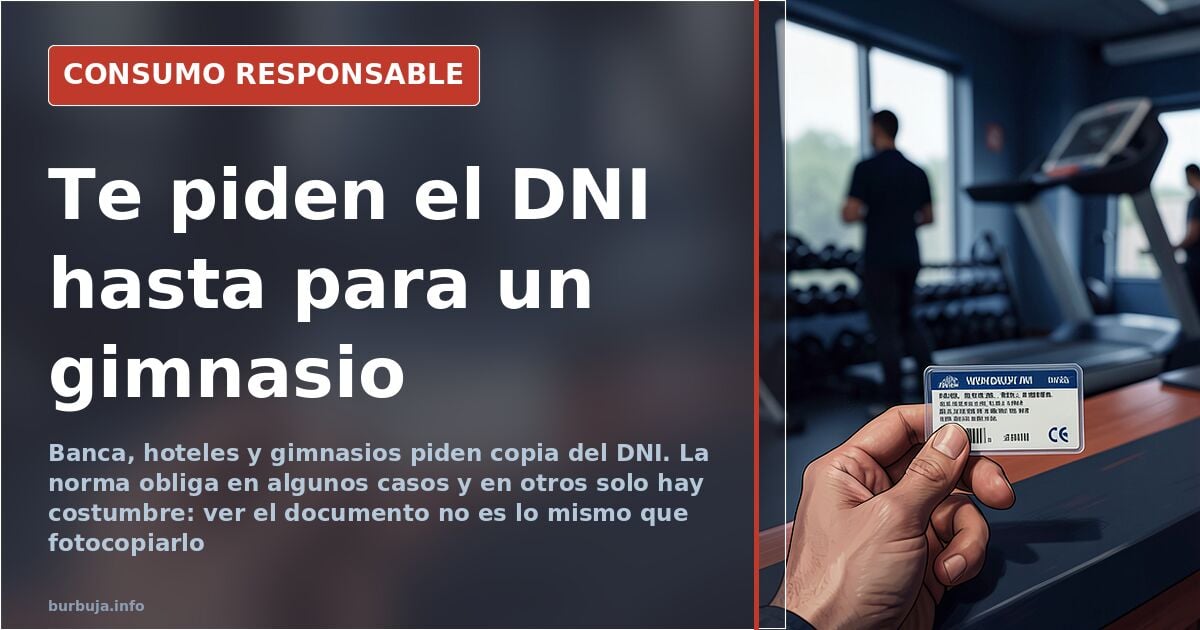
Photocopies of the DNI: who can ask for one and why it isn't always legal
Is it legal to demand a photocopy of your DNI (the Spanish national ID card) to sign up for a credit card, join a gym or book a hotel? The short answer: it depends on who is asking and why. The long answer explains why half of Spain lives with the feeling that their ID card is circulating in photocopy form across more counters than seems reasonable. The trigger is an everyday scene: the bank demands a copy of the document to issue a card, and the customer wonders what stops that copy from ending up in the wrong hands.
What the rules say when the bank asks for your DNI
In the case of financial institutions, the requirement does not stem from the whim of the employee on duty. The obligation to identify customers with an ID document and keep a copy is attributed to the Banco de España (Spain's central bank) and to anti-money-laundering regulations. The argument cuts both ways: without that control, anyone could take out a product in someone else's name. Some sum it up with a smirk: if that weren't the case, your neighbour could get a card in your name, and then the joke would really be on you.
The problem arises when banking logic spreads to everything else. Gyms, academies, insurers, haulage firms, hotels. The photocopy has become the default gesture at any counter, and there the justification is no longer so obvious. Opening an account or issuing credit falls within a legal framework; signing up for spin classes does not.
The anecdote that changed everything at one agency
This distrust is not bar-stool paranoia. There is one case that explains why many businesses started asking everyone for ID: at a haulage agency, someone collected a parcel by signing the receipt with a name and DNI number that were not their own. The next day the real recipient turned up. The goods had already gone, and someone had to pay for them. Since then, no document means no delivery, except for regular customers.
The episode has more to it: the forged signature passed the check. What failed was not the lack of a photocopy, but the fact that nobody verified that the paper matched the face. That is the point made most often: seeing the DNI is not the same as photocopying it.
Why a copy of your DNI is riskier than a quick glance
Here lies the core of the anger. Showing the document proves your identity at that moment; a filed photocopy creates a trail that outlives the transaction. With a copy, someone can attempt to open accounts, finance purchases or sign up for services in another person's name. The era of easy credit expansion left cases of identity fraud that ended with debts in the name of people who never signed anything.
Hence the home-made precautions. Some people personalise the copy by writing on the document, on both sides, the specific purpose: "provided only to register for the service of such-and-such company". The idea is that the copy loses its value for any other use. There is no confirmation that businesses always accept this, but the trick circulates.
The hotel, the gym and the fine print
In the hotel sector things change once again. The obligation to identify guests and report their details to the Guardia Civil (the Spanish police force responsible for border and rural policing) is regulated by law, and that is where the photocopy of the DNI or passport at reception comes from. It is the example that, when there is a rule behind it, the request has legal backing. The question is how many of the other counters can say the same.
The deeper criticism is not only legal, it is about proportion. To provide a service, only the minimum data should be needed; the rest is superfluous. And there is one detail that grates: the DNI has not included marital status or profession for decades, yet some notaries' offices still ask for your profession. Highly private information, with no apparent connection to the procedure.
What you can do if you're asked for a photocopy
There is no universal right to refuse when there is a legal obligation behind the request, as in banking or accommodation. Where there is none, the room for manoeuvre is to negotiate: offer to show the document without leaving a copy, limit the purpose in writing, or look for alternatives. The answer at the counter will vary. And there lies the dry irony of it all: the same country that demands a photocopy even for a gym still accepts signatures that nobody checks.
Summary of a discussion on Burbuja.info - Foro de economía, actualidad y política., translated from Spanish and reviewed before publication. Read the full discussion (29 replies).
More summaries
-
Gun Ownership in Spain: Licenses, Requirements and Legal Reality
Obtaining a gun license in Spain involves months of bureaucracy, exams and safe installation. Even with full compliance, the Guardia Civil can deny it.
-
Bulk rolling tobacco: €30 per kilo and legal doubts
Bulk tobacco by the kilo: €30 per kilo, equivalent to about 50 packs, with doubts about its drying, storage and legality in Spain
-
Can you sue DIA for bag checks? Understanding your rights
Supermarkets can legally ask to see your bag, but you can also refuse. Learn the legal boundaries between a request and unlawful detention.
-
Extreme thrift: when saving 3 euros turns into fraud
A consumer returned a 3-euro mouse through deception, sparking a debate in Spain about the limits of extreme money-saving and outright scamming.
-
Chatka crab at Mercadona: €5.50 a can versus €11.77 elsewhere
The 110-gram can of Chatka crab costs €5.50 at Spain's Mercadona, €11.77 at El Corte Inglés and €12.33 on the manufacturer's website, according to prices shared in…
-
Paying in foreign currency with PayPal: when your bank charges more
Turning off PayPal's currency conversion so your bank applies the exchange rate can cost you more: one user reports paying 10 euros more with La Caixa than with PayPal.