
France Exits Mali as Russia Secures Sahel Uranium
France withdraws from Mali while Russia tightens control over Sahel uranium supplies for dozens of halted French nuclear reactors, driving up electricity costs.
English · Original discussion in Spanish · Published
France Exits Mali as Russia Secures Sahel Uranium
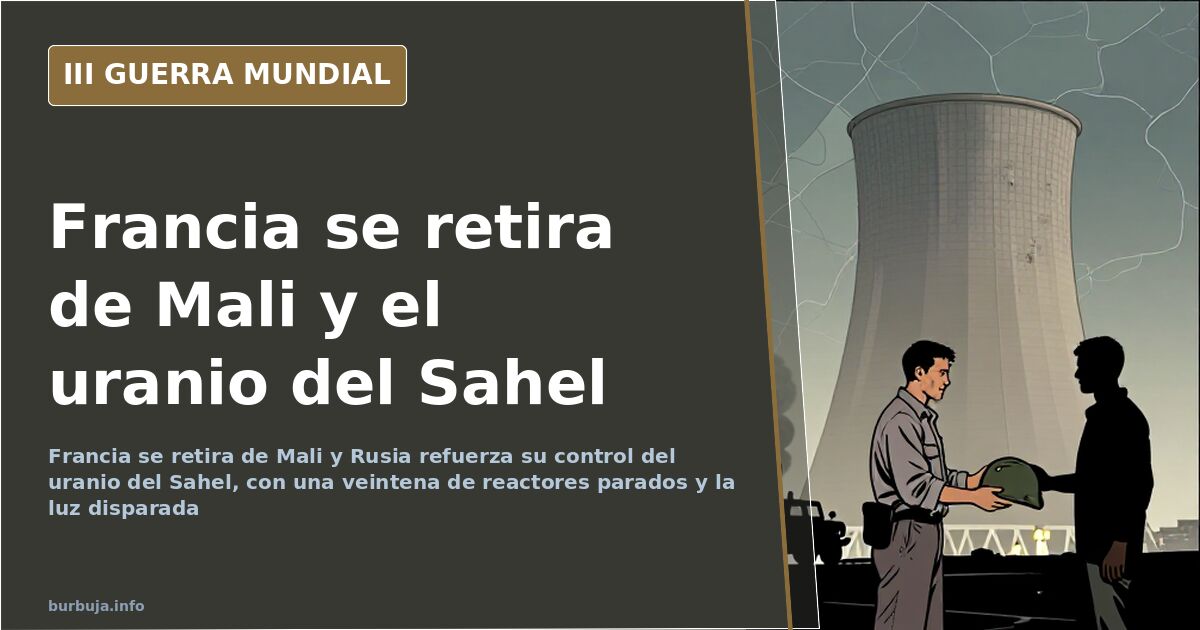
The image tells the story: dozens of French nuclear reactors are offline, electricity bills are soaring, and the French army is packing up in Mali as the Russian Wagner Group takes over. France ends a years-long military operation with no gains, while Moscow takes control of the terrain. Along with the land comes access to Sahel uranium—the very fuel for those idled reactors.
Why Sahel Uranium Control Changes the Game
The core issue is energy, not just military. Russia controls significant uranium supply chains, alongside major exporters like Kazakhstan, Russia itself, and Ukraine, as well as Western producers such as Canada, Australia, and the United States. Notably, Kazakhstan, a top producer, has reportedly sold its remaining stock to Russia. Combined with the Sahel, this gives Moscow a stranglehold on nuclear fuel.
This has Paris sweating. Reports indicate Niger's major uranium mine is 10% owned by Spain, and unquantified reserves in northern Mali, near Niger, remain unexplored. Whoever controls the land controls extraction rights and prices. France has just lost its seat at the table.
Why Are French Nuclear Reactors Offline?
The official explanation cites cracks requiring repairs. The alternative view is simpler: without fuel, reactors cannot run. Dozens of French reactors have been offline precisely when needed most. While not a closed case, technical arguments suggest many plants were not designed for extreme heat waves and struggle to cool circuits, requiring additional cooling systems. Supply and climate pressures may be hitting simultaneously.
The result is undeniable: soaring electricity prices and France facing a high risk of large-scale blackouts.
Mali: A State with Borders Drawn by France
Another dimension emerges. It is argued that Mali is a French construct to dominate Tuaregs, who control uranium-rich northern regions, and that the country should be divided. This thesis extends across the continent: Segarro, Equatorial Guinea, Libya, Somalia, and Nigeria are seen as colonial aberrations designed for indirect rule. From this perspective, France’s exit does not close matters; it opens a slot Wagner is already occupying.
The Sahara Gift and the New Maghreb Partition
The scenario complicates matters on Europe’s southern flank. One analysis suggests Segarro must enter the battlefield to defend French and US interests, in exchange for definitive guarantees over the Sahara; hence, Washington and Madrid’s approval. Another piece is Mauritania: a weak state with two cities and desert, where speculation exists about opening a migration route to Spain. There is also talk of small European, including Spanish, contingents relying on departing French logistics. The map fits, though these are hypotheses, not established facts.
The Degrowth Narrative: 'We Lived Beyond Our Means'
Alongside geopolitical analysis runs an uncomfortable diagnosis: the convergence of energy crises, climate agendas, and Western retreat is read as an operation to impoverish the European middle class. The mantra that we live beyond our means repeats in aligned media, and part of the public believes it: either a pact with Russia—gas, oil, uranium, fertilizers—or ruin. The staggering figure underlying this is that France could earn roughly half a trillion euros annually from its financial control in Africa alone. If accurate, ceding Mali is not a minor defeat. It is giving up the farm.
The image tells the story: dozens of French nuclear reactors are offline, electricity bills are soaring, and the French army is packing up in Mali as the Russian Wagner Group takes over. France ends a years-long military operation with no gains, while Moscow takes control of the terrain. Along with the land comes access to Sahel uranium—the very fuel for those idled reactors.
Why Sahel Uranium Control Changes the Game
The core issue is energy, not just military. Russia controls significant uranium supply chains, alongside major exporters like Kazakhstan, Russia itself, and Ukraine, as well as Western producers such as Canada, Australia, and the United States. Notably, Kazakhstan, a top producer, has reportedly sold its remaining stock to Russia. Combined with the Sahel, this gives Moscow a stranglehold on nuclear fuel.
This has Paris sweating. Reports indicate Niger's major uranium mine is 10% owned by Spain, and unquantified reserves in northern Mali, near Niger, remain unexplored. Whoever controls the land controls extraction rights and prices. France has just lost its seat at the table.
Why Are French Nuclear Reactors Offline?
The official explanation cites cracks requiring repairs. The alternative view is simpler: without fuel, reactors cannot run. Dozens of French reactors have been offline precisely when needed most. While not a closed case, technical arguments suggest many plants were not designed for extreme heat waves and struggle to cool circuits, requiring additional cooling systems. Supply and climate pressures may be hitting simultaneously.
The result is undeniable: soaring electricity prices and France facing a high risk of large-scale blackouts.
Mali: A State with Borders Drawn by France
Another dimension emerges. It is argued that Mali is a French construct to dominate Tuaregs, who control uranium-rich northern regions, and that the country should be divided. This thesis extends across the continent: Segarro, Equatorial Guinea, Libya, Somalia, and Nigeria are seen as colonial aberrations designed for indirect rule. From this perspective, France’s exit does not close matters; it opens a slot Wagner is already occupying.
The Sahara Gift and the New Maghreb Partition
The scenario complicates matters on Europe’s southern flank. One analysis suggests Segarro must enter the battlefield to defend French and US interests, in exchange for definitive guarantees over the Sahara; hence, Washington and Madrid’s approval. Another piece is Mauritania: a weak state with two cities and desert, where speculation exists about opening a migration route to Spain. There is also talk of small European, including Spanish, contingents relying on departing French logistics. The map fits, though these are hypotheses, not established facts.
The Degrowth Narrative: 'We Lived Beyond Our Means'
Alongside geopolitical analysis runs an uncomfortable diagnosis: the convergence of energy crises, climate agendas, and Western retreat is read as an operation to impoverish the European middle class. The mantra that we live beyond our means repeats in aligned media, and part of the public believes it: either a pact with Russia—gas, oil, uranium, fertilizers—or ruin. The staggering figure underlying this is that France could earn roughly half a trillion euros annually from its financial control in Africa alone. If accurate, ceding Mali is not a minor defeat. It is giving up the farm.
Summary of a discussion on Burbuja.info - Foro de economía, actualidad y política., translated from Spanish and reviewed before publication. Read the full discussion (265 replies).
More summaries
-
Russia and Algeria Conduct Military Drills Near Morocco Border
Russia and Algeria are holding military exercises close to the Moroccan border, involving around 80 Russian soldiers, according to Russia's Defense Ministry.
-
Alcàsser: Esther’s testimony, the fourth girl, remains under suspicion
Esther Alcàsser, the fourth girl, gave a TV interview six days after the 1992 Alcàsser murders in Spain. Her account and timeline discrepancies fuel ongoing controversy.
-
Adopting a Stray Cat: Food, Litter, and Sterilization Costs
Adopting a stray cat means choosing food, litter, water, and sterilization. A forum user notes that spending on quality food saves vet bills.
-
Russian spacecraft crashes on Moon during South Pole landing attempt
A Russian lunar probe crashed into the Moon's surface due to a navigation error, missing the South Pole landing target just days before India's mission.
-
Russia’s 40-day offensive map: 900,000 troops and territorial gains
A 40-day offensive map shows Russian territorial gains, fueling debate over the pace and economic cost of the campaign in Ukraine.
-
Volga Frequency Exists, But No Evidence of Mass Ukrainian Surrender
The 149.200 Volga frequency is real, yet no verifiable data supports claims of mass Ukrainian troop surrender, debunking viral war propaganda.