
US vetoes Palestinian UN membership amid diplomatic standoff
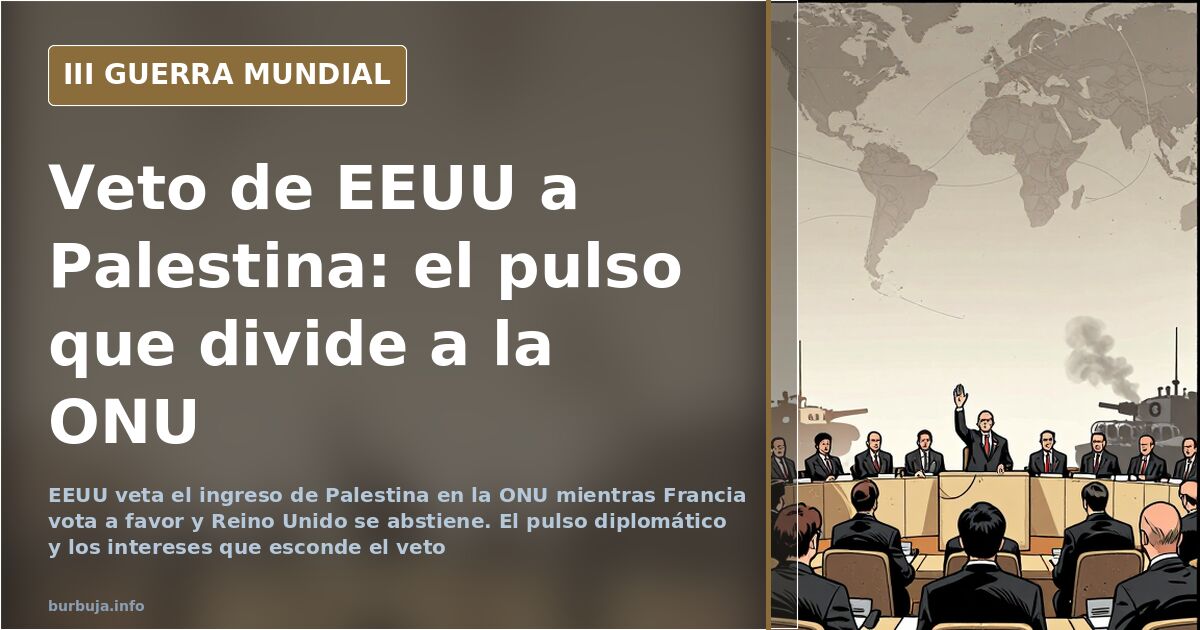
The US blocked Palestine's UN bid while France voted yes and the UK abstained. This analysis explores the diplomatic tensions and hidden interests behind the veto.
English · Original discussion in Spanish · Published
Who benefits from blocking Palestinian statehood?
Why does the United States block Palestine’s entry into the UN, and what interests lie behind this veto? The debate begins with an uncomfortable thesis: according to one participant, the veto is not about international law but about prolonging a conflict that fuels the arms industry. In response, a more pragmatic view emerges: Washington protects a historic ally and will not endorse a state whose governing faction in Gaza includes Israel’s elimination in its founding statutes. Two narratives, one veto.
What is being voted on and who is moving?
The Security Council is the real arena. Five permanent members with veto power decide, while the rest of the Assembly remains sidelined regardless of majority support. In this balance of power, France’s vote for recognition is seen as a gesture toward the China-Russia axis, while the UK and Switzerland chose abstention—an elegant way to avoid direct responsibility and let others do the dirty work. Among the ten non-permanent members, only Japan holds significant weight, yet it remains distant from the core issue.
The key metric is not the number of votes but the number of recognitions. Most countries already officially recognize Palestine, including Iceland, Sweden, and much of the Global South, despite differing interests. The argument that these supports are purely economic calculations faces a problem: if true, the map of recognitions would look different.
The strongest argument: Gaza first, then the state
The most repeated objection is not legal but sequential. Palestine is divided politically and militarily, with factions fighting each other and Israel. Recognizing a state while one part holds civilians hostage seems premature at best. The condition proposed is specific: when prominent Palestinian voices demand the release of hostages, there may be a real chance for statehood.
This is the same reasoning used by the Spanish government when its Foreign Minister advocates for the two-state solution. The counter-argument is that any alternative perpetuates the conflict and continues what is described as a genocide against the Palestinian people. The debate stalls here: some see a roadmap, others see gradual surrender.
The past no one wants to face
The historical part of the exchange is the harshest. It is recalled that the strip where millions now crowd together is the result of decades of own decisions: rejected statehood opportunities, lost wars, neighbors cutting off southern exits with fences, and hand-picked leaders who have spent twenty years provoking their neighbor. The rebuttal is that judging the current situation without looking at how we got here is perverse.
The data that unsettles both sides is the same: for decades, many Gaza residents worked in Israel. That flow broke, and with it, the only daily coexistence that functioned. Comparing September 2023, October 2023, and spring 2024 leaves an uncomfortable conclusion for all: things were better before, and they get worse every month.
The underlying problem: no agreement even on the diagnosis
There is an uncomfortable consensus among disparate voices: the conflict is too old, too religious, and too identity-based to be resolved by a vote. Those with perspective admit that positions depend more on ideology than facts, and that most people form opinions based on influencers without deepening understanding. Manipulative politics does the rest.
The most cynical yet honest conclusion circulating is this: if the goal is to reduce tension, granting statehood and seating Palestine in all international forums with embassies and delegations would at least organize the violence. Currently, without a state, there are only incentives to provoke. And with the veto, the status quo renews annually.
What does the United States gain from all this? Nothing new. It maintains its ally, avoids a recognition it considers diplomatic nonsense, and takes the heat for being the villain. As known, someone else always does the dirty work.
Why does the United States block Palestine’s entry into the UN, and what interests lie behind this veto? The debate begins with an uncomfortable thesis: according to one participant, the veto is not about international law but about prolonging a conflict that fuels the arms industry. In response, a more pragmatic view emerges: Washington protects a historic ally and will not endorse a state whose governing faction in Gaza includes Israel’s elimination in its founding statutes. Two narratives, one veto.
What is being voted on and who is moving?
The Security Council is the real arena. Five permanent members with veto power decide, while the rest of the Assembly remains sidelined regardless of majority support. In this balance of power, France’s vote for recognition is seen as a gesture toward the China-Russia axis, while the UK and Switzerland chose abstention—an elegant way to avoid direct responsibility and let others do the dirty work. Among the ten non-permanent members, only Japan holds significant weight, yet it remains distant from the core issue.
The key metric is not the number of votes but the number of recognitions. Most countries already officially recognize Palestine, including Iceland, Sweden, and much of the Global South, despite differing interests. The argument that these supports are purely economic calculations faces a problem: if true, the map of recognitions would look different.
The strongest argument: Gaza first, then the state
The most repeated objection is not legal but sequential. Palestine is divided politically and militarily, with factions fighting each other and Israel. Recognizing a state while one part holds civilians hostage seems premature at best. The condition proposed is specific: when prominent Palestinian voices demand the release of hostages, there may be a real chance for statehood.
This is the same reasoning used by the Spanish government when its Foreign Minister advocates for the two-state solution. The counter-argument is that any alternative perpetuates the conflict and continues what is described as a genocide against the Palestinian people. The debate stalls here: some see a roadmap, others see gradual surrender.
The past no one wants to face
The historical part of the exchange is the harshest. It is recalled that the strip where millions now crowd together is the result of decades of own decisions: rejected statehood opportunities, lost wars, neighbors cutting off southern exits with fences, and hand-picked leaders who have spent twenty years provoking their neighbor. The rebuttal is that judging the current situation without looking at how we got here is perverse.
The data that unsettles both sides is the same: for decades, many Gaza residents worked in Israel. That flow broke, and with it, the only daily coexistence that functioned. Comparing September 2023, October 2023, and spring 2024 leaves an uncomfortable conclusion for all: things were better before, and they get worse every month.
The underlying problem: no agreement even on the diagnosis
There is an uncomfortable consensus among disparate voices: the conflict is too old, too religious, and too identity-based to be resolved by a vote. Those with perspective admit that positions depend more on ideology than facts, and that most people form opinions based on influencers without deepening understanding. Manipulative politics does the rest.
The most cynical yet honest conclusion circulating is this: if the goal is to reduce tension, granting statehood and seating Palestine in all international forums with embassies and delegations would at least organize the violence. Currently, without a state, there are only incentives to provoke. And with the veto, the status quo renews annually.
What does the United States gain from all this? Nothing new. It maintains its ally, avoids a recognition it considers diplomatic nonsense, and takes the heat for being the villain. As known, someone else always does the dirty work.
Summary of a discussion on Burbuja.info - Foro de economía, actualidad y política., translated from Spanish and reviewed before publication. Read the full discussion (124 replies).
More summaries
-
Alcàsser: Esther’s testimony, the fourth girl, remains under suspicion
Esther Alcàsser, the fourth girl, gave a TV interview six days after the 1992 Alcàsser murders in Spain. Her account and timeline discrepancies fuel ongoing controversy.
-
Report claims over 17,000 Ukrainian soldiers missing
A report cites over 17,000 missing Ukrainian soldiers without a clear source, while circulating estimates suggest the number is much higher.
-
Russia holds back northern front despite 400,000 new volunteers
Russia added 400,000 volunteers in 2023, yet the northern front remains inactive. Analysis covers attrition, Odessa, and why no offensive launches.
-
Gaza Civilian Deaths: Collateral Damage or War Crime?
Forum users debate if civilian deaths used as human shields constitute war crimes. The thread devolves into misinformation and dehumanization.
-
US and UK Revive Mandatory Military Service Debate
US committee approves automatic Selective Service registration; Sunak proposes conscription at 18, while Germany, France, Italy and Spain reject it.
-
Russia Evacuates Tartus Naval Base as Syrian Army Collapses
Reports indicate Russia is withdrawing from its Tartus naval base, abandoning citizens while the Syrian army collapses without fighting.