
Scholz urged Spain for a gas pipeline that Spain doesn't produce
In August 2022, Scholz pushed for a gas pipeline from Spain to supply Germany. Spain doesn't extract gas; it only has pipelines and buys it abroad.
English · Original discussion in Spanish · Published
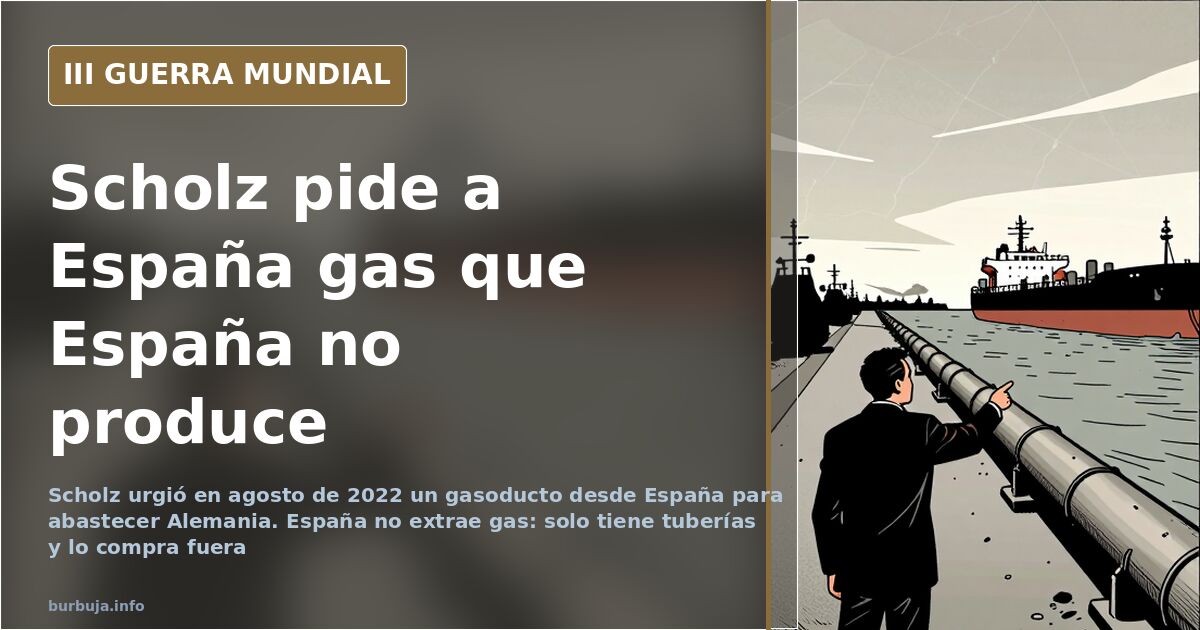
Scholz wants Spanish gas for Germany that Spain doesn't have
On August 11, 2022, Olaf Scholz urged for a pipeline to transport gas from Spain to Germany "massively." The awkward detail: Spain does not extract gas. It has regasification plants, pipelines, and underground storage, but the gas it moves is bought from abroad. In the debate, some argue that at the height of the crisis, around 15% of Spanish consumption was still coming from Russia, and Algerian supply was already in question.
The paradox stands on its own. The country that sanctions its supplier asks the country that barely produces to save its winter. The request came wrapped in European common strategy and suddenly peine a project shelved for two decades.
What gas will Spain send to Germany
Spain is an infrastructure hub, not a producer. Its regasification plants receive liquefied gas by ship, reheat it, and inject it into the grid. The pipeline to the north exists up to the Pyrenees, and there it ends. To bring gas to Germany, a new interconnection is needed, and that takes years.
The technical argument weighs more than the political one. Cooling the gas, shipping it, and reheating it costs more than pushing it through a pipe. Logically, and physically. If the toll is set high, some argue that Germany will end up building its own plants, and the pipeline will be left for tourist strolls.
Why France is blocking the Pyrenees pipeline
Comments in the thread suggest that the bottleneck is not in Spain or Germany, but in France. Interconnections through the Pyrenees have been on the table for years with a French refusal as the response, just like with almost any Spanish product intended to cross its territory.
There is a recurring explanation: French nuclear energy gave Paris independence, and it was not interested in a corridor that would strengthen its southern neighbors. Germany, meanwhile, according to another participant, continued to burn coal without wanting to hear about atoms.
Who pays for the pipe: toll, debt, and solidarity
The cost is the part no one brings to the table. The project speaks of billions and years of construction. A current of analysis advocates for charging a transit toll: if gas passes through Spanish territory, it must be paid for, and not a small amount. Another proposes something more ambitious: building the pipe in exchange for debt forgiveness.
There is a separate discussion about debt. It is argued that Spain carries a huge burden placed in its name by external decisions, and that giving away storage capacity or lowering the toll would be making the fool again. Spain's underground storage facilities are also pointed out as the resource Germany would want to have on hand for its own winter.
Nord Stream 2 and the hypocrisy of the narrative
If the problem was depending on a single supplier, several participants recall that Nord Stream 2 was ready for delivery and only needed certification. The war in Ukraine left it blocked, they argue, while Russian gas continued to enter through other routes. That double standard is what sparks cynicism: the supplier that provides is sanctioned, gas is bought through the back door, and the South is asked to cede what it doesn't have.
The wear and tear is not minor. Some argue that the Franco-German axis, the engine of the Union for decades, appears strained just when it is most needed.
Two decades later, the pipe still does not exist. How much of Germany's crisis is the Kremlin's fault, and how much is due to closing both nuclear power and the Russian tap at the same time?
On August 11, 2022, Olaf Scholz urged for a pipeline to transport gas from Spain to Germany "massively." The awkward detail: Spain does not extract gas. It has regasification plants, pipelines, and underground storage, but the gas it moves is bought from abroad. In the debate, some argue that at the height of the crisis, around 15% of Spanish consumption was still coming from Russia, and Algerian supply was already in question.
The paradox stands on its own. The country that sanctions its supplier asks the country that barely produces to save its winter. The request came wrapped in European common strategy and suddenly peine a project shelved for two decades.
What gas will Spain send to Germany
Spain is an infrastructure hub, not a producer. Its regasification plants receive liquefied gas by ship, reheat it, and inject it into the grid. The pipeline to the north exists up to the Pyrenees, and there it ends. To bring gas to Germany, a new interconnection is needed, and that takes years.
The technical argument weighs more than the political one. Cooling the gas, shipping it, and reheating it costs more than pushing it through a pipe. Logically, and physically. If the toll is set high, some argue that Germany will end up building its own plants, and the pipeline will be left for tourist strolls.
Why France is blocking the Pyrenees pipeline
Comments in the thread suggest that the bottleneck is not in Spain or Germany, but in France. Interconnections through the Pyrenees have been on the table for years with a French refusal as the response, just like with almost any Spanish product intended to cross its territory.
There is a recurring explanation: French nuclear energy gave Paris independence, and it was not interested in a corridor that would strengthen its southern neighbors. Germany, meanwhile, according to another participant, continued to burn coal without wanting to hear about atoms.
Who pays for the pipe: toll, debt, and solidarity
The cost is the part no one brings to the table. The project speaks of billions and years of construction. A current of analysis advocates for charging a transit toll: if gas passes through Spanish territory, it must be paid for, and not a small amount. Another proposes something more ambitious: building the pipe in exchange for debt forgiveness.
There is a separate discussion about debt. It is argued that Spain carries a huge burden placed in its name by external decisions, and that giving away storage capacity or lowering the toll would be making the fool again. Spain's underground storage facilities are also pointed out as the resource Germany would want to have on hand for its own winter.
Nord Stream 2 and the hypocrisy of the narrative
If the problem was depending on a single supplier, several participants recall that Nord Stream 2 was ready for delivery and only needed certification. The war in Ukraine left it blocked, they argue, while Russian gas continued to enter through other routes. That double standard is what sparks cynicism: the supplier that provides is sanctioned, gas is bought through the back door, and the South is asked to cede what it doesn't have.
The wear and tear is not minor. Some argue that the Franco-German axis, the engine of the Union for decades, appears strained just when it is most needed.
Two decades later, the pipe still does not exist. How much of Germany's crisis is the Kremlin's fault, and how much is due to closing both nuclear power and the Russian tap at the same time?
Summary of a discussion on Burbuja.info - Foro de economía, actualidad y política., translated from Spanish and reviewed before publication. Read the full discussion (212 replies).
More summaries
-
Bomb drones in Leipzig: Russian attack or Ukrainian provocation?
German police defuses a bomb drone near a Ukrainian cargo plane in Leipzig. A second drone impacts an aircraft. Russia or false flag?
-
Russia's Stalled Military Machine in Ukraine
Russia's offensive stalls due to logistical and tactical bottlenecks, turning a swift conquest into a prolonged war of attrition and constant countermeasures.
-
Ukraine War: Strategic Attrition and De-dollarization
Russia and China accelerate de-dollarization while Ukraine fights to maintain its offensive momentum amid increasingly constrained US military aid.
-
Ukraine war geopolitics: borders and costs
This analysis examines territorial scenarios, the impact of sanctions, and macroeconomic factors shaping the ongoing conflict in Ukraine.
-
Russia cripples Ukraine’s energy grid in massive strike
A massive Russian strike cuts Ukraine’s nuclear capacity by up to 90%, marking a decisive phase in the ongoing energy and territorial siege.
-
Ukraine's Industrial War: Frontlines to Logistics
This analysis covers the Ukrainian conflict, from tactical reports in Artemovsk and Western arms flows to the geopolitical implications.