
Gen Z: 1,000 Euros Monthly Salary and the Anxiety of Doing Nothing
Earning just over 1,000 euros, spending on wellness and therapy, and battling daily anxiety since age 15: Gen Z seeks answers for their distress.
English · Original discussion in Spanish · Published
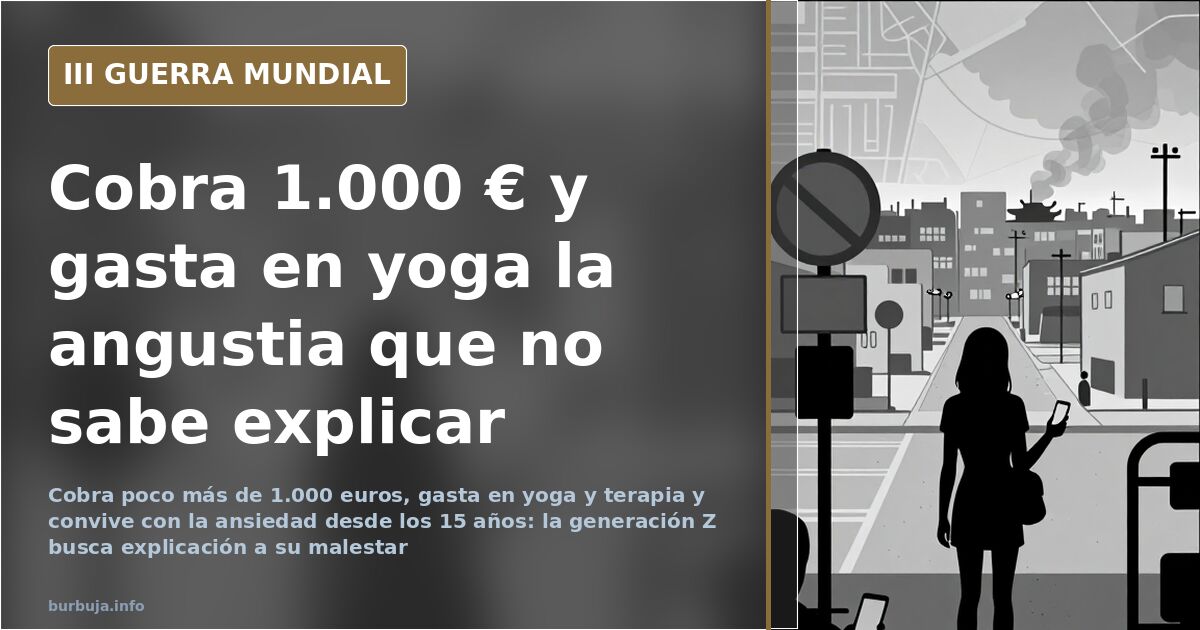
Gen Z anxiety: 1,000 euros a month and no lasting plans
Andrea Farnós, 26, moved out of Madrid’s Aluche neighborhood in September with two friends, earning «a bit over 1,000 euros» monthly as a journalist. She spends her income on «boxing, yoga, private therapy, travel, alcohol, and tobacco» to avoid facing her uncertain future. She experienced her first anxiety attack at 15 and lives with it daily, noting: «the worst part is that nothing is wrong with me».
This article reinvigorated discussions about Gen Z, born between 1995 and 2010. Labeled soft and fragile, they suffer higher anxiety, depression, and burnout than previous generations. The unsettling question remains: what is wrong with a generation that, theoretically, has nothing wrong with them?
Why Gen Z Discusses Distress Rather Than Lack of Money
Money is part of the diagnosis but does not explain it all. Comparing real budgets shows that 1,000 euros barely covers rent, utilities, taxes, insurance, and fuel, leaving over 500 euros monthly for food. With this budget, there is no room for boxing, yoga, or private therapy. Critics argue these young people are poor but unaware, focusing on invented problems. However, if it were only about salaries, distress would not start at age 15.
This creates a major disagreement. One analysis focuses on the shopping basket and rent; another on mental health. Both describe the same shared room in Aluche.
1,000 Euros Monthly: Boxing, Yoga, and Therapy vs. Cost of Living
The protagonist’s expense list serves as a trigger. In contrast, others spend their entire salary on survival: water, electricity, insurance, diesel, taxes, and food, with no margin for activities. This contrast fuels accusations of spending on whims rather than necessities. The itemized breakdown—rent, utilities, transport, and leisure—reveals surprising differences, explaining how the same salary produces two incompatible life stories.
It is obvious that 1,000 euros a month is a survival budget in any Spanish city, not one for excesses. Debates on whether money is wasted on vices may last forever, but whether it covers more than just making ends meet does not.
Children, Family, and the Life Project No One Added to the List
The most common answer in these discussions is one word: children. Critics argue Gen Z grew up without a life project providing continuity, lacking their own family or a partner to build a future. For this view, the described void is demographic, not existential: the plan that structured their grandparents' lives is missing.
The counterargument is quick: raising a child is neither free nor a guarantee of stability. Much of this generation cannot afford housing, let alone a family. When asked why parents understood life’s meaning but they do not, the answer is not ideological but financial: parents had land, salary, and a horizon; they have temporary contracts and a shared room.
Marry and you will see still functions as an argument but has lost the material backing it once had.
Dopamine, Screens, and Patience No Longer Trained
The second major diagnostic points to the digital environment. Constantly checking likes and external approval, needing to try everything immediately, and lacking patience for daily tasks create a profile unable to tolerate even minor frustration. Comparisons with previous generations are inevitable: previously, one had to rewind and wait; now, a single button suffices.
The interesting nuance is that stimulus volume grows exponentially, not linearly. Today’s distraction options are practically infinite, and no human has the capacity to process them all. This turns lack of endurance into an environmental design problem, not a character flaw. The practical consequence is the same: diffuse distress that feeds back with every screen swipe.
Pensions and Generational Replenishment: 1.74 Euros per Euro Contributed
A third axis gives these complaints an arithmetic basis. Data from the Bank of Spain shows pensioners receive 74% more than they contributed, i.e., 1.74 euros per euro paid in, with the average pensioner receiving about 4,500 euros annually without having contributed the corresponding amount. This adds to an accumulated system deficit of 100 billion euros since the crisis.
The conclusion drawn from these figures is simple: the current generation works with the prospect of supporting an aging population without their salaries rising. The example cited is Japan and South Korea since 1990, where high employment has not prevented wage stagnation for an entire cohort. If this pattern repeats here, distress ceases to be an attitude issue.
The conversation stalls exactly here. Some point to spending on yoga and tobacco; others, rent prices; others, the absence of children; others, excessive stimulation. None of these four diagnoses explains why the first anxiety attack occurs at age 15, before having a salary, children, or a mortgage.
Andrea Farnós, 26, moved out of Madrid’s Aluche neighborhood in September with two friends, earning «a bit over 1,000 euros» monthly as a journalist. She spends her income on «boxing, yoga, private therapy, travel, alcohol, and tobacco» to avoid facing her uncertain future. She experienced her first anxiety attack at 15 and lives with it daily, noting: «the worst part is that nothing is wrong with me».
This article reinvigorated discussions about Gen Z, born between 1995 and 2010. Labeled soft and fragile, they suffer higher anxiety, depression, and burnout than previous generations. The unsettling question remains: what is wrong with a generation that, theoretically, has nothing wrong with them?
Why Gen Z Discusses Distress Rather Than Lack of Money
Money is part of the diagnosis but does not explain it all. Comparing real budgets shows that 1,000 euros barely covers rent, utilities, taxes, insurance, and fuel, leaving over 500 euros monthly for food. With this budget, there is no room for boxing, yoga, or private therapy. Critics argue these young people are poor but unaware, focusing on invented problems. However, if it were only about salaries, distress would not start at age 15.
This creates a major disagreement. One analysis focuses on the shopping basket and rent; another on mental health. Both describe the same shared room in Aluche.
1,000 Euros Monthly: Boxing, Yoga, and Therapy vs. Cost of Living
The protagonist’s expense list serves as a trigger. In contrast, others spend their entire salary on survival: water, electricity, insurance, diesel, taxes, and food, with no margin for activities. This contrast fuels accusations of spending on whims rather than necessities. The itemized breakdown—rent, utilities, transport, and leisure—reveals surprising differences, explaining how the same salary produces two incompatible life stories.
It is obvious that 1,000 euros a month is a survival budget in any Spanish city, not one for excesses. Debates on whether money is wasted on vices may last forever, but whether it covers more than just making ends meet does not.
Children, Family, and the Life Project No One Added to the List
The most common answer in these discussions is one word: children. Critics argue Gen Z grew up without a life project providing continuity, lacking their own family or a partner to build a future. For this view, the described void is demographic, not existential: the plan that structured their grandparents' lives is missing.
The counterargument is quick: raising a child is neither free nor a guarantee of stability. Much of this generation cannot afford housing, let alone a family. When asked why parents understood life’s meaning but they do not, the answer is not ideological but financial: parents had land, salary, and a horizon; they have temporary contracts and a shared room.
Marry and you will see still functions as an argument but has lost the material backing it once had.
Dopamine, Screens, and Patience No Longer Trained
The second major diagnostic points to the digital environment. Constantly checking likes and external approval, needing to try everything immediately, and lacking patience for daily tasks create a profile unable to tolerate even minor frustration. Comparisons with previous generations are inevitable: previously, one had to rewind and wait; now, a single button suffices.
The interesting nuance is that stimulus volume grows exponentially, not linearly. Today’s distraction options are practically infinite, and no human has the capacity to process them all. This turns lack of endurance into an environmental design problem, not a character flaw. The practical consequence is the same: diffuse distress that feeds back with every screen swipe.
Pensions and Generational Replenishment: 1.74 Euros per Euro Contributed
A third axis gives these complaints an arithmetic basis. Data from the Bank of Spain shows pensioners receive 74% more than they contributed, i.e., 1.74 euros per euro paid in, with the average pensioner receiving about 4,500 euros annually without having contributed the corresponding amount. This adds to an accumulated system deficit of 100 billion euros since the crisis.
The conclusion drawn from these figures is simple: the current generation works with the prospect of supporting an aging population without their salaries rising. The example cited is Japan and South Korea since 1990, where high employment has not prevented wage stagnation for an entire cohort. If this pattern repeats here, distress ceases to be an attitude issue.
The conversation stalls exactly here. Some point to spending on yoga and tobacco; others, rent prices; others, the absence of children; others, excessive stimulation. None of these four diagnoses explains why the first anxiety attack occurs at age 15, before having a salary, children, or a mortgage.
Summary of a discussion on Burbuja.info - Foro de economía, actualidad y política., translated from Spanish and reviewed before publication. Read the full discussion (223 replies).
More summaries
-
TikTok and the West’s Degeneration: The Double Standard
A news report blames China for using TikTok to degrade the West, but its addictive design and double standard with Google and Facebook weaken the claim.
-
Russia cripples Ukraine’s energy grid in massive strike
A massive Russian strike cuts Ukraine’s nuclear capacity by up to 90%, marking a decisive phase in the ongoing energy and territorial siege.
-
Expiring Iodine: The Nuclear Threat That Never Came
Stocked iodine expires before the promised Russian Kinzhal attack. An analysis of 4,500 hypersonic missiles and the reality of the nuclear threat.
-
Europe Faces Russian Gas Winter With No Backup Plan
Europe prepares for a winter without Russian gas: Italy, relying 40% on Moscow, faces shortages as Nord Stream 1 halts for 11 days.
-
Russia demands ruble gas payments as Germany and Bulgaria open to compliance
Putin mandates ruble payments for European gas, with Bulgaria and Germany considering compliance while India and China accelerate trade without the dollar.
-
One Month of War: Kiev Stands, Russia’s Plan Stretches
A week-long conquest fades after a month: Ukrainian flags, an extended Russian strategy, and open negotiations emerge.