
Europe Faces Russian Gas Winter With No Backup Plan
Europe prepares for a winter without Russian gas: Italy, relying 40% on Moscow, faces shortages as Nord Stream 1 halts for 11 days.
English · Original discussion in Spanish · Published
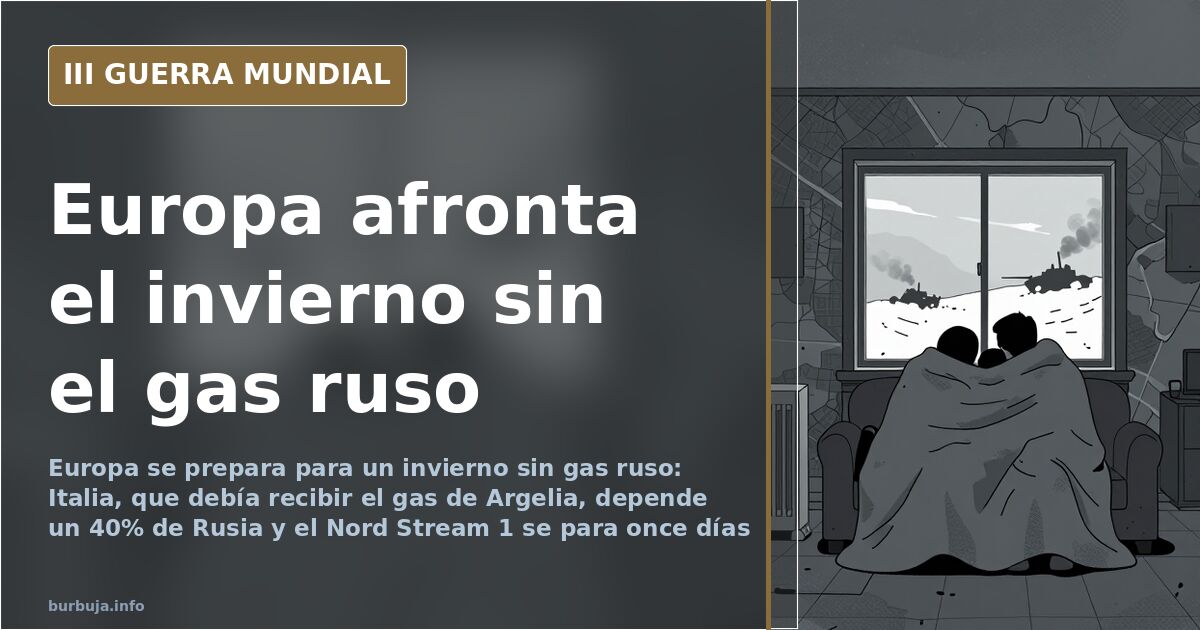
Europe Faces Russian Gas Winter With No Backup Plan
Europe has been insisting it will survive the winter without Russian gas. The debate trinc these lines reveals what several governments calculate privately: preparation is essential. The warning arrives from a country that was supposed to act as a savior—Italy, the recipient of Algerian gas—depending, according to one participant, on 40% Russian gas and in panic. Meanwhile, Russia and Ukraine argue over a pipeline that no longer pumps what it used to.
Why is the margin for maneuver narrowing?
Because the margin for maneuver has been narrowing piece by piece, without a definitive blow. Ukraine stopped maintaining the flows through the pipeline that crosses it, and transit has been declining since May; the Sokhranivka station went out of service amid fighting, and the Ukrainian operator admits it does not know what is happening there. Russia, meanwhile, does not reserve new slots for auctions on that route.
Less gas enters, and there are fewer alternative routes than Brussels claims. Russia repeats that other pipelines are available. True. It is also true that the remaining ones do not compensate for those closed, and that each dropped supply point falls at the worst time of the calendar.
Gas weighs more on electricity than rhetoric suggests
Here it is important to look at the data often evaded. Electricity generation from gas is not a system residual: it hovers around 20%, was 17% in 2021, and at times covers half the demand. With peaks of 50%, no energy policy holds without this fuel.
Hence, gas is not just home heating. Rail transport runs on electricity; enriched uranium, coal, and oil also arrive largely from Russia. Each link depends on the previous one. When the first fails, it is not just a bill that fails: the entire chain fails.
Nord Stream 1 and the turbine blocked by sanctions
Germany watches the Baltic with apprehension. Nord Stream 1 will be inoperative for 11 days, from July 11 to 21, for routine repairs according to the operator, and Berlin antiestéticars the review may result in a permanent blockade. The official technical explanation and political suspicion coexist unresolved.
Some argue that Russia has continued pumping as much as requested and that the flow drop responds to a missing turbine that cannot be sent to Russia due to European sanctions themselves. Opposing this is the argument that Moscow uses gas as leverage and that the repair schedule is not coincidental. Neither reading is closed, and anyone claiming otherwise sells a certainty no one has.
Italy, the savior depending 40% on Russia
The emergency plan had a name: Italy would be the entry point for Algerian gas, and the rest would breathe easier. The problem is that, as stated in the debate, the receiver itself depends on 40% Russian gas and faces the winter with the same panic as its neighbors. An intermediary on the brink of a precipice rescues no one.
Meanwhile, US liquefied gas ships cross the Atlantic. This is the real short-term alternative and also the most expensive: gas arriving by sea is paid at prices that have nothing to do with what Europe considered normal. As one participant summarizes, at the bottom of the conflict there is little epic and much economic control.
Back to coal: thermal plants that no longer exist
If gas fails, the grid has a theoretical Plan B: burn coal. There is coal for many years and of good quality, those trinc the sector agree. The uncomfortable detail is that thermal power plants no longer exist: they were demolished, mines closed, or converted into lakes.
The irony is summarized by anyone who has looked at the map: coal also comes from Russia. And the uranium needed for nuclear power does too. The promised backward step does not exist as a button to press; it exists as a multi-year project no one started.
The coming winter
At street level, the price hikes already have a bill. One participant says filling the tank cost about 100 euros in a single visit, and another pays 300 euros for two months of winter when it used to be 200. Heating, groceries, and transport rise simultaneously, before the cold arrives.
The rope, as one participant summarizes, was tied by Europe itself: no one forced concentrating industrial production in Asia or closing plants before having a substitute. Sanctions and prices have become the same thing. What happens if gas does not arrive in January and there is no turbine left to claim?
Europe has been insisting it will survive the winter without Russian gas. The debate trinc these lines reveals what several governments calculate privately: preparation is essential. The warning arrives from a country that was supposed to act as a savior—Italy, the recipient of Algerian gas—depending, according to one participant, on 40% Russian gas and in panic. Meanwhile, Russia and Ukraine argue over a pipeline that no longer pumps what it used to.
Why is the margin for maneuver narrowing?
Because the margin for maneuver has been narrowing piece by piece, without a definitive blow. Ukraine stopped maintaining the flows through the pipeline that crosses it, and transit has been declining since May; the Sokhranivka station went out of service amid fighting, and the Ukrainian operator admits it does not know what is happening there. Russia, meanwhile, does not reserve new slots for auctions on that route.
Less gas enters, and there are fewer alternative routes than Brussels claims. Russia repeats that other pipelines are available. True. It is also true that the remaining ones do not compensate for those closed, and that each dropped supply point falls at the worst time of the calendar.
Gas weighs more on electricity than rhetoric suggests
Here it is important to look at the data often evaded. Electricity generation from gas is not a system residual: it hovers around 20%, was 17% in 2021, and at times covers half the demand. With peaks of 50%, no energy policy holds without this fuel.
Hence, gas is not just home heating. Rail transport runs on electricity; enriched uranium, coal, and oil also arrive largely from Russia. Each link depends on the previous one. When the first fails, it is not just a bill that fails: the entire chain fails.
Nord Stream 1 and the turbine blocked by sanctions
Germany watches the Baltic with apprehension. Nord Stream 1 will be inoperative for 11 days, from July 11 to 21, for routine repairs according to the operator, and Berlin antiestéticars the review may result in a permanent blockade. The official technical explanation and political suspicion coexist unresolved.
Some argue that Russia has continued pumping as much as requested and that the flow drop responds to a missing turbine that cannot be sent to Russia due to European sanctions themselves. Opposing this is the argument that Moscow uses gas as leverage and that the repair schedule is not coincidental. Neither reading is closed, and anyone claiming otherwise sells a certainty no one has.
Italy, the savior depending 40% on Russia
The emergency plan had a name: Italy would be the entry point for Algerian gas, and the rest would breathe easier. The problem is that, as stated in the debate, the receiver itself depends on 40% Russian gas and faces the winter with the same panic as its neighbors. An intermediary on the brink of a precipice rescues no one.
Meanwhile, US liquefied gas ships cross the Atlantic. This is the real short-term alternative and also the most expensive: gas arriving by sea is paid at prices that have nothing to do with what Europe considered normal. As one participant summarizes, at the bottom of the conflict there is little epic and much economic control.
Back to coal: thermal plants that no longer exist
If gas fails, the grid has a theoretical Plan B: burn coal. There is coal for many years and of good quality, those trinc the sector agree. The uncomfortable detail is that thermal power plants no longer exist: they were demolished, mines closed, or converted into lakes.
The irony is summarized by anyone who has looked at the map: coal also comes from Russia. And the uranium needed for nuclear power does too. The promised backward step does not exist as a button to press; it exists as a multi-year project no one started.
The coming winter
At street level, the price hikes already have a bill. One participant says filling the tank cost about 100 euros in a single visit, and another pays 300 euros for two months of winter when it used to be 200. Heating, groceries, and transport rise simultaneously, before the cold arrives.
The rope, as one participant summarizes, was tied by Europe itself: no one forced concentrating industrial production in Asia or closing plants before having a substitute. Sanctions and prices have become the same thing. What happens if gas does not arrive in January and there is no turbine left to claim?
Summary of a discussion on Burbuja.info - Foro de economía, actualidad y política., translated from Spanish and reviewed before publication. Read the full discussion (218 replies).
More summaries
-
NATO Summit, at Germany's request, to send urgent munitions to Ukraine: Patriot interceptors, drones, long-range artillery, etc.
Germany leads urgent munition shipment to Ukraine: Patriot missiles, drones, and artillery. NATO reinforces Ukrainian defense.
-
Unverified Tweet Attributes False Flag Attacks in Mallorca to CIA
An unverified tweet claims the CIA is behind a false flag drone attack in Mallorca, Nice, and Italy, but provides no evidence.
-
Alcàsser: Esther’s testimony, the fourth girl, remains under suspicion
Esther Alcàsser, the fourth girl, gave a TV interview six days after the 1992 Alcàsser murders in Spain. Her account and timeline discrepancies fuel ongoing controversy.
-
NASA's 2012 solar storm prediction never materialized
A NASA-ESA report forecasted the strongest solar storm in 50 years for 2012, but the event never occurred.
-
Russian Army Crisis in Ukraine: Mass Withdrawals Reported
Analysis of reported Russian military withdrawals in Ukraine and the collapse of their supply lines.
-
Pedro Baos Fired for Challenging Official Media Narrative
Analysis of Pedro Baños dismissal for not adhering to official media narratives, highlighting censorship concerns and geopolitical complexity.