
TikTok and the West’s Degeneration: The Double Standard
A news report blames China for using TikTok to degrade the West, but its addictive design and double standard with Google and Facebook weaken the claim.
English · Original discussion in Spanish · Published
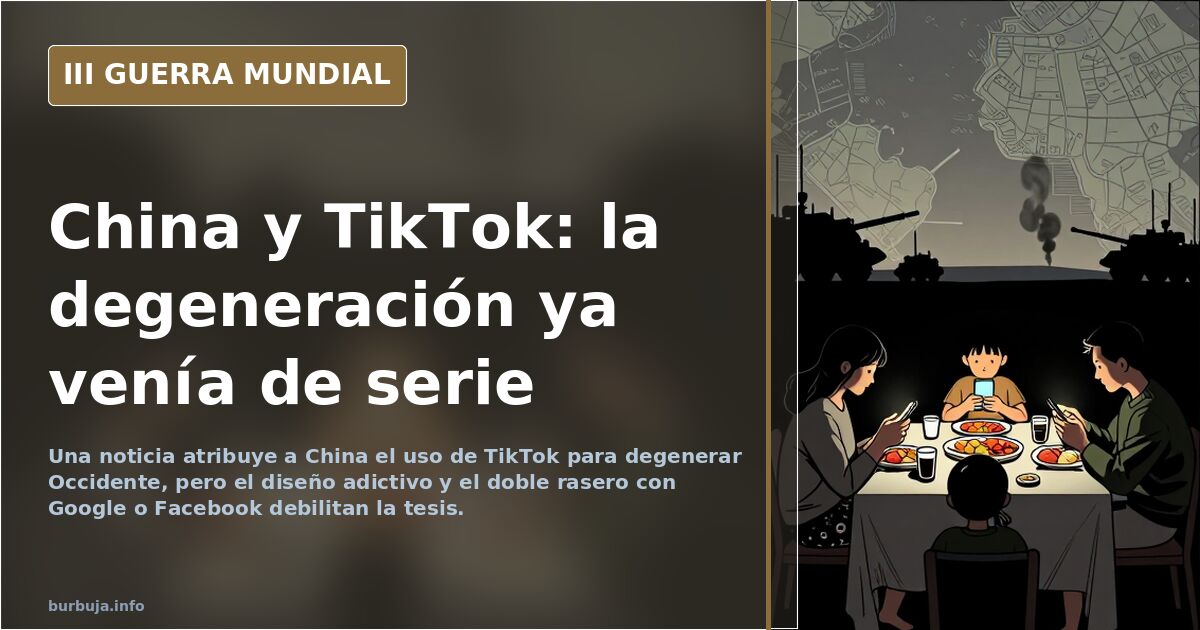
China and TikTok: The West’s Degeneration Comes as Standard
A news item published by okdiario blames China for using TikTok as a tool to degenerate the West. The thesis has obvious appeal: it turns a short-video app into the Chinese Communist Party’s ultimate weapon. The problem is that the diagnosis, powerful as it is, has a hole through which half the accusation escapes. The degeneration didn’t arrive with the app. It came as standard.
How the 30-second video machine works
The product design itself is beyond doubt. One analysis describes it as an engineered drug: short pleasurable videos, constant stimulation, zero room for reflection. The artificial intelligence learns from every clip watched and also from those abandoned halfway, and sharpens the next hook. The result, according to that reading, is a user dulled by microshots of adrenaline. Not a single deep video.
The shift from the previous era, according to that analysis, comes down to one leap: from 160-character reflections to banal 30-second videos. On that reading, the app doesn’t seek to hold attention but to chop it up. A full video feeds the algorithm; one cut off halfway does too, and teaches it where not to return. The machine optimizes itself. Beijing doesn’t sign off on that: any product department with access to retention data does.
The double standard with Google, Facebook and YouTube
Here the story’s first hole appears. TikTok doesn’t come preinstalled by default on any Android phone, while Google and Facebook services do come preinstalled on countless devices. YouTube has its Shorts and Facebook its Reels: the addictive format isn’t Chinese property, it’s the industry standard. If the problem is surveillance, some voices argue, the focus on the Chinese app is selective.
The list of possible suspects grows without anyone lifting a finger: the Chinese phone bought online, the computer from the same origin and even the sports watch. No one proposes banning them. And then there’s the administrative detail: if a public employee installs what they shouldn’t on a government phone, the question is whether the fault lies with the app, the worker or the agency that hands out devices without controls. All three candidates fit in the same sentence.
TikTok’s two versions and their two audiences
The comparison between versions gives ammunition to the thesis. In China, according to this reading, the app applies time limits and filters the catalog toward educational content. In the West, another menu arrives: banal, sensual and strident content, all compressed into a few seconds. That yields the most repeated conclusion: the factory of docile users is calibrated to the market.
In China it’s consumed on a leash; in the West, in bulk. It’s a way of putting it, not proof. The gap between versions isn’t confirmed by the platform, and it’s worth remembering that before turning suspicion into a firm accusation. What is documentable is the difference in catalog between markets: what succeeds in one country rarely works the same in another, and algorithms adjust to what each audience rewards. There’s no conspiracy there: there’s business.
The West Already Had Fertile Ground
The argument that holds up best is the one that assigns the least blame. TikTok would be worthless without a prior substrate. And that substrate has been decades in the making: an individualistic, hedonistic society eager to show off to strangers in exchange for admiration or envy. The trips, the purchases, the “look how hot I am.” Instagram was already on its way to becoming a showcase catalog before the Chinese app arrived.
The US entertainment industry does the rest, along with any entrepreneur with servers and an algorithm. If TikTok fell tomorrow, another platform would inherit its place within weeks. That’s the point that disarms the crudest accusation: you can’t degenerate someone who has been degenerating themselves for years. The Chinese app didn’t invent the market, it exploited it.
Trump, Biden and the Geopolitical Maze
Foreign policy adds noise. Trump banned TikTok during his term and Biden revived the attempt later. Part of the analysis reads the offensive as a coordinated Western campaign, and places China within the same globalist ecosystem Trump railed against. The response is blunt: no communist government can be globalist, and the term is misused on purpose.
What nobody disputes is that Trump’s economic war and the cross-accusations over the bicho muddied the ground. The date some point to as the origin of everything, 1789, doesn’t help settle anything either: it serves to locate the start of a narrative, not to explain an app. And amid that trench warfare, the simple question —who benefits from TikTok remaining in the news?— goes unanswered.
With this material, what’s foreseeable is that TikTok will remain in the crosshairs and the next platform will inherit the stigma. The next degeneration, if it comes, probably won’t travel on a Chinese passport: it will be programmed in California and distributed for free. The substrate, meanwhile, is already ready.
A news item published by okdiario blames China for using TikTok as a tool to degenerate the West. The thesis has obvious appeal: it turns a short-video app into the Chinese Communist Party’s ultimate weapon. The problem is that the diagnosis, powerful as it is, has a hole through which half the accusation escapes. The degeneration didn’t arrive with the app. It came as standard.
How the 30-second video machine works
The product design itself is beyond doubt. One analysis describes it as an engineered drug: short pleasurable videos, constant stimulation, zero room for reflection. The artificial intelligence learns from every clip watched and also from those abandoned halfway, and sharpens the next hook. The result, according to that reading, is a user dulled by microshots of adrenaline. Not a single deep video.
The shift from the previous era, according to that analysis, comes down to one leap: from 160-character reflections to banal 30-second videos. On that reading, the app doesn’t seek to hold attention but to chop it up. A full video feeds the algorithm; one cut off halfway does too, and teaches it where not to return. The machine optimizes itself. Beijing doesn’t sign off on that: any product department with access to retention data does.
The double standard with Google, Facebook and YouTube
Here the story’s first hole appears. TikTok doesn’t come preinstalled by default on any Android phone, while Google and Facebook services do come preinstalled on countless devices. YouTube has its Shorts and Facebook its Reels: the addictive format isn’t Chinese property, it’s the industry standard. If the problem is surveillance, some voices argue, the focus on the Chinese app is selective.
The list of possible suspects grows without anyone lifting a finger: the Chinese phone bought online, the computer from the same origin and even the sports watch. No one proposes banning them. And then there’s the administrative detail: if a public employee installs what they shouldn’t on a government phone, the question is whether the fault lies with the app, the worker or the agency that hands out devices without controls. All three candidates fit in the same sentence.
TikTok’s two versions and their two audiences
The comparison between versions gives ammunition to the thesis. In China, according to this reading, the app applies time limits and filters the catalog toward educational content. In the West, another menu arrives: banal, sensual and strident content, all compressed into a few seconds. That yields the most repeated conclusion: the factory of docile users is calibrated to the market.
In China it’s consumed on a leash; in the West, in bulk. It’s a way of putting it, not proof. The gap between versions isn’t confirmed by the platform, and it’s worth remembering that before turning suspicion into a firm accusation. What is documentable is the difference in catalog between markets: what succeeds in one country rarely works the same in another, and algorithms adjust to what each audience rewards. There’s no conspiracy there: there’s business.
The West Already Had Fertile Ground
The argument that holds up best is the one that assigns the least blame. TikTok would be worthless without a prior substrate. And that substrate has been decades in the making: an individualistic, hedonistic society eager to show off to strangers in exchange for admiration or envy. The trips, the purchases, the “look how hot I am.” Instagram was already on its way to becoming a showcase catalog before the Chinese app arrived.
The US entertainment industry does the rest, along with any entrepreneur with servers and an algorithm. If TikTok fell tomorrow, another platform would inherit its place within weeks. That’s the point that disarms the crudest accusation: you can’t degenerate someone who has been degenerating themselves for years. The Chinese app didn’t invent the market, it exploited it.
Trump, Biden and the Geopolitical Maze
Foreign policy adds noise. Trump banned TikTok during his term and Biden revived the attempt later. Part of the analysis reads the offensive as a coordinated Western campaign, and places China within the same globalist ecosystem Trump railed against. The response is blunt: no communist government can be globalist, and the term is misused on purpose.
What nobody disputes is that Trump’s economic war and the cross-accusations over the bicho muddied the ground. The date some point to as the origin of everything, 1789, doesn’t help settle anything either: it serves to locate the start of a narrative, not to explain an app. And amid that trench warfare, the simple question —who benefits from TikTok remaining in the news?— goes unanswered.
With this material, what’s foreseeable is that TikTok will remain in the crosshairs and the next platform will inherit the stigma. The next degeneration, if it comes, probably won’t travel on a Chinese passport: it will be programmed in California and distributed for free. The substrate, meanwhile, is already ready.
Summary of a discussion on Burbuja.info - Foro de economía, actualidad y política., translated from Spanish and reviewed before publication. Read the full discussion (175 replies).
More summaries
-
Hu Jintao Removed from Chinese Congress Amid Purge Rumors
Hu Jintao was escorted out of the closing of the 20th Chinese Communist Party Congress, sparking conflicting accounts of a purge.
-
New Venezuelan 'Tren de Aragua' Leader Declares War on the US: Will Confiscated Oil Be Recovered from 'Master' Donald Trump?
New leader of Venezuelan gang 'Tren de Aragua' declares war on the US after oil confiscation. Will it be recovered?
-
Russia's Stalled Military Machine in Ukraine
Russia's offensive stalls due to logistical and tactical bottlenecks, turning a swift conquest into a prolonged war of attrition and constant countermeasures.
-
Ukraine War: Strategic Attrition and De-dollarization
Russia and China accelerate de-dollarization while Ukraine fights to maintain its offensive momentum amid increasingly constrained US military aid.
-
Ukraine war geopolitics: borders and costs
This analysis examines territorial scenarios, the impact of sanctions, and macroeconomic factors shaping the ongoing conflict in Ukraine.
-
Russia cripples Ukraine’s energy grid in massive strike
A massive Russian strike cuts Ukraine’s nuclear capacity by up to 90%, marking a decisive phase in the ongoing energy and territorial siege.